The Price Tag Doesn't Tell the Whole Story
I understand the pressure. Your co-packer quotes a per-unit cost, your retailer demands a margin structure, and suddenly every penny on the ingredient bill matters. So when a supplier offers tomato paste at 30% less than your current source, or a soybean oil that's half the price of the olive oil in your formula, the math looks obvious.
Except the math is wrong. The real cost of cheap ingredients shows up in reformulation cycles, quality complaints, shorter shelf life, retailer chargebacks, and brand erosion that takes years to repair. I've watched brands save $0.08 per jar on ingredients and lose $50,000 in a single retailer relationship. The "savings" are never what they appear to be.
This isn't an argument for overspending on ingredients. It's an argument for understanding what you're actually buying when you choose between quality tiers — and making that decision with full information instead of just the price column on a quote sheet.
How Ingredient Quality Directly Affects Product Performance
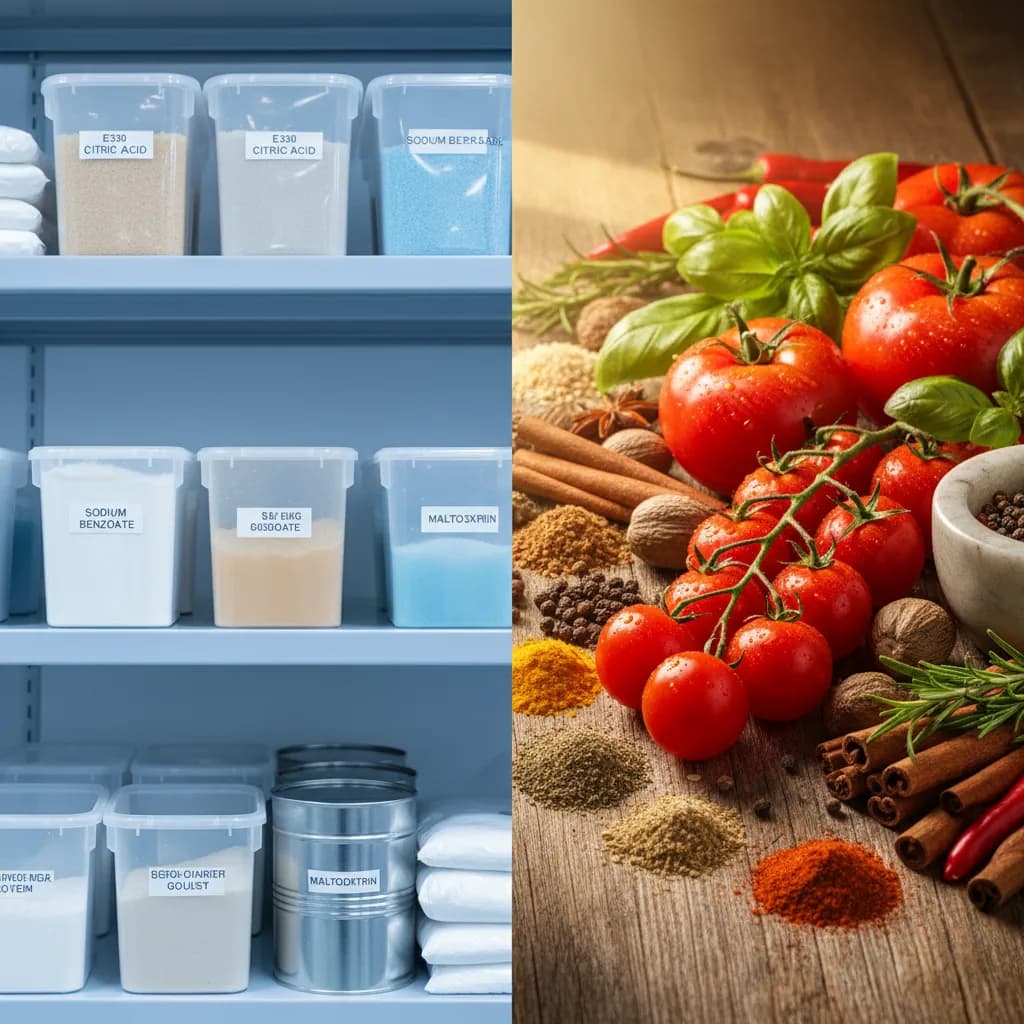
Every ingredient in your formula has a job to do. When you substitute a cheaper version, you're not getting the same ingredient at a lower price — you're getting a different ingredient with different performance characteristics. Here's how that plays out in real sauce and condiment production:
Tomato Products: The Brix Problem
Tomato paste is typically the largest ingredient by weight in pasta sauces, pizza sauces, and tomato-based condiments. The quality difference between premium and economy tomato paste is substantial. Premium paste from San Marzano or similar high-solid varieties runs 28-32 Brix (soluble solids). Economy paste from lower-grade processing tomatoes might hit 24-26 Brix.
That 4-6 Brix difference means you need more paste to achieve the same flavor intensity, body, and color. When you factor in the higher usage rate, the "cheap" paste often costs nearly the same per jar — but with inferior flavor. Worse, the higher water content from using more lower-Brix paste raises water activity, which can compromise shelf life. You saved on the ingredient but lost on the formulation.
Oils: Rancidity and Off-Flavors
Cheap oils — particularly bulk commodity soybean, canola, and blended vegetable oils — often have higher peroxide values (indicating existing oxidation) and lower levels of natural antioxidants than premium options. In a dressing or oil-based sauce, starting with a partially oxidized oil means your shelf-life clock is already running before you even fill the first jar.
I've tested sauces made with premium vs. economy olive oil side by side in accelerated aging studies. The premium oil version maintained acceptable flavor through 18 months. The economy version developed noticeable off-notes by month 10. That's a 40% reduction in effective shelf life from a single ingredient swap.
Spices: Potency Variation
Spice quality varies enormously, and price is a direct indicator. Economy garlic powder can have half the allicin content of premium sourced material. Cheap chili powders often have higher ash content and lower Scoville units. When your spices are weaker, you either use more (increasing cost and potentially changing texture) or accept a less flavorful product. Neither outcome is what you wanted when you "saved money" on spices.
For brands navigating these quality decisions in the context of clean-label positioning, I cover the strategic angle in what clean label really means for CPG brands.
The Supply Chain Risks of Bottom-Dollar Sourcing
Beyond performance in the formula, cheap ingredients carry supply chain risks that rarely appear on the quote sheet:
Adulteration and Food Fraud
The global food supply has a fraud problem, and it disproportionately affects commodities where price pressure is highest. Olive oil diluted with cheaper oils. Honey adulterated with corn syrup. Spices cut with fillers, artificial colors, or even lead-containing adulterants. Oregano blended with olive leaves. These aren't theoretical risks — they're documented, recurring problems.
When you source on price alone, you increase your exposure to adulterated ingredients. If adulterants are detected in your finished product — by a retailer's incoming quality program, an FDA sampling, or a third-party investigation — the consequences cascade. Retailer delisting, product recall, press coverage, and potential legal liability all dwarf whatever you saved on ingredient cost.
Inconsistent Quality Batches
Premium suppliers invest in quality control — incoming testing, lot-to-lot consistency specifications, proper storage, and traceability documentation. Budget suppliers cut costs precisely by reducing these quality assurance steps. The result is batch-to-batch variation that wreaks havoc on your production.
I've seen brands receive vinegar batches that were 0.5% off the stated acidity, requiring emergency reformulation mid-production run. I've seen garlic powder arrive with moisture content high enough to cause clumping in the dry blend. Each of these incidents costs production time, waste, and sometimes an entire batch. The cheapest ingredient on the quote is the most expensive one in the factory.
Documentation Gaps
Retailers and regulatory bodies increasingly demand full supply chain documentation: Certificates of Analysis (COAs), allergen statements, country of origin, non-GMO verification, organic certification, and more. Budget suppliers often can't produce this documentation — or produce documents that don't withstand scrutiny. When a retailer audits your supply chain and finds gaps, you're the one who gets the corrective action notice, not your ingredient supplier.
The Brand Damage Equation
The hardest cost to quantify — and often the largest — is brand damage. In the specialty food space, your brand is built on the promise that your product is better than the mass-market alternative. Cheap ingredients undermine that promise in ways that consumers notice even if they can't articulate why.
Taste Degradation
Consumers might not know that you switched from San Marzano paste to commodity paste. But they'll notice that the sauce "tastes different" or "isn't as good as it used to be." In the specialty food market, repeat purchase is everything. A 10% drop in repeat purchase rate from a flavor-impacting ingredient swap can erase far more revenue than the ingredient savings generated.
Ingredient Panel Perception
Reformulating with cheaper ingredients often changes your ingredient panel. "Extra virgin olive oil" becomes "vegetable oil blend." "Cane sugar" becomes "high fructose corn syrup." Every downgrade on the ingredient panel is visible to the growing number of consumers who flip the jar before buying. In 2026, your ingredient label is your brand promise — and downgrades signal that you've chosen margin over quality.
Review and Social Media Impact
One-star reviews mentioning "changed the recipe" or "not as good as before" are nearly impossible to recover from on Amazon and retailer e-commerce platforms. These reviews persist, accumulate, and directly impact conversion rates. I've watched a brand's Amazon rating drop from 4.6 to 4.1 over six months following an ingredient cost-cutting reformulation. That 0.5-star drop reduced unit sales by approximately 25%.
When Cost Reduction Makes Sense (And How to Do It Right)
I'm not arguing that you should never optimize ingredient costs. But there's a right way to do it:
Reformulate, Don't Just Substitute
If you need to reduce ingredient cost, redesign the formula around the new cost target rather than swapping one ingredient at a time. A holistic reformulation can find savings across the entire formula — slightly less of an expensive ingredient, a process change that improves yield, a different format of the same ingredient (diced tomatoes vs. crushed vs. paste) that achieves the same flavor at lower cost. This approach maintains product quality because you're optimizing the system, not degrading individual components.
For more on when and how to approach reformulation effectively, see recipe reformulation: when and why it's necessary.
Audit by Function, Not by Line Item
Instead of asking "where can I spend less?", ask "what is each ingredient doing, and is there a more cost-effective way to achieve that function?" Maybe your formula uses both butter and cream where one could do the work of both. Maybe your spice blend includes an expensive ingredient at a level below its flavor threshold. Functional auditing finds real savings without compromising quality.
Negotiate Volume, Not Quality
As your production volume grows, your purchasing power increases. Use that leverage to negotiate better pricing on the same quality tier, not to "graduate" to cheaper ingredients. A 10% volume discount on premium tomato paste is a genuine savings. Switching to a different grade of tomato paste is a formulation change with quality implications.
The True Cost Calculator: What to Factor In
When evaluating an ingredient change, here's what should be on your cost comparison — not just the per-pound price:
- Usage rate adjustment — cheaper ingredients often require higher usage
- Reformulation labor — bench trials, taste panels, shelf-life testing
- Shelf-life impact — shorter shelf life means faster turns, more waste, tighter logistics
- Quality complaint rate — returns, replacements, retailer chargebacks
- Retailer relationship risk — audit findings, delisting potential
- Brand perception impact — review ratings, repeat purchase rate, social media sentiment
- Supply reliability — order minimums, lead times, backup source availability
If you're only comparing the per-pound price, you're missing 80% of the actual cost.
Frequently Asked Questions
How much can ingredient quality really affect shelf life?
Significantly. In my testing, a low-quality oil with a high starting peroxide value reduced effective shelf life by 30-40% compared to the same formula made with premium oil. Low-quality spices with higher moisture content can raise water activity enough to shift spoilage dynamics. Tomato paste with lower solids requires higher usage, increasing water content and reducing natural preservation. Each of these effects compounds. A formula built entirely on economy ingredients can have half the shelf life of the same formula built on premium ingredients.
Is it ever acceptable to use economy-grade ingredients?
Yes, for ingredients that are functionally equivalent across quality tiers and don't impact flavor, safety, or shelf life. Water is water. Food-grade salt is food-grade salt (in most applications). Some emulsifiers and processing aids are genuinely commoditized with no meaningful quality variation. The key is understanding which ingredients in your specific formula are quality-sensitive and which are truly interchangeable. In a typical sauce formula, I'd estimate 20-30% of ingredients are safely commoditized and 70-80% are quality-sensitive.
How do I evaluate ingredient supplier quality without overspending?
Request Certificates of Analysis (COAs) for every lot and actually read them. Compare stated specifications to actual test results. Ask for third-party audit reports (SQF, BRC, FSSC 22000). Request a sample and run your own bench test — make a batch with the new ingredient and compare it objectively to your current formula. The best suppliers welcome this kind of scrutiny. Suppliers who resist providing documentation or samples are telling you something important about their quality confidence.
What should I do if my co-packer suggests cheaper ingredient alternatives?
Co-packers are motivated to reduce their costs, and ingredient substitution is one lever they'll pull. Never approve an ingredient change without running a bench trial and evaluating the finished product yourself. Require that any substitution be documented in writing, with the original spec and the proposed alternative side by side. Include a clause in your co-packing agreement that prohibits ingredient substitution without written approval. This isn't adversarial — it's standard practice for protecting your brand. Any co-packer worth working with will respect it.
Can premium ingredients actually save money in the long run?
Absolutely, and I see this play out regularly. Premium tomato paste at higher Brix concentration means you use less per batch, partially offsetting the price premium. Higher-potency spices mean lower usage rates. Better oils mean longer shelf life, which means less waste and more flexibility in distribution. When you account for usage rates, waste reduction, quality complaint rates, and brand value protection, premium ingredients frequently have a lower total cost of ownership than economy alternatives. The upfront per-pound price is just one input in a much larger equation.
Need Help With Your Formulation?
Whether you're scaling your first recipe or reformulating an existing product, let's talk about how to get it right.
Book a Free Discovery Call