Two Categories Everyone Wants In, and the Jar Nobody Remembers
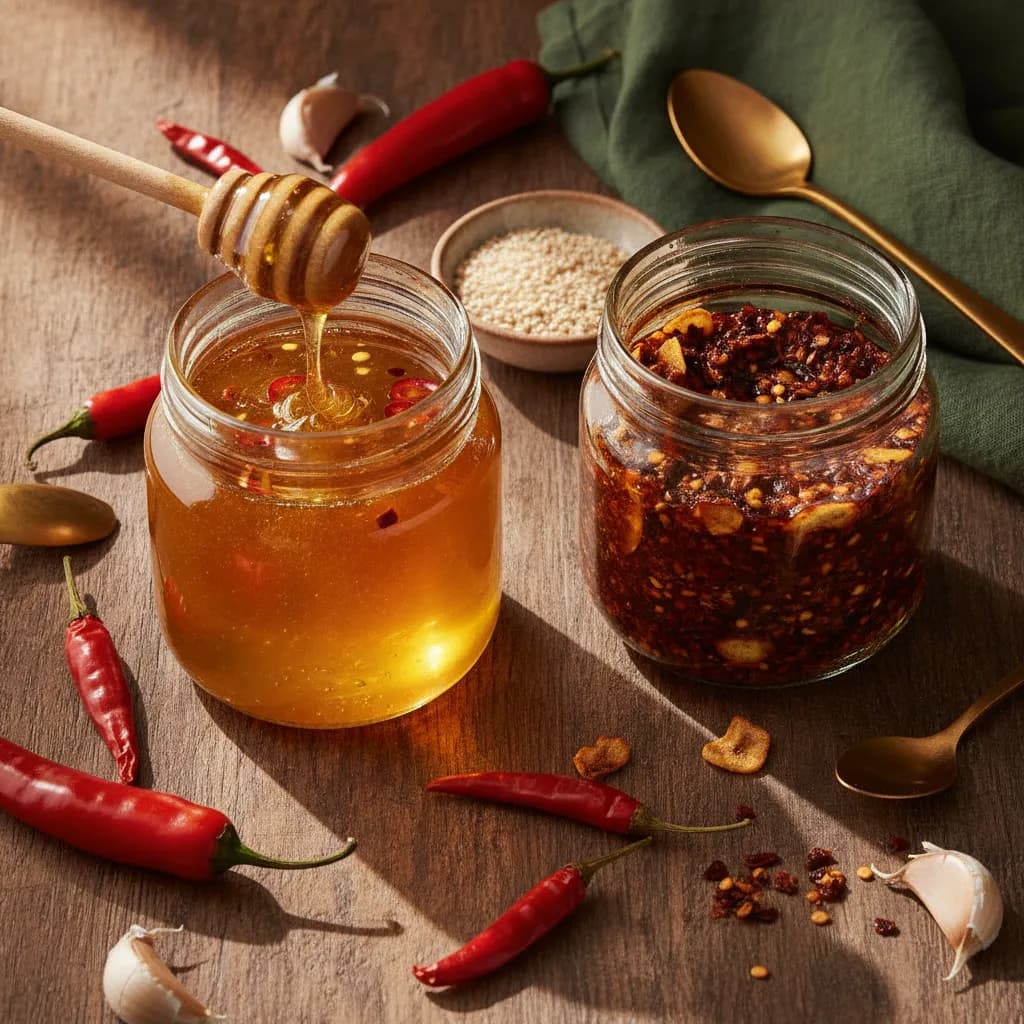
Hot honey and chili crisp are two of the fastest-moving stories in the condiment aisle, and for good reason. They are craveable, they photograph beautifully, and they cross over from serious home cooks to casual buyers who just want to make a pizza or a bowl of noodles more interesting. When a category moves that fast, founders rush in, and that is where the trouble starts.
The rush produces a shelf full of near-identical jars: honey with some pepper flakes shaken in, or a chili oil that looked incredible on day one and tasted like cardboard by month four. Buyers try one, then another, then stop, because the products blur together and half of them disappoint on the second use. Being early to a trend does not protect you. Being genuinely, obviously better does.
This is one of the most common conversations I have with founders chasing a hot category. The winning move is not a cheaper version of what is already there. It is a product built on real, recognizable ingredients that a buyer can taste immediately, executed with enough technical control that the difference survives a year on the shelf.
Real, Recognizable Ingredients Are the Only Durable Moat
Price, packaging, and a louder brand voice are all easy to copy. What is hard to copy is a product that tastes like it was made by someone who cares, from ingredients a customer recognizes and trusts. For hot honey, that means honey that is actually honey, chilies you could name, and aromatics that came from a plant rather than a flavor house. For chili crisp, it means real fried alliums and real dried chilies in a real oil, not a base propped up by artificial capsicum and a synthetic savory note. That is the through-line here. Whenever a shortcut trades a real ingredient for a processed stand-in, I will name it honestly, because sometimes it is a legitimate tool. But the default is to solve the problem with real food first, because that is the product that earns a second purchase.
Hot Honey: The Honey Is the Product
Founders obsess over the heat and underinvest in the honey. That is backwards. Honey is the majority of the jar by weight, the majority of the flavor, and the majority of the cost.
Sourcing honey that is actually honey
Honey is one of the most commonly adulterated foods in the world, frequently cut with rice or corn syrup in ways standard testing does not always catch. If your positioning is real ingredients, your supply chain has to back it up: ask suppliers for country of origin, floral source, and testing documentation. Varietal matters more than founders expect. Clover is a mild, neutral canvas for chili; wildflower shifts with the season; single-source honeys like orange blossom or buckwheat bring distinct color and flavor that can become a signature, or a consistency problem if supply is unstable. Decide early whether your story is a consistent house blend or a rotating varietal, because that choice drives sourcing, cost, and how you talk to customers about batch variation.
Crystallization and heat, two ways to quietly damage good honey
Honey crystallizes. That is not a defect, it is a natural property of a supersaturated sugar solution, and in raw honey it often signals minimal processing. But a customer who opens a grainy jar reads it as spoilage, so you manage it. The tempting fix is heat, and heat is where founders damage the ingredient they paid a premium for. Warming honey much above roughly 60 degrees Celsius (140 degrees Fahrenheit) accelerates formation of HMF (hydroxymethylfurfural), the chemical fingerprint of honey that got cooked, along with losses in aroma, color, and character. Gentle warming in a controlled water bath to re-liquefy, rather than aggressive heat, protects the product. Your co-packer needs a specified temperature ceiling and hold time in the process sheet, not an instruction to warm the honey until it pours. Verify current handling standards with your co-packer and a process authority.
Moisture decides whether it ferments
Honey is shelf stable largely because its water activity is too low for most microbes to grow, but that margin is thinner than it looks. Honey above roughly 18 to 19 percent moisture can ferment from naturally present yeasts. When you infuse it with fresh chilies, garlic, ginger, or citrus, you add water and low-acid material to a system that was safe precisely because it was dry, which can raise moisture and water activity and introduce the safety questions covered below. Using dried, low-moisture chilies and aromatics, or accounting for added moisture in the formulation, is the real-ingredient way to protect both stability and flavor. Design this deliberately rather than tossing fresh aromatics into warm honey and hoping.
Hot Honey: Building Heat You Can Repeat
Real chilies and aromatics over a flavor packet
The craveable version gets its heat and character from actual chilies: chile de arbol for clean bright heat, aleppo or gochugaru for fruit and moderate warmth, habanero for aroma and a serious kick, plus supporting notes like a touch of vinegar for brightness. A customer can taste the difference between honey infused with real peppers and honey dosed with an extract. Oleoresin capsicum, a concentrated chili extract, delivers standardized heat in tiny doses and is used across the category, but leaning on it as the primary flavor builder gives you a product that is hot without being interesting, and interesting is what earns the reorder. If you use it at all, treat it as a small leveling tool on top of real chilies, not as the flavor itself.
Heat-level consistency when your raw material will not cooperate
Two lots of the same dried chili can differ meaningfully in heat depending on growing conditions, ripeness, and handling. Dose by a fixed recipe and your finished heat drifts, and customers notice when the jar they loved comes back milder or hotter. The real-ingredient answer is to target a measured outcome, not a fixed weight of pepper: get incoming heat data from your supplier, blend lots toward a consistent target, and adjust the dose batch to batch. It is the same logic a chef uses tasting toward a result, formalized into a spec a co-packer can hit without you in the room.
Viscosity and pour
Honey is viscous, and temperature swings it hard: stiff and slow when cool, thin and runny when warm. A hot honey needs to pour cleanly from a squeeze bottle in a cold kitchen and not run everywhere in a warm one. Small additions of vinegar or water, often present anyway for flavor and safety, thin the body and change that pour. The levers to pull are honey selection and formulation, plus a defined fill temperature and a viscosity target measured at a standard temperature, so the product behaves the same in a customer's hand as it did on your bench. Reaching first for corn syrup to standardize body undercuts a real-ingredient brand, and it is usually unnecessary.
Chili Crisp: The Crunch Is the Whole Promise
Chili crisp lives and dies on texture. The name has the word crisp in it. If the fried bits are soggy, the product has failed at the one thing it promised, and no amount of good flavor rescues it.
Keeping fried alliums and chilies crisp in oil for a year
Here is the hard physics: you are asking fried, crunchy particulates to stay crunchy while submerged in oil for a shelf life that can run many months. Crunch comes from low moisture in the fried piece, and over time residual moisture migrates and oil penetrates the porous structure, so the crisp softens. The real-food levers that fight this are all upstream of any additive. Fry the alliums and chilies to a genuinely low moisture rather than just golden, because color is not the same as dryness. Control particulate size so pieces hold structure, and keep finished water activity low across every component, since a single moist ingredient can soften the whole jar. Modified starch coatings and anti-caking agents can prop up texture, but they are a clean-label compromise, not the first answer. The first answer is frying technique, particulate design, and moisture control.
Particulate settling and the jar that looks half empty
Chili crisp separates. Solids settle, oil rises, and the customer sees oil over a dense bottom layer. Some separation is honest and expected, and a good label can instruct the customer to stir, but heavy settling reads as cheap and makes dosing inconsistent spoon to spoon. Particulate size distribution, the ratio of solids to oil, and the viscosity of the oil phase all influence how fast and how far things settle. Solve it deliberately at the formulation stage, so the jar on the shelf still looks like the jar you designed.
Chili Crisp: Oil Selection, Oxidation, and Real Aromatics
The oil is not a neutral carrier. It is the largest ingredient by volume, the medium every flavor lives in, and the biggest driver of whether your product tastes fresh or rancid at month eight.
Choosing an oil that will not go off
Oils oxidize, and oxidation is what produces the stale, painty, cardboard off-notes that ruin an aging chili crisp. Highly unsaturated oils tend to oxidize faster; more stable oils hold longer but bring their own flavor and cost. There is a real trade-off among flavor contribution, oxidative stability, smoke point for the frying step, and cost, with no single right answer for every brand. What matters is choosing with oxidation in mind from the start, rather than picking the cheapest oil and discovering the rancidity problem after a few thousand jars are in distribution.
Controlling rancidity with real tools first
The strongest defenses against rancidity are the boring, real ones: a more oxidatively stable oil, fresh oil with a short and known time from press to production, protection from light, heat, and oxygen in packaging, and honest shelf-life testing so your dating reflects reality. Where an antioxidant is warranted, natural options like rosemary extract or mixed tocopherols (a form of vitamin E) fit a real-ingredient brand far better than synthetic antioxidants such as TBHQ or BHA and BHT. Those synthetics are effective and legal within limits, and the category does use them, but they are a last resort, not the starting point. Solve for freshness and oil choice first, reach for a natural antioxidant next, and consider a synthetic only if the real tools genuinely cannot get you there.
Real aromatics versus a flavor that fakes it
A great chili crisp is layered: fried garlic and shallot, several kinds of chili, sometimes fermented black bean, sesame, a savory backbone from real ingredients. Under cost pressure it is tempting to shortcut that complexity with artificial flavor or a synthetic savory note and call it close enough. It is not close enough, and a devoted chili crisp buyer detects it instantly. The umami and depth that make these products addictive come far more convincingly from real sources: toasted alliums, fermented elements, mushroom, seaweed, real spice. Building the savory depth from recognizable foods is both the better-tasting path and the one that holds up when a customer reads the ingredient list on the back of the jar.
The Food-Safety Conversation You Cannot Skip: Alliums in Oil
This is the part of both categories that founders most often underestimate, and it is not one to improvise on. Garlic, onion, shallot, and other alliums stored in oil are a recognized source of serious food-safety risk, because oil creates a low-oxygen (anaerobic) environment, and Clostridium botulinum, the organism behind botulism, can grow and produce toxin in exactly those conditions when acidity and moisture are not controlled. This applies to chili crisp directly, and it can apply to a hot honey that includes fresh garlic or other low-acid aromatics.
A dangerous but common assumption is that oil is safe because it is dry. The oil itself has very low water activity, but the fried allium and chili particulates suspended in it can hold pockets of moisture, and those pockets are enough to support growth. Frying reduces moisture, which helps, but frying alone is not a validated safety control and does not make an allium-in-oil product safe at ambient shelf storage by itself. The recognized routes to a safe product include acidifying the low-acid components to a target below the regulatory threshold (research on garlic has centered on reaching pH 4.2 or lower using tested methods), controlling water activity across every component, and running the product under a validated process. A splash of vinegar or lemon juice is not a substitute for a tested acidification method, and casual approaches that are fine for something you eat this week are not acceptable for a jar sitting at room temperature for a year.
I am a formulator, not your regulatory authority, and this is exactly where a product needs a qualified process authority. For a shelf-stable acidified product, expect to work with one to establish and file a scheduled process, and to verify current requirements for your specific formulation, facility, and market. Design the product and the safety strategy together from the beginning, rather than building a delicious chili crisp and only then discovering that selling it safely at ambient temperature requires reformulation. Refrigerated distribution, acidification, and water-activity control are all levers, and the right combination depends on your product and channel. Verify all of it with a process authority and your co-packer before you produce or sell.
Related Reading: For the broader technical picture behind these products, see condiment formulation, flavor, and shelf stability, FDA process authority letters for acidified foods, and developing a signature hot sauce.
Frequently Asked Questions
Is hot honey a food-safety concern like chili crisp, or is honey safe on its own?
Plain honey is shelf stable because its water activity is low enough to prevent most microbial growth. The concern appears when you infuse it with fresh, low-acid aromatics such as garlic, ginger, or citrus, which add moisture and can change both the fermentation risk and, if garlic or other alliums are involved, the botulism picture. Using dried, low-moisture chilies and aromatics reduces that risk, but any product with fresh alliums or meaningful added moisture should be reviewed with a process authority for your specific formulation.
How do I keep the crunch in chili crisp from going soft on the shelf?
Start with real technique rather than an additive. Fry the alliums and chilies to a genuinely low moisture rather than just to color, control particulate size so the pieces are structurally robust, keep finished water activity low across every component, and choose packaging that limits oxygen and light. Modified starch coatings exist as a processed way to prop up texture, but they are a clean-label compromise, not the first move. Most of the durable crunch is won in the fry and the moisture control.
Do I need artificial flavors or extracts to keep heat and taste consistent batch to batch?
No, though the category does use them. Because chilies vary in heat lot to lot, the real-ingredient path is to get incoming heat data from your supplier, blend lots toward a measured target, and adjust the dose to hold the finished heat steady, rather than dosing a fixed weight and hoping. A standardized chili extract can serve as a small leveling tool on top of real chilies if you want tighter control, but it works best as a supplement to real peppers and aromatics, not as a replacement for the flavor they provide.
How worried should I be about my oil going rancid?
Worried enough to design for it from the start. Oxidation produces the stale, cardboard off-notes that ruin an aging chili crisp, so choose an oil with oxidative stability in mind, use fresh oil with a short time from press to production, protect it from light, heat, and oxygen in packaging, and run honest shelf-life testing to set realistic dating. Natural antioxidants like rosemary extract or mixed tocopherols fit a real-ingredient brand better than synthetic options, which are best treated as a last resort.
Building the Version Worth Remembering
Hot honey and chili crisp are crowded for a reason: people love them. That popularity means a me-too jar gets lost, and a genuinely excellent one, built on real honey and real chilies, real fried alliums in a real oil, with the crunch, the heat consistency, the oxidative stability, and the food safety all engineered rather than assumed, stands out and keeps its customers. Protecting the honey from heat and moisture, holding the crunch across a year, keeping the oil fresh, and getting the allium-in-oil safety strategy right with a process authority are exactly where a real-ingredient product separates itself from the shortcuts around it. If you are building in either category and want to get it right the first time rather than after a failed batch, Book a Free Discovery Call and we will map the product, the ingredients, and the safety path together.
Need Help With Your Formulation?
Whether you're scaling your first recipe or reformulating an existing product, let's talk about how to get it right.
Book a Free Discovery Call