Why the Preservative Conversation Has Changed
Ten years ago, the question was simple: "How do we keep this product from growing mold?" The answer was usually potassium sorbate, sodium benzoate, or both. They worked. They were cheap. Nobody asked questions.
That era is over. Retailer exclusion lists now flag most synthetic preservatives, consumers treat them as red flags, and the brands growing fastest in the sauce and condiment space are the ones that solved preservation without reaching for the chemical toolkit.
But here's what frustrates me about most "natural preservatives" content online: it reads like a chemistry textbook with no practical guidance. Which alternatives actually work in kettle-cooked products? What are the real usage rates? What do they cost? Where do they fail? I've tested all of these across hundreds of formulations, and I'm going to give you the unvarnished truth.
Understanding Preservation Mechanisms First
Before diving into specific alternatives, you need to understand the three fundamental mechanisms that prevent microbial growth in food products. Every preservation strategy — natural or synthetic — works through one or more of these:
pH Reduction (Acid Control)
Most spoilage organisms and all foodborne pathogens of concern cannot grow below pH 4.6. This is the single most important number in sauce and condiment formulation. If your product is naturally below 4.6 — and most vinegar-based sauces, hot sauces, and many condiments are — you already have a powerful preservation hurdle built into your formula. The lower you go, the more robust your microbial stability. A pH of 3.8 gives you significantly more safety margin than 4.4.
Water Activity Reduction
Water activity (aw) measures how much water is available for microbial growth. Sugar, salt, and glycerol all bind water and reduce aw. Most bacteria need aw above 0.91 to grow; most molds need above 0.80. A barbecue sauce with high sugar content might have an aw of 0.85, giving it inherent mold resistance that a low-sugar sauce at 0.97 simply doesn't have.
Direct Antimicrobial Activity
This is where most people start, but it should actually be the third line of defense. Antimicrobial compounds — whether synthetic like sodium benzoate or natural like rosemary extract — directly inhibit or kill microorganisms. The most robust preservation systems use all three mechanisms in combination, which is why I always formulate using a hurdle approach rather than relying on any single preservative.
Natural Preservatives That Actually Work in Sauces and Condiments
Here are the alternatives I reach for most frequently, with honest assessments of what they can and cannot do:
Vinegar and Acetic Acid
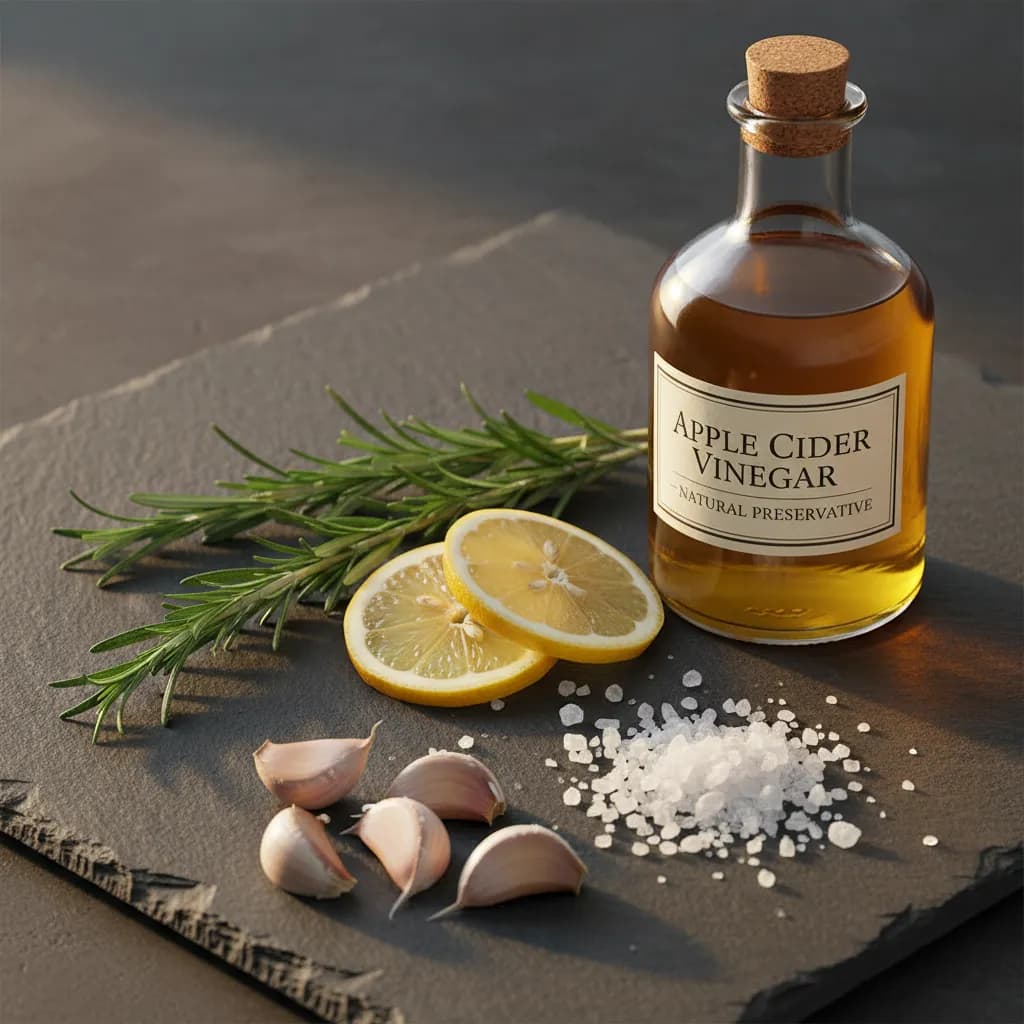
This is the workhorse of clean-label preservation for acidic products. Vinegar doesn't just reduce pH — acetic acid has direct antimicrobial activity that increases as pH drops. In most hot sauces and vinegar-based condiments, properly dosed vinegar is all the preservation you need. The key is selecting the right vinegar type for your flavor profile. Distilled white vinegar is the most efficient preservative but adds sharpness. Apple cider vinegar is milder. Rice vinegar is gentler still but less effective per volume.
Cost impact: Negligible. Vinegar is already in most sauce formulas. Adjusting the level is a formulation tweak, not an ingredient addition.
Citric Acid and Lemon Juice Concentrate
Citric acid is the second most common acidulant I use. It's universally recognized as clean label, it's cost-effective, and it provides sharp pH reduction without the flavor dominance of vinegar. Lemon juice concentrate is the "label-friendly" version — functionally similar but reads better on the ingredient panel. The tradeoff is cost: lemon juice concentrate runs 4-6x more than food-grade citric acid for equivalent acidification.
Where it works best: dressings, marinades, fruit-based sauces, and any product where citrus notes are welcome.
Rosemary Extract
Rosemary extract is a legitimate antioxidant that delays lipid oxidation — the process that makes oils go rancid and causes off-flavors in oil-containing sauces. It is not a strong antimicrobial, despite what some suppliers claim. Use it to extend flavor stability in products with olive oil, nut oils, or other unsaturated fats, but don't rely on it as your primary microbial hurdle.
Cost impact: $0.01-0.03 per unit at typical usage rates (0.02-0.05% of oil weight). Flavor impact is minimal with deodorized versions, though some sensitive palates detect a slight herbal note.
Cultured Sugar / Cultured Dextrose
This is the most commercially significant natural preservative to emerge in the last decade. It's produced by fermenting sugar with Propionibacterium, producing propionic acid and other organic acids that inhibit mold and yeast growth. It works. In my testing, cultured dextrose provides mold inhibition roughly 70-80% as effective as potassium sorbate at recommended usage rates.
The catch: it adds 1-2g of sugar per serving, it can impart a slight tangy note, and it costs significantly more than synthetic alternatives. For products where mold is the primary spoilage concern — think tomato-based sauces, salsas, dressings — it's an excellent tool.
To understand how these options fit into broader clean-label strategy, see what clean label really means for CPG brands in 2026.
Fermented Ingredients (Fermentates)
Beyond cultured dextrose, a growing category of fermented ingredients offer both flavor complexity and preservation benefits. Fermented chili pastes, fermented garlic, and fermented vegetable bases contribute organic acids, lower pH, and introduce competitive microbial cultures that suppress pathogen growth. For kettle-cooked products, these are particularly powerful because they add preservation function and flavor depth simultaneously.
Salt and Sugar (The Originals)
Don't overlook the oldest preservatives in human history. Salt at 3-5% and sugar at concentrations above 50% (like jams and preserves) provide meaningful water activity reduction. For BBQ sauces, teriyaki sauces, and sweet condiments, sugar does double duty as flavor and preservative. The challenge in 2026 is balancing effective preservation levels against consumer demand for lower sodium and lower sugar. This is where the hurdle approach becomes essential — you can use less of each when they're working in combination.
Preservation Strategies for Specific Product Categories
Theory is useful, but what actually works in practice? Here's how I approach preservation for the most common kettle-cooked product types:
Hot Sauces (pH 2.8-3.5)
These are the easiest category for clean-label preservation. The combination of low pH, vinegar's antimicrobial activity, and capsaicin's mild antimicrobial properties means most hot sauces need nothing beyond their core ingredients for adequate preservation. Hot-fill into glass at 185 degrees F or above, and you're looking at 18-24 months of ambient stability with no preservative additions.
Tomato-Based Sauces (pH 3.9-4.5)
The higher pH range makes these trickier. Marinara, pasta sauce, and salsa typically sit right around the critical 4.6 threshold before acidification. Citric acid or lemon juice brings them safely below 4.6, but mold remains the primary spoilage concern post-opening. Cultured dextrose or potassium sorbate replacement systems work well here. Hot-fill processing is essential.
Mayonnaise and Creamy Dressings (pH 3.6-4.0)
These emulsion products present unique challenges because the fat phase creates microenvironments. EDTA (disodium calcium EDTA) is the traditional chelating agent that prevents oxidation, but it's firmly on most clean-label exclusion lists. Rosemary extract plus citric acid is the standard clean-label replacement. The oil quality matters enormously — refined oils have fewer pro-oxidants and perform better in clean-label emulsions.
For the complete picture on shelf-life strategy, I cover the full methodology in how to extend shelf life without artificial ingredients.
What Doesn't Work: Honest Failures
I want to be transparent about alternatives that look promising on paper but underperform in real-world sauce and condiment applications:
Nisin — a bacteriocin produced by Lactococcus lactis — is highly effective against gram-positive bacteria but does almost nothing against gram-negative bacteria, yeasts, or molds. In acidic sauces where mold and yeast are the primary spoilage organisms, nisin alone is inadequate.
Essential oils (oregano oil, thyme oil, cinnamon oil) have real antimicrobial activity in lab settings, but the concentrations required for effective preservation make products taste like you're drinking potpourri. I've never successfully used essential oils as a primary preservation system in a consumer product without unacceptable flavor impact.
Chitosan shows promise in academic literature but faces consumer perception challenges ("made from shrimp shells" is not a clean-label win) and allergen concerns. It's not practical for most CPG applications yet.
Building Your Preservation System: A Practical Framework
Here's the process I follow for every clean-label formulation:
Step 1: Establish your baseline pH and water activity. These two numbers tell you 80% of what you need to know about your preservation needs.
Step 2: Identify your primary spoilage organisms. For acidic sauces, it's almost always mold and yeast. For higher-pH products approaching 4.6, you need to consider Clostridium botulinum — and that's a food safety issue, not just a quality issue.
Step 3: Stack your hurdles. Combine pH reduction, water activity reduction, and if needed, a direct antimicrobial. Each hurdle doesn't need to be individually sufficient — together, they create a system that microorganisms can't overcome.
Step 4: Validate with shelf-life testing. Accelerated studies give you directional data in weeks. Real-time studies confirm it over months. Never skip the real-time study, especially for a new preservation system.
For related guidance on making formulas hold up under production conditions, see balancing flavor and shelf stability in condiment formulation.
Frequently Asked Questions
Can natural preservatives achieve the same shelf life as synthetic ones?
In most sauce and condiment applications, yes — when used as part of a multi-hurdle preservation system. A well-formulated hot sauce or vinegar-based condiment can achieve 18-24 months of ambient shelf life with no synthetic preservatives. Higher-pH products like cream-based sauces may see a modest reduction (12-15 months vs. 18 months), but this is usually acceptable for retail velocity in the natural channel. The key is combining pH control, water activity management, thermal processing, and packaging rather than expecting a single natural ingredient to replace a synthetic preservative one-for-one.
What's the most cost-effective natural preservative for sauces?
Vinegar and citric acid, by a wide margin. They're inexpensive, universally clean-label, and provide the most critical preservation mechanism (pH reduction) in acidic products. If your product is already acidic, optimizing your vinegar type and concentration should be your first move before investing in specialty natural preservatives. Cultured dextrose and rosemary extract are the next tier — more expensive but solving specific problems (mold inhibition and lipid oxidation, respectively) that acids alone don't address.
Do natural preservatives affect the taste of my product?
Some do, and pretending otherwise is dishonest. Cultured dextrose adds a slight tangy note and 1-2g sugar per serving. Rosemary extract, even deodorized versions, can be detectable in delicate-flavored products. Vinegar obviously contributes acidity and flavor. The formulation work is in building the preservation system around your flavor profile, not fighting against it. This is where working with a product developer who understands both flavor chemistry and food safety pays for itself — the wrong natural preservative choice can ruin a product's taste while technically extending its shelf life.
Is "preservative-free" the same as "no preservatives added"?
Technically, no. "Preservative-free" implies the product contains no substances that function as preservatives, but vinegar and salt are preservatives — they're just also ingredients. "No artificial preservatives" or "no synthetic preservatives" are more accurate and defensible claims for most clean-label products. Be careful with absolute claims like "preservative-free" if your product contains vinegar, citric acid, or salt at levels that contribute to preservation. The FTC and state attorneys general are increasingly scrutinizing food marketing claims.
How do I choose between cultured dextrose and other natural antimicrobials?
Match the preservative to your spoilage organism. Cultured dextrose excels at mold and yeast inhibition, making it ideal for tomato sauces, salsas, and dressings where post-opening mold is the primary concern. For lipid oxidation in oil-based products, rosemary extract is more appropriate. For bacterial control in higher-pH products, you may need a combination approach or more aggressive thermal processing. There is no single natural preservative that replaces all functions of synthetic systems — the solution is almost always a tailored combination.
Need Help With Your Formulation?
Whether you're scaling your first recipe or reformulating an existing product, let's talk about how to get it right.
Book a Free Discovery Call