What Makes Kettle Cooking Different from Continuous Processing
If you have spent any time in a commercial food facility, you have likely seen both batch kettle systems and continuous-flow processing lines. On paper, they accomplish the same thing: apply heat to ingredients, cook them, and package the result. In practice, the sauces that come out of these two systems are fundamentally different products.
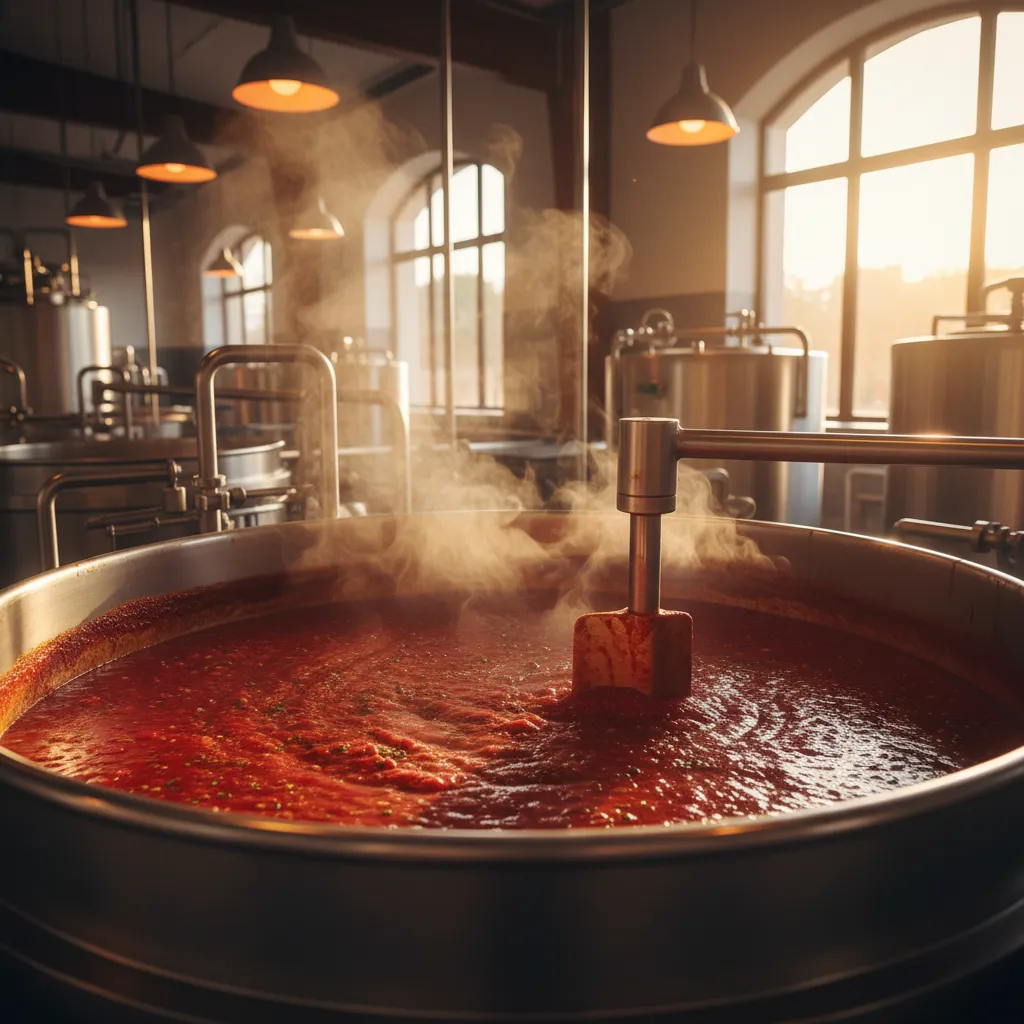
A steam-jacketed kettle operates as a batch system. You load your ingredients, bring them to temperature, hold them there while flavors develop, then discharge the entire batch. The key difference is residence time control — every particle in that kettle experiences the same thermal history. In a continuous system, ingredients flow through heated tubes or scraped-surface heat exchangers at a fixed rate. The system is designed for throughput and consistency, but the flavor development window is narrow and uniform.
This matters enormously for sauces and condiments because flavor is not just about ingredients — it is about what happens to those ingredients over time. The Maillard reaction, caramelization, volatile development, and pectin breakdown are all time-and-temperature-dependent processes. A kettle gives you the ability to manage those reactions in ways that continuous processing simply cannot.
I have formulated hundreds of sauces across both systems, and the difference is audible before it is visible. A kettle full of BBQ sauce undergoing proper caramelization sounds different — a low, steady bubble versus the hiss of a thin film over a heat exchanger surface. That sound tells you complex sugars are breaking down slowly, producing hundreds of flavor compounds instead of a handful.
The Science Behind Superior Flavor Development in Kettles
The Maillard reaction is the single most important chemical process in sauce development. It occurs when reducing sugars react with amino acids under heat, producing melanoidins (the brown color compounds) and hundreds of volatile flavor molecules. Here is why kettles do this better:
- Temperature gradient control: In a kettle, the product nearest the jacket wall reaches higher temperatures while the bulk stays cooler. This creates a gradient where Maillard products form at the wall and distribute through gentle agitation. You get complexity without scorching. Continuous systems apply heat uniformly, which means you either under-develop Maillard flavors or overshoot and create bitter, burnt notes.
- Time at temperature: Kettle cooking lets you hold a sauce at 190–210°F for 45 minutes to 2 hours. That extended cook time allows secondary and tertiary Maillard products to form — the pyrazines, furanones, and thiophenes that give a sauce depth. Continuous systems typically process in 2–15 minutes.
- Evaporative concentration: Open or vented kettles allow water to evaporate, concentrating flavors and increasing Brix. This natural reduction is what gives a kettle-cooked sauce that rich, round mouthfeel. You can simulate this in continuous systems with vacuum concentration, but the flavor profile is different because the volatile compounds that evaporate during kettle cooking are selectively lost — and that selective loss is part of the flavor design.
Beyond Maillard chemistry, caramelization in kettle systems is more controllable. When sugars like sucrose, fructose, or glucose reach 320–360°F at the kettle wall, they undergo pyrolysis and produce diacetyl, maltol, and furanone compounds. In a well-agitated kettle, these form in trace amounts and add sweetness complexity. In a burned-on heat exchanger, they form as defects.
Volatile Retention and Loss: A Design Tool, Not a Problem
Most food scientists treat volatile loss as a problem to solve. In kettle cooking, it is a formulation tool. Acetic acid (vinegar sharpness), certain sulfur compounds from alliums, and low-molecular-weight aldehydes all have relatively low boiling points. During an extended kettle cook, these compounds partially evaporate, which is exactly what you want when you are building a mellow, rounded sauce rather than a sharp, raw-tasting one.
I design my kettle cook profiles to account for this. If I want more vinegar punch in the finished product, I add a portion of the vinegar post-cook, after the kettle has already driven off the volatile edge from the initial charge. This two-stage acid addition is one of those techniques that separates production-ready formulas from home recipes that taste different every time they are scaled. For more on this, see my article on common mistakes when scaling sauce recipes.
Texture and Body: Why Kettle-Cooked Sauces Feel Different
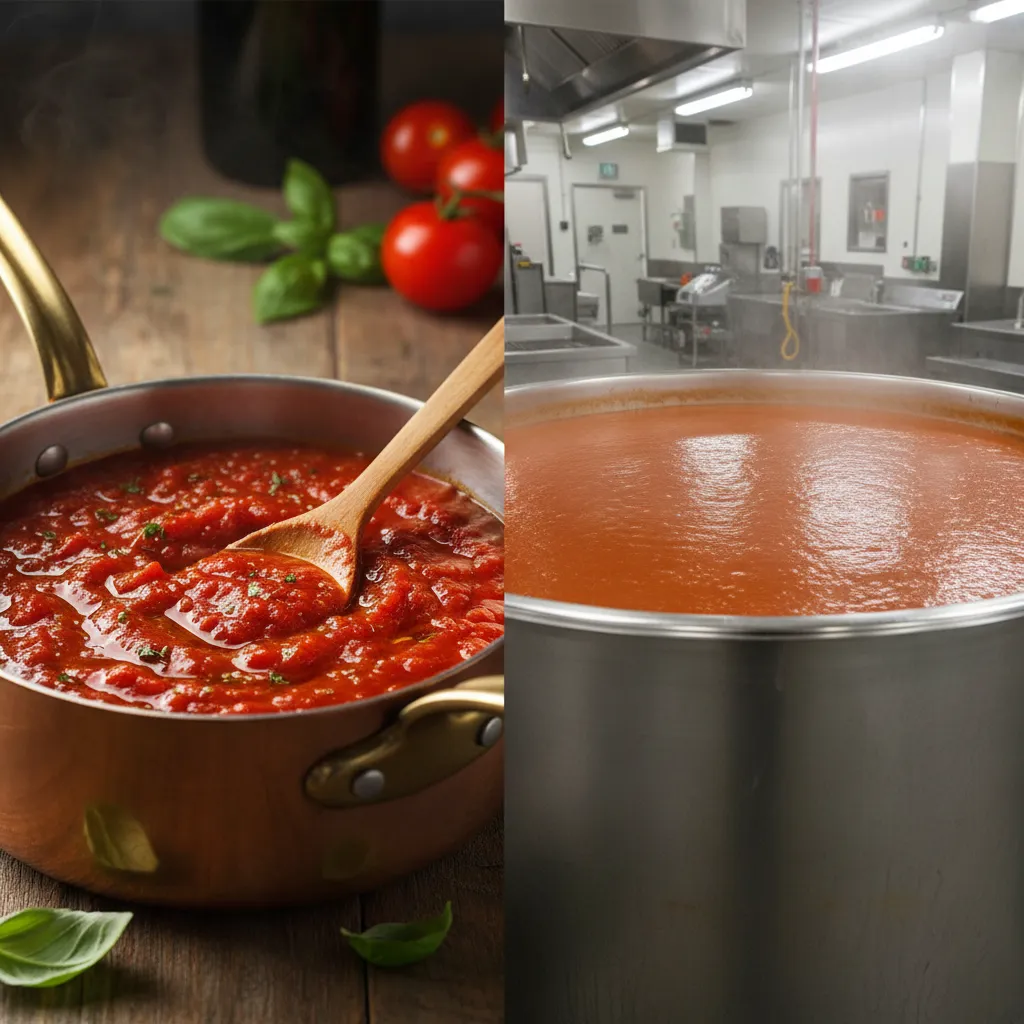
Pick up a spoon of kettle-cooked tomato sauce and a spoon of continuously processed tomato sauce. Tilt them. The kettle-cooked version will sheet off the spoon more slowly, with a viscous, clinging quality. The continuously processed version will drip faster and feel thinner in the mouth, even at the same measured viscosity.
This is not an illusion. It is the result of several physical changes that happen during extended kettle cooking:
- Pectin modification: Tomato-based sauces contain pectin that partially hydrolyzes during cooking, releasing galacturonic acid chains of varying length. In a kettle, this hydrolysis happens gradually, producing a distribution of chain lengths that creates a complex, gel-like network. Fast processing breaks pectin more aggressively, producing shorter chains and a thinner body.
- Starch gelatinization and retrogradation: If your sauce contains any starch (from flour, modified starch, or vegetable purees), the extended heat of kettle cooking allows full gelatinization and the beginning of retrogradation as the sauce cools in the kettle. This creates a more stable viscosity.
- Emulsion development: Sauces with oil or fat components develop more stable emulsions during kettle agitation because the mechanical shear is gentler than a pump or in-line mixer. Gentle shear produces larger, more uniform fat droplets that contribute to a creamier mouthfeel rather than a greasy one.
When I develop a BBQ sauce for scale production, the kettle cook is where the texture magic happens. You cannot replicate 90 minutes of slow evaporation and gradual thickening in a 6-minute tube-in-tube heat exchanger.
Kettle Cooking and Clean Label Compatibility
Here is a practical advantage that matters more every year: kettle-cooked products often need fewer additives. When you develop deep flavor through actual cooking rather than trying to recreate it with flavoring systems, you can eliminate or reduce ingredients like:
- Natural smoke flavoring (because real caramelization provides some of those notes)
- Caramel color (because Maillard browning happens naturally)
- Xanthan gum or other thickeners (because proper evaporation and pectin management create body)
- Flavor enhancers like yeast extract (because umami develops through protein-sugar reactions during cooking)
This is a significant competitive advantage in the current market. Consumers are reading labels, and retailers are imposing clean-label requirements on new products. A sauce that achieves its color, flavor, and texture through cooking technique rather than additive systems is easier to sell, easier to label, and easier to defend in a buyer meeting.
That said, kettle cooking is not a license to ignore food safety. Your pH, water activity, and thermal process still need to be validated. The extended cook helps with thermal kill, but you still need proper acidification for shelf-stable products. I always work with a process authority to validate that the kettle cook profile delivers the required lethality.
Practical Considerations: When Kettle Cooking Is (and Isn't) the Right Choice
I am not going to pretend kettle cooking is always the answer. It has real constraints:
- Throughput: A 300-gallon kettle cooking a 90-minute batch produces far less volume per hour than a continuous line. If you need to fill 50,000 bottles a day, you need multiple kettles or a hybrid approach.
- Labor: Kettle cooking requires skilled operators who can read the cook — checking viscosity by spoon test, adjusting agitation speed, knowing when to add ingredients. It is not a push-button operation.
- Batch variability: Without tight SOPs, kettle batches can drift. Two operators running the same recipe can produce noticeably different sauces if the process is not well-documented. This is why production-ready formulas include detailed cook profiles, not just ingredient lists.
- Energy cost: Holding a kettle at temperature for an hour costs more in steam or gas than a continuous process that cooks in minutes.
Kettle cooking is the right choice when flavor complexity, texture, and clean-label positioning are your competitive advantages. If you are making a premium sauce, a craft condiment, or anything positioned above commodity level, the kettle is where your product earns its price point.
If you are developing a signature hot sauce or any high-value condiment, I strongly recommend starting with a kettle-based process and only moving to continuous if volume demands force it — and even then, build the formula around the kettle cook and find a continuous system that approximates it, not the other way around.
Frequently Asked Questions
What is the difference between kettle-cooked and processed sauces?
Kettle-cooked sauces are made in batch kettles where ingredients cook together for extended periods (30 minutes to several hours), allowing Maillard browning, caramelization, and natural evaporative concentration to develop complex flavors and body. Processed sauces typically use continuous-flow systems that heat ingredients quickly (2–15 minutes) for efficiency but produce a flatter, less nuanced flavor profile. The difference shows up most in aroma complexity, mouthfeel, and the number of ingredients needed on the label.
Does kettle cooking affect shelf life of sauces?
Kettle cooking itself does not guarantee shelf life — that depends on pH, water activity, thermal processing, and packaging. However, extended kettle cook times do contribute to thermal kill of microorganisms, and the evaporative concentration can lower water activity, both of which support shelf stability. The key is working with a process authority to ensure your specific kettle cook profile meets FDA requirements for commercial distribution.
Is kettle cooking more expensive than continuous processing?
On a per-unit basis, yes — kettle cooking uses more energy, more labor, and produces less volume per hour. However, for premium and craft products, the cost difference is typically absorbed by higher price points. A sauce that retails for $8–$14 per bottle can easily justify kettle production costs that would be untenable for a $3 commodity product. Many successful brands start with kettle cooking and only transition to continuous processing when they reach volumes above 100,000 units per month.
Can any sauce be kettle-cooked?
Most sauces benefit from kettle cooking, but some products are better suited to other methods. Thin, vinegar-forward hot sauces with minimal cook time may not benefit much from extended kettle processing. Dairy-based sauces require careful temperature control to prevent protein denaturation. And very high-volume, low-margin products like basic ketchup or yellow mustard are typically better served by continuous systems. The sweet spot for kettle cooking is medium-viscosity sauces with complex flavor profiles — BBQ sauces, marinades, pasta sauces, curry sauces, and premium condiments.
How do I find a co-packer that does kettle cooking?
Look for co-packers that specifically list batch kettle capabilities and ask about their kettle sizes, agitation types (sweep versus anchor versus paddle), and whether they can accommodate custom cook profiles. Many co-packers have kettles but default to short cook times for efficiency, so you need a production-ready formula with a detailed cook profile that specifies temperatures, hold times, and addition sequences. A formulation consultant can provide this documentation and often has existing relationships with kettle-capable co-packers in your region.
Need Help With Your Formulation?
Whether you're scaling your first recipe or reformulating an existing product, let's talk about how to get it right.
Book a Free Discovery Call