Why BBQ Sauce Is One of the Hardest Products to Scale
BBQ sauce looks simple. Tomato base, sweetener, vinegar, spices, smoke. But BBQ sauce is one of the most technically challenging condiments to produce at scale because its defining characteristic — that layered, slow-cooked complexity — is a product of time-and-temperature reactions that do not translate linearly from a backyard pot to a 500-gallon steam kettle.
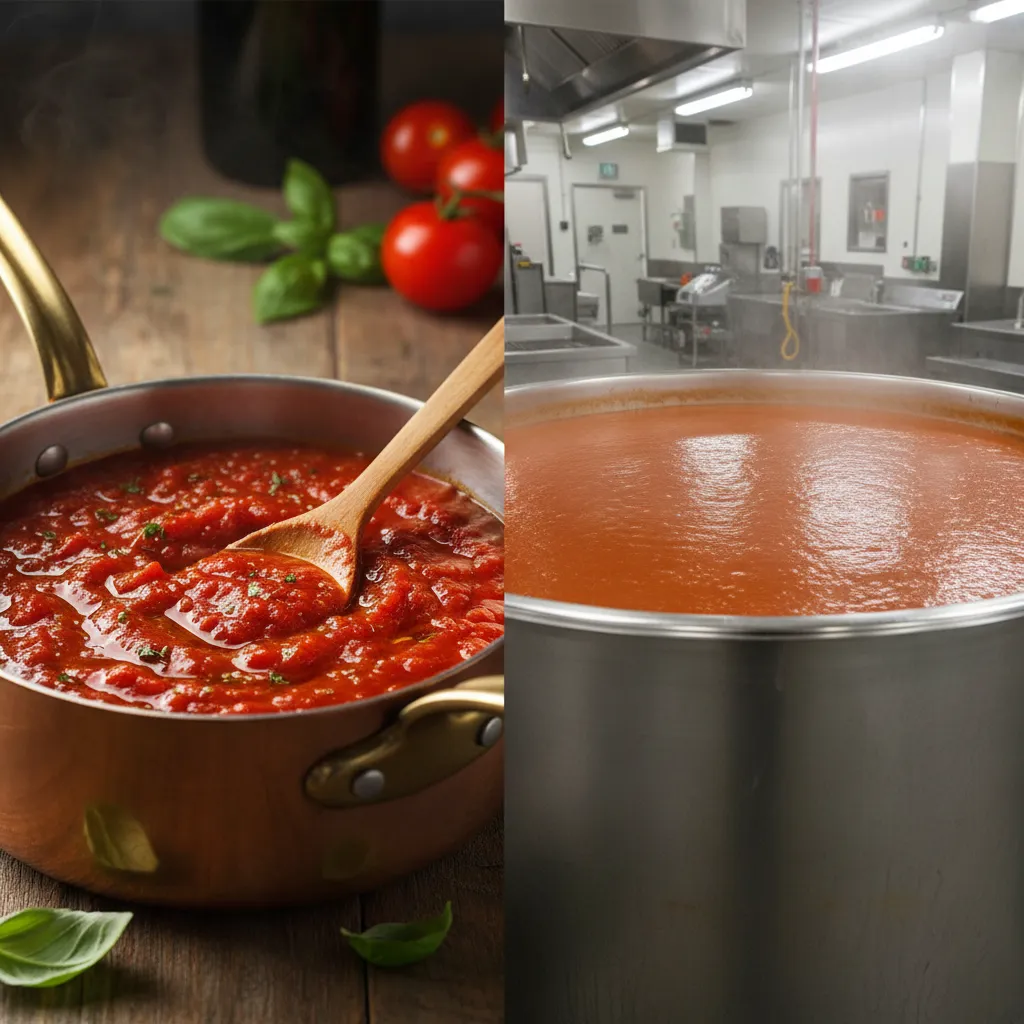
I have worked with BBQ sauce brands at every stage, from pitmaster-turned-entrepreneur with a recipe scrawled on a napkin to established brands reformulating for new co-packers. The pattern is always the same: the sauce that won the competition or built the restaurant's reputation tastes different — sometimes unrecognizably different — when produced at commercial scale. Understanding why this happens and how to prevent it is the core of BBQ sauce production science.
The stakes are high because BBQ sauce is a crowded, competitive category dominated by major brands with massive marketing budgets. Craft and premium BBQ sauces can absolutely compete, but only if the product in the bottle delivers on the promise every single time. Inconsistency is the fastest way to lose shelf space.
The Chemistry of Smoky Complexity: What You Are Actually Scaling
When someone describes a great BBQ sauce as having "depth" or "complexity," they are describing the combined effect of several distinct chemical processes:
Maillard Browning in Tomato-Sugar Systems
The Maillard reaction between reducing sugars and amino acids in tomato paste is the backbone of BBQ sauce flavor. Tomato paste is rich in both free glutamate (an amino acid) and reducing sugars (glucose and fructose), making it an ideal Maillard substrate. During a proper cook, these react to form:
- Pyrazines: Roasted, nutty, earthy aromas. These are the compounds that make the difference between "cooked tomato sauce" and "BBQ sauce."
- Furanones: Caramel, burnt sugar notes. 4-Hydroxy-2,5-dimethyl-3(2H)-furanone (HDMF, also called Furaneol) is particularly important in BBQ sauce.
- Thiazoles and thiophenes: Meaty, savory, complex notes that contribute to umami depth.
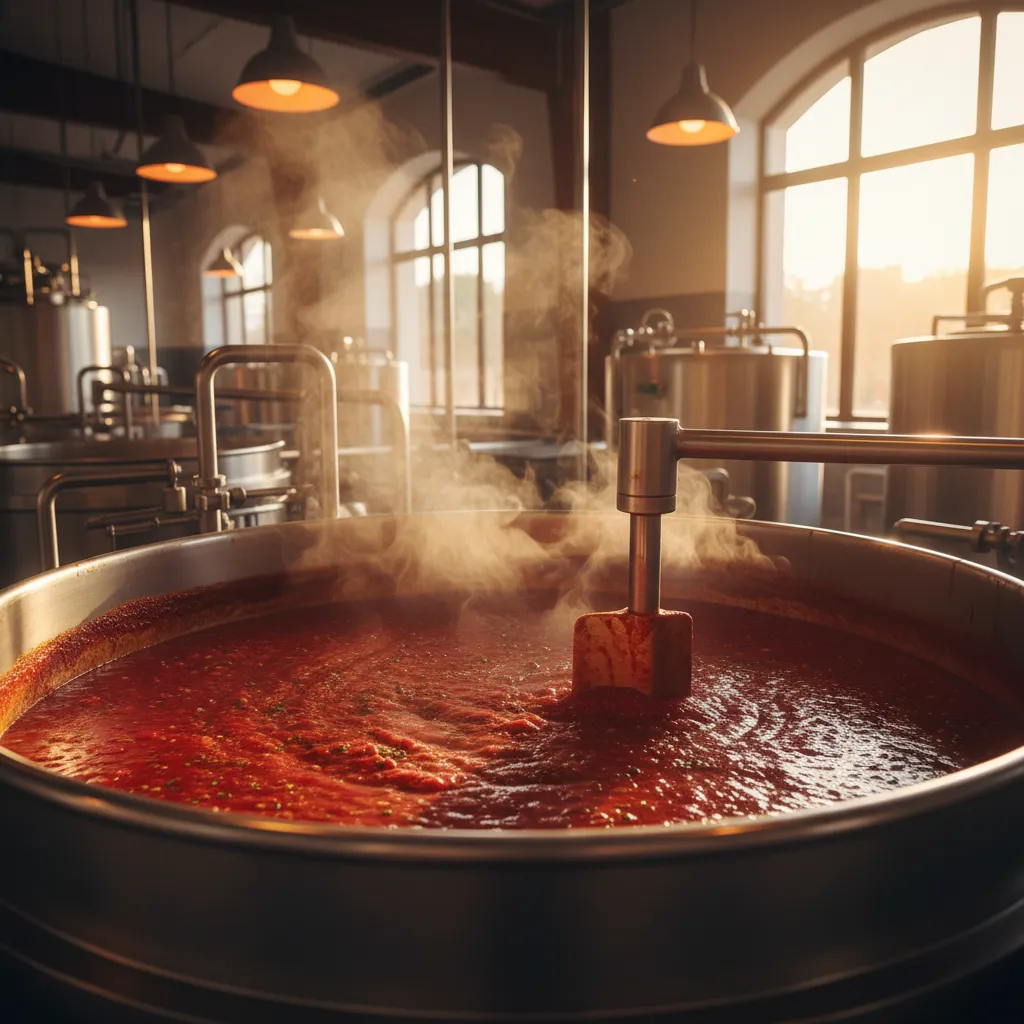
At home scale, these reactions happen over 30–60 minutes in a heavy pot. At commercial scale, the surface-area-to-volume ratio drops dramatically, which changes how heat penetrates the product. A 500-gallon kettle takes much longer to come to temperature, and the product nearest the jacket wall may be 30°F hotter than the center. This gradient is actually desirable (it creates localized Maillard zones that distribute flavor through agitation), but only if you manage it correctly with proper kettle cooking technique.
Sugar Caramelization: The Flavor Multiplier
Most BBQ sauces contain significant sugar — 20–40% of the formula by weight when you account for sugars in tomato paste, molasses, brown sugar, honey, and other sweeteners. At the kettle wall, where temperatures can exceed 300°F briefly, caramelization reactions produce over 100 different flavor compounds from sugar pyrolysis. These include diacetyl (buttery), maltol (toasty), and various furans that contribute body and warmth.
The challenge at scale is that caramelization at the kettle wall can tip from "desirable browning" to "burn-on" very quickly. Burn-on is not just a cleaning problem — it creates acrid, bitter compounds (acrolein, various polycyclic aromatic compounds) that contaminate the entire batch. Agitation speed, jacket steam pressure, and sauce viscosity all influence this threshold.
Smoke Flavor: The Most Misunderstood Ingredient
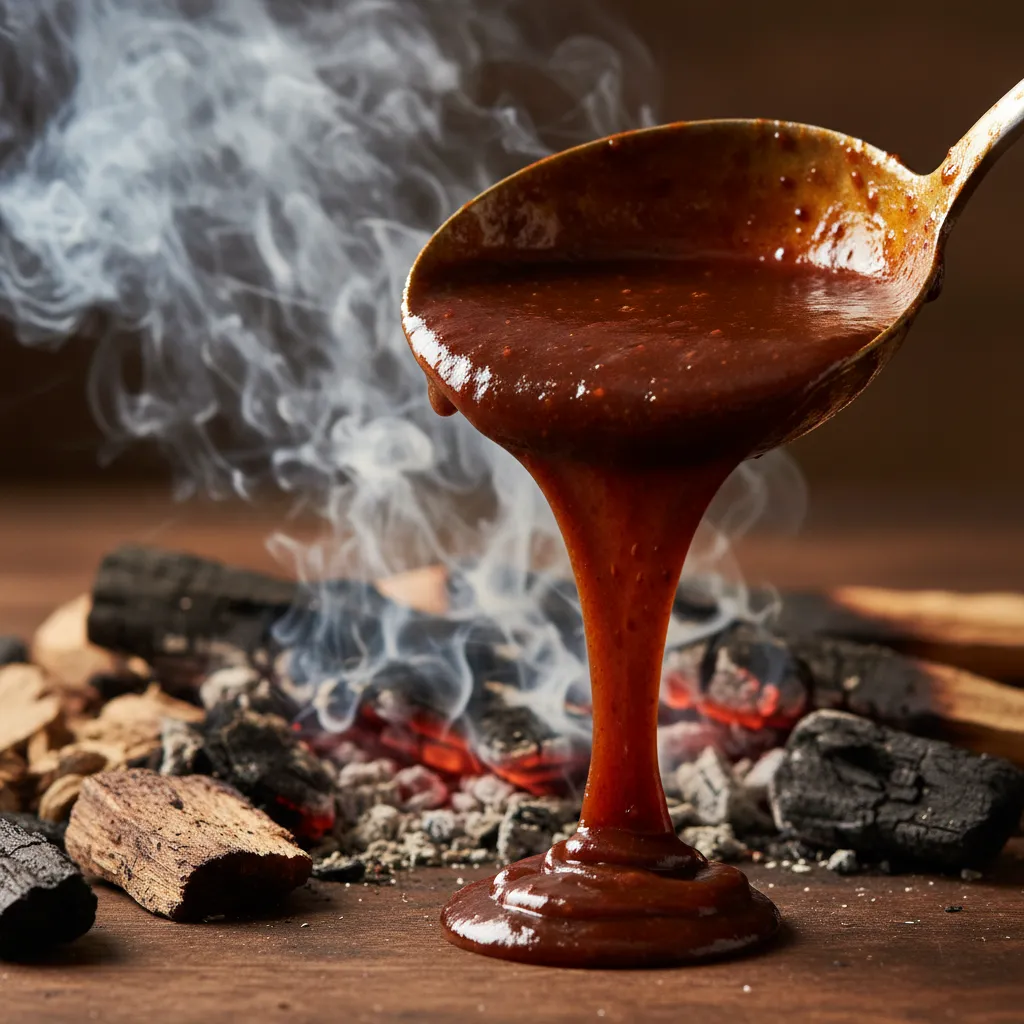
Natural liquid smoke is a legitimate, clean-label ingredient — it is literally condensed wood smoke, filtered and concentrated. But it behaves differently at scale than in small batches:
- Volatility: The phenolic compounds in liquid smoke (guaiacol, syringol, 4-methylguaiacol) are partially volatile. During an extended kettle cook, you will lose 10–30% of smoke flavor to evaporation. If your home recipe uses 1 tablespoon of liquid smoke per quart and you simply scale that ratio, the finished product will taste less smoky than expected.
- Heat interaction: Smoke compounds react with sugars and amino acids during cooking, creating new flavor compounds that do not exist in either the smoke or the sauce base alone. This is desirable but means your smoke flavor evolves during the cook rather than remaining static.
- Type matters: Hickory, mesquite, and applewood smoke condensates have completely different compound profiles. Hickory is heavy in guaiacol (smoky-medicinal). Mesquite has higher levels of syringol (sweet-smoky). The choice should match your overall flavor architecture, not just the label claim.
My approach is to split the smoke addition: add 60–70% of the smoke at the beginning of the cook (where it will react and mellow) and 30–40% post-cook (to restore the bright, forward smokiness that evaporated). This two-stage approach is one of the most effective techniques for maintaining smoke complexity at scale.
Formulation Strategies for Production-Scale BBQ Sauce
Here are the specific formulation decisions that separate a production-ready BBQ sauce from a scaled-up home recipe:
Sweetener Strategy
A common home recipe might use "1 cup brown sugar and 2 tablespoons honey." At production scale, you need to think about sweeteners as functional ingredients with distinct properties:
- High-fructose corn syrup (HFCS 42 or 55): Cost-effective, consistent, excellent humectant properties. But it is a non-starter for premium and clean-label brands.
- Cane sugar or organic cane sugar: Clean-label friendly, but contributes to crystallization at high concentrations and has limited Maillard reactivity (sucrose must first hydrolyze to glucose + fructose).
- Molasses: Essential for Kansas City-style sauces. Provides color, viscosity, mineral flavor, and significant Maillard reactivity. But it is highly variable between suppliers — always spec by grade (blackstrap, robust, mild) and Brix.
- Honey: Excellent flavor and Maillard reactivity (high in fructose), but expensive and variable. At scale, honey is often replaced with a honey-sugar blend to manage cost while maintaining the flavor note.
I typically build sweetener systems with 2–3 components that each serve a different function: a base sweetener for bulk sweetness, a specialty sweetener for flavor depth, and sometimes a reducing sugar source specifically to drive Maillard browning.
Acid Management
BBQ sauces need to balance sweetness with acid tang, and the acid does double duty as a preservation system. Target pH for most shelf-stable BBQ sauces is 3.3–3.8. Your acid sources include:
- Distilled white vinegar: Clean, sharp acidity. Workhouse acidulant but can taste harsh at high levels.
- Apple cider vinegar: Softer acidity with fruity undertones. Standard in many regional BBQ styles.
- Tomato paste: Provides citric and malic acid naturally. A sauce with 20%+ tomato paste gets significant acid contribution from the tomato itself.
- Citric acid: Useful as a fine-tuning acidulant — a small amount can bring pH into range without adding liquid volume or strong vinegar flavor.
For a comprehensive look at pH management across condiment categories, see my article on condiment formulation and shelf stability.
Thickening and Texture
BBQ sauce viscosity matters for consumer experience. Too thin and it runs off meat. Too thick and it will not pour from the bottle. The target is usually 8,000–25,000 centipoise (cP) at room temperature, measured with a Brookfield viscometer at specific spindle and speed settings.
At home scale, you get thickness from evaporation during a long cook. At production scale, you have several tools:
- Tomato paste concentration: Higher Brix tomato paste (28–32 Brix vs. standard 24–26) adds body without additional cooking time.
- Modified food starch: Clean-label options include tapioca and corn starches that are "modified" through physical processes (heat, pressure) rather than chemical treatment. These provide reliable thickening that withstands the thermal processing.
- Xanthan gum: At 0.15–0.3%, xanthan provides excellent suspension and pseudoplastic behavior (the sauce thins when squeezed from a bottle and re-thickens at rest). Clean-label acceptable. The key at scale is proper dispersion — xanthan clumps if added too quickly or to liquid that is too hot.
Production Process: The Cook Profile That Preserves Complexity
Here is a generalized cook profile for a premium kettle-cooked BBQ sauce. Specific temperatures and times will vary by formula, but this structure represents best practices:
- Stage 1 — Base development (25–35 min): Load tomato paste, primary sweeteners, and first smoke addition into the kettle. Bring to 190–200°F with moderate agitation. This is where your Maillard foundation develops. Do not rush this stage.
- Stage 2 — Spice integration (10–15 min): Add dry spices, mustard, and any paste-form ingredients (roasted garlic paste, chipotle in adobo). Hold at 195–205°F. The heat extracts essential oils from spices and integrates them into the sauce matrix.
- Stage 3 — Acid and liquid addition (5–10 min): Add vinegar and any other liquid components. Temperature will drop — bring back to 185°F minimum. Adjust pH to target range.
- Stage 4 — Final seasoning and stabilization (5–10 min): Add post-cook smoke, final salt adjustment, xanthan gum (pre-dispersed in oil or sugar), and any heat-sensitive flavors. Verify pH. Verify temperature for hot-fill (minimum 185°F).
- Stage 5 — Fill: Hot-fill into pre-heated bottles, cap immediately, invert for 30–60 seconds for cap sterilization. Cool to below 100°F within the time specified in your scheduled process.
The total cook time of 45–70 minutes is significantly longer than most co-packers' default process, which might be 15–20 minutes. This is where having a detailed, production-ready formula with a specific cook profile makes all the difference. Without it, the co-packer will optimize for throughput, and your sauce will taste flat. For more on avoiding these issues, read about common mistakes when scaling sauce recipes.
Regional Style Considerations in Production
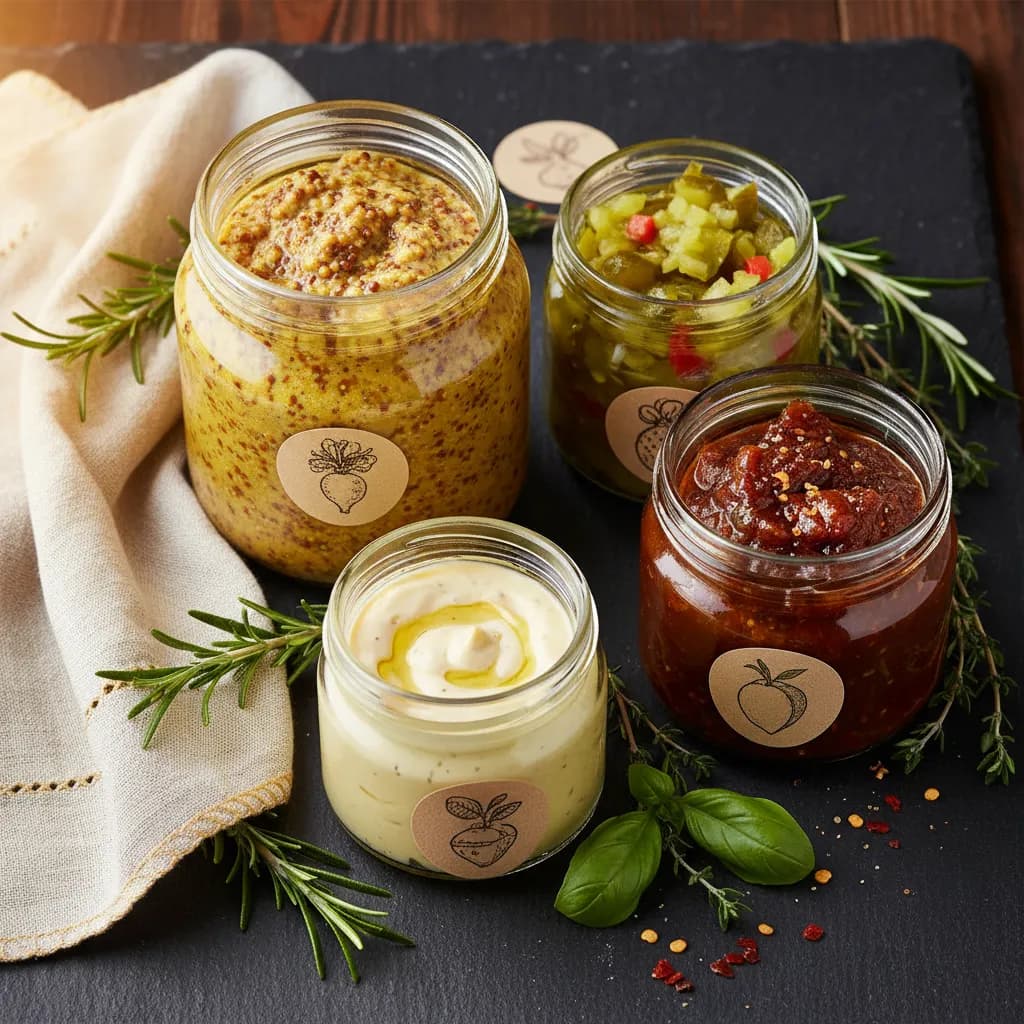
BBQ sauce is not a monolith. Different regional styles present different production challenges:
- Kansas City (thick, sweet, tomato-based): The most common commercial style. High sugar content means aggressive Maillard browning and potential burn-on. Requires careful agitation and jacket temperature management.
- Carolina vinegar (thin, vinegar-forward, minimal tomato): Low viscosity makes it easy to produce but hard to differentiate. The simplicity of the formula means every ingredient must be perfect — there is nowhere to hide.
- Carolina mustard (mustard-based, tangy-sweet): Mustard flour hydration and flavor development requires specific time-temperature profiles. Under-hydrated mustard tastes raw and pungent. Over-cooked mustard loses its characteristic bite.
- Alabama white (mayonnaise-based): An emulsion product that requires completely different processing — cold or warm processing, high-shear mixing, and careful pH management to prevent emulsion breakdown.
- Texas (minimal sugar, high heat, cumin-forward): Spice extraction is critical. The cook time for proper cumin development is different than for a sweet, tomato-heavy KC sauce.
Frequently Asked Questions
How do I prevent my BBQ sauce from tasting different at production scale?
The biggest cause of flavor change at scale is insufficient cook time. Co-packers optimize for throughput, which means shorter cooks. Insist on a detailed cook profile with minimum hold times at specific temperatures. Also account for evaporative loss — if your home recipe loses 20% of its volume to evaporation during a long cook, your production formula needs to start with extra water to hit the same final concentration after a shorter (but still adequate) production cook. Finally, split volatile ingredients (smoke, vinegar, fresh spice aromas) between early-cook and post-cook additions.
What is the best way to achieve smoky flavor in commercial BBQ sauce?
Use natural liquid smoke (condensed wood smoke, clean-label compliant) as your primary smoke source, applied in two stages: the majority during the cook for mellow, integrated smokiness, and a smaller portion post-cook for bright, forward smoke aroma. Choose your wood type to match your style — hickory for traditional, mesquite for Texas-style, applewood for sweeter profiles. Avoid "smoke flavor" that is synthetically derived, as it reads as artificial on both the palate and the label. Some premium brands also use smoked ingredients (smoked paprika, smoked salt, smoked tomatoes) to build smoke complexity through multiple sources rather than relying on liquid smoke alone.
Can I make a clean-label BBQ sauce without xanthan gum?
Yes, but you need alternative thickening strategies. Options include increasing tomato paste concentration (use 28–32 Brix paste), adding fruit or vegetable purees (date paste adds sweetness and body), using chia seed or flax mucilage as natural thickeners, or simply cooking longer to concentrate through evaporation. However, xanthan gum is widely accepted as clean-label — it is produced by bacterial fermentation of sugar and appears on labels as simply "xanthan gum." Most clean-label certifications and retailers accept it. The exception is some "ultra-clean" or Whole30-type standards that exclude all gums.
How much does it cost to produce BBQ sauce at commercial scale?
Cost of goods for a premium BBQ sauce in a 16 oz glass bottle typically ranges from $1.50 to $3.50 per unit at volumes of 5,000–20,000 units per run. This includes ingredients ($0.40–$1.00), packaging ($0.50–$1.20 for glass bottle, label, cap, and shrink band), and co-packer fees ($0.40–$1.20 per unit depending on batch size and complexity). Higher volumes reduce per-unit cost significantly. At 50,000+ units, COGS can drop below $1.50. Most premium BBQ sauces retail at $6.99–$12.99, so the margins support the cost if your distribution and marketing are sound.
What shelf life can I expect for a commercial BBQ sauce?
A properly formulated, hot-filled BBQ sauce with a pH below 3.8 will typically achieve 18–24 months of shelf life. The limiting factor is usually not microbial but sensory — flavor fading, color darkening, and texture changes. The most common shelf life failures are smoky flavor loss (volatile phenols degrade over time), color shift from red-brown to dark brown (continued non-enzymatic browning during storage), and separation in sauces with insufficient stabilization. Accelerated shelf life testing is essential to identify your specific product's weak points before launch.
Need Help With Your Formulation?
Whether you're scaling your first recipe or reformulating an existing product, let's talk about how to get it right.
Book a Free Discovery Call