Why Sauce Scaling Is Uniquely Challenging
Sauces are among the most difficult food products to scale. Unlike baked goods (where formula precision matters but the process is relatively forgiving) or dry blends (where scaling is largely a mixing problem), sauces involve complex interactions between heat, time, acidity, emulsification, and viscosity — and every one of those variables behaves differently at commercial volumes.
I've spent the better part of my career in kettle-cooked product development, and I still approach every new sauce scaling project with respect for how many things can go wrong. The mistakes I see aren't random — they're predictable, and they fall into clear categories. Understanding these categories before your first production run can save you tens of thousands of dollars and months of frustration.
If you're early in the scaling process, start with my complete guide to scaling kitchen recipes for commercial manufacturing for the foundational principles. This article dives into the specific pitfalls that trip up sauce brands most often.
Mistake #1: Ignoring Viscosity Changes at Volume
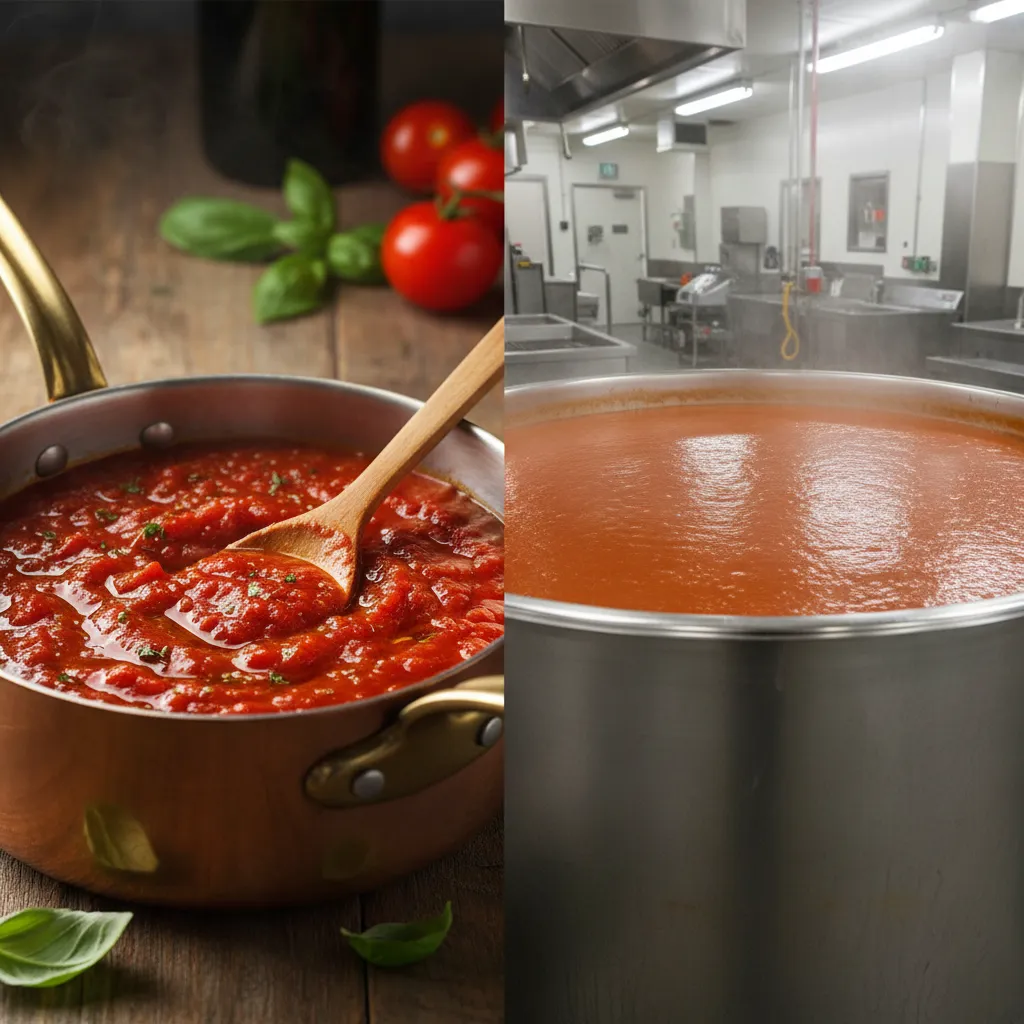
Your sauce has the perfect consistency in a 2-quart batch. At 200 gallons, it's noticeably thinner — or sometimes thicker. What happened?
Viscosity in sauces is determined by the interaction of solids concentration, temperature, emulsion stability, and shear history. At kitchen scale, you stir gently with a spoon. At commercial scale, a powerful agitator applies continuous shear to the product, and that mechanical energy breaks down structure.
Starch-thickened sauces are particularly vulnerable. Cornstarch and modified food starches develop viscosity when heated, but excessive shear from commercial agitators can break the starch gel, resulting in a thinner product. The same sauce made in a kettle with a slow-speed anchor agitator versus a high-speed dispersion mixer will have completely different viscosity profiles.
The Fix
Choose your thickening system based on the equipment it will encounter. Shear-stable starches (like certain modified tapioca or waxy maize starches) resist mechanical breakdown. Alternatively, combine thickeners — a starch for body plus xanthan gum for shear-stable viscosity. And always specify the agitator speed in your manufacturing procedure. "Mix until combined" means different things to different operators.
Mistake #2: Not Accounting for Spice and Flavor Extraction Rates
Founders linearly scale their spice quantities and are shocked when the production batch is significantly hotter, more bitter, or more intensely flavored than the kitchen version. Flavor extraction from whole and ground spices is time-and-temperature dependent, and both variables increase at scale.
In your kitchen, your sauce might cook for 20 minutes total. In a commercial kettle, the heat-up time alone might be 30 minutes, followed by a 45-minute cook. That's 75 minutes of extraction versus 20 — and you've pulled out dramatically more capsaicin from your chili peppers, more essential oils from your garlic, and more tannins from your spice seeds.
The Fix
Reduce spice quantities by 15-30% as a starting point for scaled batches, then adjust based on pilot batch results. For very heat-sensitive products (hot sauces, chili oils), consider adding some portion of the spice later in the process to limit extraction time. Document the flavor intensity targets in your quality specification — Scoville units for heat, sensory panel scores for overall flavor balance — so you have objective measures rather than subjective opinions guiding the adjustment.
Mistake #3: Failing to Manage the Emulsion
Many popular sauces are emulsions — oil and water held together by emulsifiers. Vinaigrettes, creamy hot sauces, aioli-based condiments, and many barbecue sauces contain fat that needs to stay evenly dispersed. An emulsion that's stable in a mason jar can break apart in a 300-gallon kettle.
The physics are straightforward: emulsion stability depends on droplet size, which depends on the shear energy applied during emulsification. Your immersion blender at home creates very small oil droplets. A kettle's anchor agitator creates much larger droplets — insufficient for stable emulsification. The result: fat separation, an oily surface layer, and an inconsistent product.
The Fix
Identify whether your sauce requires a stable emulsion and engineer the process accordingly. Options include: inline homogenization (passing the product through a high-pressure homogenizer after cooking), adding emulsifiers like mustard powder, lecithin, or specific hydrocolloids that stabilize the oil-water interface, or reformulating to reduce or eliminate the oil phase if it's not critical to the product's character. The key is making this decision during development, not discovering the problem during your first production run.
Mistake #4: Underestimating pH Variability
pH is the single most important safety parameter for acidified sauces and condiments. And it's the parameter most likely to vary between batches at scale. A pH shift of 0.3 units can mean the difference between a safe product and a potentially hazardous one.
Sources of pH variability at scale include:
- Ingredient lot variation: The pH of fresh tomatoes can range from 4.0 to 4.8 depending on variety, ripeness, and growing conditions. Vinegar grain strength varies by supplier and lot.
- Water chemistry: Municipal water pH and mineral content affect the final product pH, and it changes seasonally.
- Process variation: Longer cook times at scale concentrate acids differently than short cook times at kitchen scale.
- Measurement error: Poorly calibrated pH meters, incorrect temperature compensation, or testing at the wrong point in the process all introduce error.
The Fix
Build a pH safety margin into your formulation. If your process authority filing specifies a maximum equilibrium pH of 4.0, formulate to consistently hit 3.7. Specify the exact pH measurement protocol in your manufacturing procedure: calibrate the meter before each batch with fresh buffer solutions, measure at a defined temperature (typically 25C/77F), and measure at a specific point in the process (usually after cooking and before filling). And always have a corrective action ready — a pre-calculated amount of acid to add if a batch tests above your specification limit.
Mistake #5: Neglecting Cook Time's Effect on Color and Flavor
Time is an ingredient in sauce making, and at scale, you have a lot more of it. The extended cook times in commercial kettles drive additional Maillard reactions and caramelization that don't happen at kitchen scale. This can darken your product, shift the flavor profile toward cooked/caramelized notes, and reduce the brightness of fresh ingredients.
A fresh-tasting tomato sauce that's vibrant red in your kitchen might come out of a commercial kettle as a brownish-red sauce with muted tomato flavor and pronounced cooked notes. This isn't a defect in the co-packing process — it's the predictable result of heat exposure over time.
The Fix
Redesign the process to minimize total heat exposure. Options include: pre-heating ingredients separately to reduce total kettle time, adding heat-sensitive ingredients (fresh herbs, citrus, volatile aromatics) late in the process, using higher temperatures for shorter times instead of lower temperatures for longer times, and closing the kettle to reduce evaporation time. Sometimes the answer is also to adjust expectations — the commercial version may have a slightly different flavor profile than the kitchen version, and that's acceptable as long as it's still excellent. For more on achieving superior results with kettle cooking specifically, see my article on why kettle cooking produces better sauces.
Mistake #6: Treating Label Compliance as an Afterthought
I include this because it's technically a scaling mistake, even though it's not a recipe issue. Many founders develop their scaled formula, produce the product, and then discover that their ingredient list doesn't comply with FDA labeling requirements, or their nutrition facts panel doesn't match the actual product, or they've made claims on their label ("all natural," "no preservatives") that their formula doesn't support.
Your label must match your formula exactly. If you changed an ingredient during scaling — switched from fresh garlic to garlic powder, added citric acid for pH control, incorporated a modified food starch — your ingredient list needs to reflect those changes. The time to verify label compliance is during formula development, not after you've printed 10,000 labels.
The Fix
Develop your label concurrently with your formula. Every formula change triggers a label review. Have your nutrition facts panel generated from the final production formula (not your original kitchen recipe) and verify it with laboratory analysis of the finished product. If you're making marketing claims, verify that every claim is supportable by your actual ingredient list and process.
The Cost of Getting It Wrong
A failed production batch isn't just the cost of ingredients and production time. It's also: the opportunity cost of delayed market entry (often 4-8 weeks to re-schedule production), the cost of rushed reformulation, potential damage to your co-packer relationship, and — if you've already committed to retail placement — the catastrophic cost of missing your shelf date.
I've worked with founders who burned through $40,000-$60,000 in failed production runs before seeking professional help. That money would have funded complete recipe development, pilot batching, and the first successful production run with change left over. The complexities of scaling BBQ sauce are a particularly good example of how multiple mistakes can compound.
The antidote to all of these mistakes is the same: thorough development, rigorous pilot testing, and complete documentation before your first commercial production run. It's less exciting than jumping straight to production, but it's how successful sauce brands are built.
Frequently Asked Questions
Why does my sauce taste different when made in a large batch?
Several factors change at scale: longer cook times alter flavor chemistry (more Maillard browning, more spice extraction), different equipment applies different shear forces (affecting texture and emulsion stability), and ingredient sourcing often changes (commercial-grade ingredients differ from retail). The flavor difference isn't a flaw in manufacturing — it's a formulation gap. Your scaled formula needs to be adjusted to produce the same sensory outcome in different equipment, not simply multiplied from the kitchen version.
How do I prevent my scaled sauce from being too thin or too thick?
First, understand why the viscosity changed. Thinner product usually results from inadequate solids concentration (not enough evaporation) or shear breakdown of starch thickeners. Thicker product usually results from over-concentration (too much evaporation) or temperature effects on hydrocolloids. Choose thickening systems that are stable under your specific processing conditions, and specify exact target viscosity values in your quality specification — measured with a defined method at a defined temperature.
What's the most expensive scaling mistake you've seen?
A founder produced 8,000 units of a chipotle sauce without pilot testing. The pH came in at 4.5 — above their process authority's maximum of 4.2. The entire batch had to be destroyed because it couldn't be legally sold, and re-acidifying the already-bottled product wasn't feasible. Total loss: approximately $28,000 in ingredients, production, and packaging. A $400 pilot batch with a $15 pH test would have caught the issue before it became a five-figure loss.
Can I use my kitchen thickeners (cornstarch, flour) in commercial sauce production?
You can, but they often aren't the best choice. Native starches like cornstarch have poor shear stability and freeze-thaw stability, which creates problems in commercial production and distribution. Modified food starches, while less "clean label" sounding, are engineered for the specific conditions of commercial food manufacturing — high shear, extended holding times, temperature cycling during distribution. If clean label is critical to your brand, look at tapioca starch, arrowroot, or specific clean-label modified starches that offer better performance than native corn or wheat starch.
How many test batches should I run before full production of a sauce?
For most sauce products, plan for 3-5 pilot batches. The first batch tests the basic formula at scale. The second adjusts for whatever you learned (almost always spice levels, viscosity, and cook time). The third validates the adjustments. Additional batches may be needed for complex products or if the co-packer's equipment requires further process refinement. At $300-$800 per pilot batch, this is a fraction of the cost of a failed $5,000-$15,000 production run.
Need Help With Your Formulation?
Whether you're scaling your first recipe or reformulating an existing product, let's talk about how to get it right.
Book a Free Discovery Call