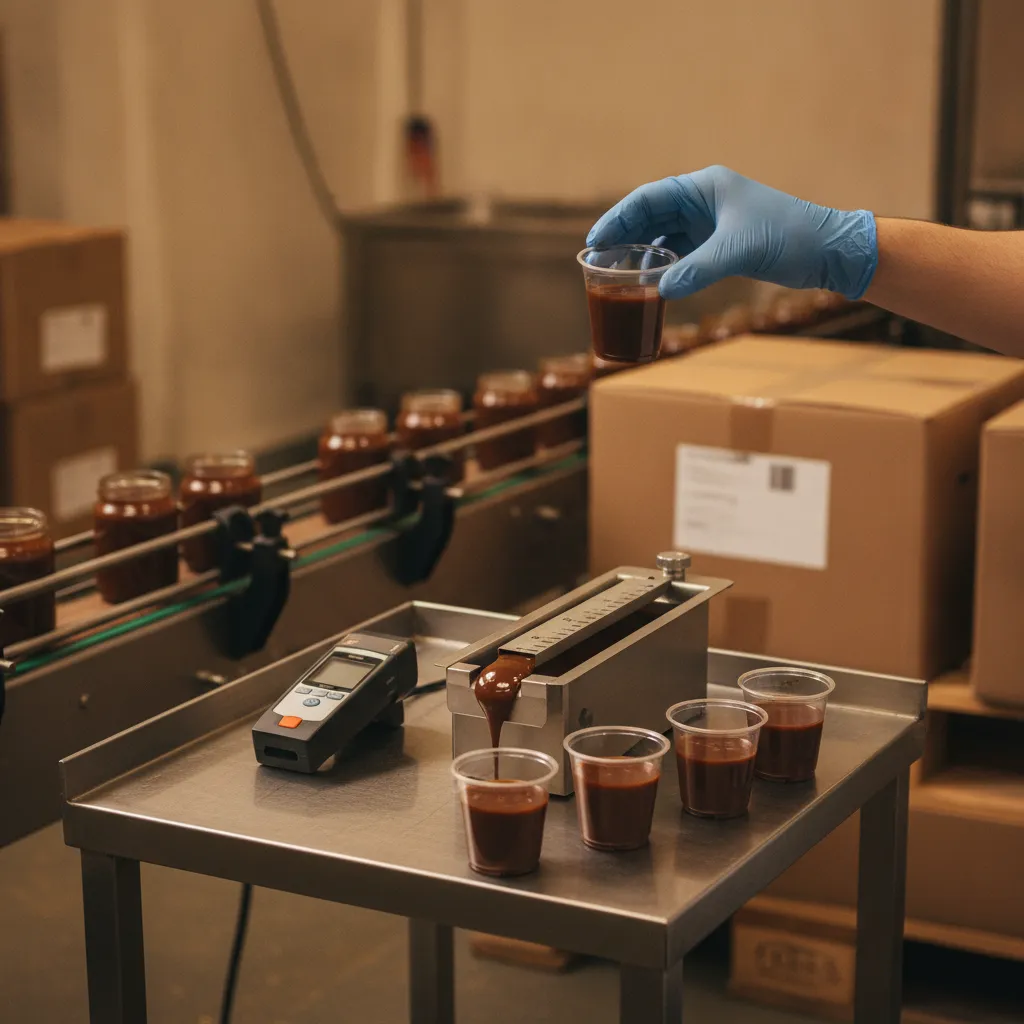
Before you sign with a new co-packer, sit down with its quality team and go through your spec one line at a time. For each number, ask how they'd read it: on what kind of instrument, how warm the sample is, and whether it's read in the kettle, at the filler or on a jar days later. You want them reading it the way you do, because a plant can only hold the numbers it can measure. Then ask whether they'll set aside jars from every batch for you.
I'm writing for a brand that already has a working spec and a gold standard, the approved jar every batch gets compared against, and is about to sign with a new plant or add a second one. If you're still checking fit, minimums, allergens and certifications, start with how to find and vet a co-packer. This piece covers the quality side that list doesn't get into.
I write the targets and ranges that go into specs like yours, so I know how each one has to be read to mean the same thing at another plant. I don't run quality control or audit plants; that program belongs to the plant.
Why the Same Jar Can Give Two Different Readings
A line that says "Brix 32" looks complete. It doesn't say how the sample was prepared, how warm it was or how long after cooking it was read, and any of those can move the number.
Viscosity
Say your target was set on a jar cooled to room temperature the morning after filling, and the new plant's quality tech reads viscosity from the kettle, close to fill temperature. Viscosity is the line on your spec that moves most with temperature, and a sauce flows faster hot than cool, so the reading comes out thin against your target. A careful crew might cook the next batch longer to bring the number up, and the jars that reach your customers set up too thick once they cool.
The plant read it hot off the kettle. Your target came from a jar that sat overnight.
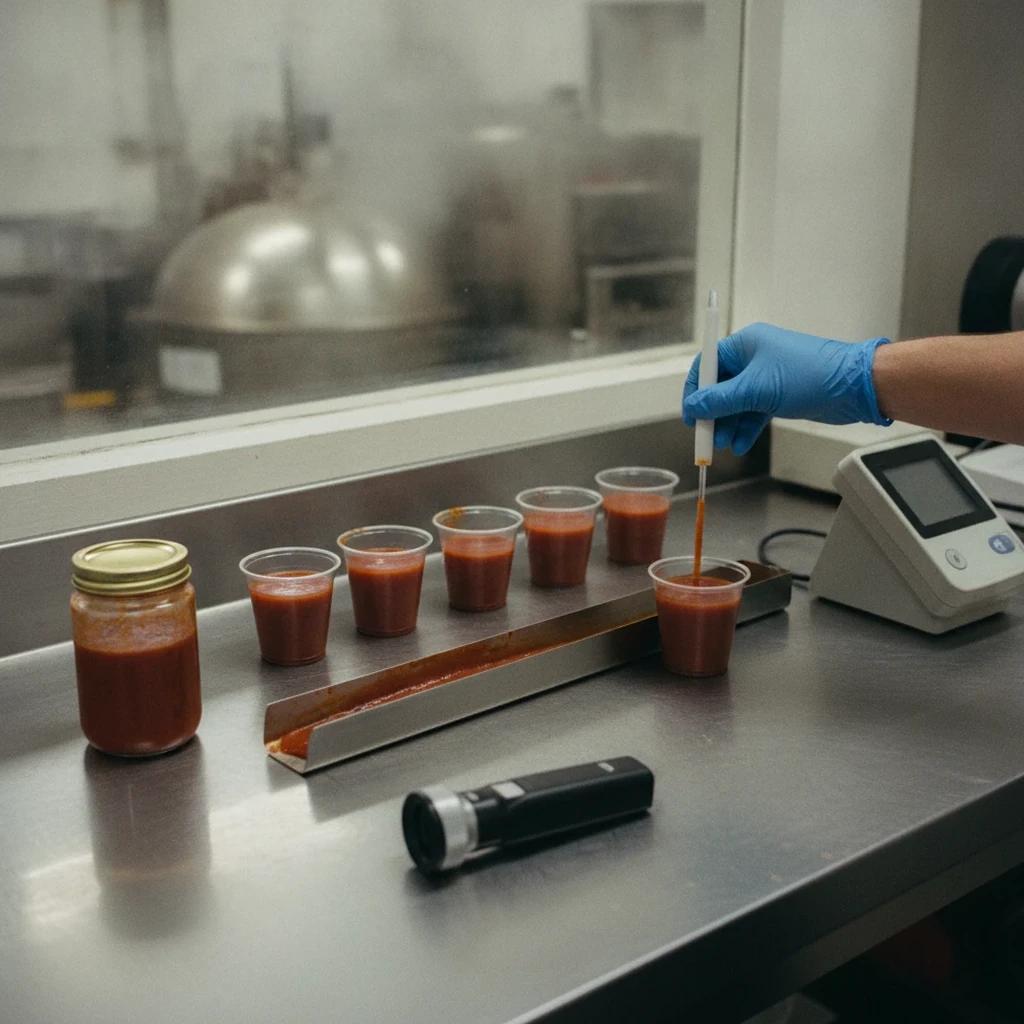
Timing moves it as well. A starch-thickened sauce can keep building body for a day or more after filling, so a reading at the filler and one the next morning differ even at the same temperature. The instrument matters too. A flow trough, where the sauce runs down a channel for a set time, and a rotational viscometer, where a spindle turns in the sample, measure thickness in different ways and report it in different units. No single conversion between the two holds for every sauce.
pH
A pH reading shifts with the temperature of the sample, so a hot sample off the filler and a cooled one aren't the same reading unless both are brought to the same temperature first. Pieces add a timing problem. On fill day the liquid around diced onion or pepper is more acidic than the centers of the pieces, and over the following hours and days the two even out and a reading of the liquid creeps up (I go into why in pH drift after production). So the spec has to say whether pH is read on the liquid or on the whole jar blended smooth, at what temperature and when, and the plant's method has to match. In a dressing, a film of oil on the meter's probe can throw the reading off too.
pH is also a safety number. How the plant measures and records it for safety is set by its food safety team and by your product's scheduled process, which comes from your process authority, the qualified expert who decides how an acidified product has to be made to be safe. If running at the new plant means a new process authority review, find out who books it, you or the plant, and get that in writing. In my experience, most process authorities and co-packers want the finished pH to top out somewhere between 4.0 and 4.3, because pH can drift after filling. All you're checking here is that you and the plant get the same pH from the same jar.
Brix
A refractometer that doesn't correct for temperature reads a warm sample differently from a cool one. Pieces and pulp blur the reading, so a chunky sauce is usually strained or pressed through cloth to get a clear drop, and the spec should say which. Ask where the plant reads it, too, because a kettle reading and a filled-jar reading can differ if the batch keeps cooking while it waits for the filler.
Salt
Salt is easy to write down as a bare percentage with nothing beside it. A handheld salt meter on the line and a lab method can disagree on a sauce full of vinegar and tomato. The meter usually reads conductivity, which the sauce's acids and minerals affect along with the salt, while a lab titration measures the chloride itself. Thick sauces are often diluted with water before a meter reading, and the dilution has to be the same every time or the number moves with it. Find out which method your own target came from before you ask which one the plant uses.
Color and Flavor
The same sauce looks one way in a clear cup on a white bench in daylight and another way in the jar under warehouse lights. A jar that cools slowly keeps cooking, so color can deepen for a while after filling. If the plant reads color with an instrument and you've always judged it by eye against a reference jar, agree on which one decides.
Nobody has a meter for flavor. I've found it takes about two weeks to settle, so I judge the week-two jar against the gold standard. A plant tasting on fill day beside your reference jar is checking for defects, which is worth doing, but whether the batch still tastes like your product only shows at week two. Agree up front which tasting the plant does and which one you do.
Meet the Plant's Quality Team
Ask for this meeting early, and make sure the quality manager or QC lead is in the room, not only your sales contact, because they know how the plant actually reads each number.
You don't need the recipe on the table, only the finished product spec, which says what comes out of the kettle and how each number is read. The formula by weight can wait until an NDA is signed and you're close to an agreement, the order I lay out in what to send a new co-packer before the NDA.
Before the meeting, write the method next to any number on your spec that doesn't have one, and ask your current plant if you're not sure how it's read there. These are the questions I'd bring, and what a good answer tends to sound like.
| Target | What to ask | A good answer sounds like |
|---|---|---|
| pH | Liquid or blended jar? At what temperature, and when? | Whole jar blended, at a set temperature, meter calibrated that day. |
| Brix | Does it correct for temperature? How are pieces handled? | Temperature-corrected, with chunky samples strained the same way each time. |
| Viscosity | Which instrument, at what temperature, how long after filling? | Our method, and exactly how it differs from yours. |
| Salt | Meter or lab method? Diluted how? | A meter with a fixed dilution, checked against a lab now and then. |
| Color | By eye or instrument? Against what, in what light? | Beside your reference jar, in the same light every time. |
| Flavor | Who tastes it, against what? | A trained taster, beside your gold standard and its written description. |
| Batch samples | Will you keep jars from every batch and send us some? | Yes, from the start, middle and end of the fill, by lot code. |
Listen for detail. An answer about sample prep and meter calibration tells you more than "we check pH on every batch," and some of the best answers come back as questions about how your gold standard was read.
Ask what each reading is for, as well. Some are taken in the kettle to decide when a batch is done, some at the filler to release it, some on held jars days later. Agree which reading each of your targets applies to, so nobody aims a fill-day reading at a target you set on settled jars. A batch released on fill-day numbers needs a release range built for fill day, which I cover in finished product specs as release criteria.
Each flavor has its own targets and can need its own methods, so walk the spec for every product you plan to run there, not only your best seller. A plant that reads your smooth tomato sauce easily may struggle with your chunky salsa, because big pieces don't run evenly down a trough.
Send the Plant Jars From One of Your Lots
Then check what they told you against real numbers. If the plant's quality team is willing, send them jars from one of your current production lots and ask them to read every number their way, while jars from the same lot are read your way, on your own bench, through your current plant or at an outside lab. Labs call this a split sample: jars from one lot, tested in two places. Shelf jars already carry the ingredient statement, so sending them gives away nothing beyond what any buyer of your sauce has.
Talk through any line where the numbers don't match before the first production batch. A shelf jar has already settled, though, so this shows whether the two methods agree, not how the plant's fill-day readings will relate to your settled targets. That's why you agree which reading each target applies to.
When the Plant Measures Differently From You
A plant's quality team runs one set of methods across many products, so switching to your method for one sauce is a real change for them. Usually it goes one of four ways. The plant reads your sauce your way, if it has the instrument and the time for it on each batch. You restate your target and range in the plant's units, from the same jars read both ways. An outside lab reads that line on a schedule, which is fine as a regular check but too slow when the reading decides whether today's batch ships. Or the plant buys the instrument, which is the plant's decision, and who pays for it is between the two of you.
Say your viscosity target came from a rotational viscometer and the plant has a flow trough. Have the quality team run jars from several of your lots through their trough at the temperature your spec names, while the same jars are read on your instrument. Pairs from lots that span your range give the plant a target and range in its own units, for your sauce alone. Write whatever you agree into the spec, with the method next to the number, so whoever is on shift next year reads it the same way.
Ask for Jars From Every Batch
A good plant checks every batch itself. Ask for jars from every batch anyway, so you can test them against your gold standard yourself, and put the details in the agreement: the plant keeps its own retained samples from every lot, and a few jars from each batch come to you with the plant's readings for that lot. Settle who pays for those jars and the shipping, too.
In the first months at a new plant, read those jars the way you agreed and lay your numbers beside the plant's for the same lot, so a gap between the two methods shows up early. If this plant will run alongside your current one, keep comparing the two plants' numbers as well, the way I describe in adding a second co-packer.
If the Plant Can't Measure What Your Product Needs
Sometimes the gap doesn't close: the plant has no way to read a line your product depends on, an outside lab can't turn the reading around fast enough, or the plant can't set samples aside the way you need. That doesn't make it a bad plant, just one that isn't set up for this sauce.
Then go back to your shortlist. More names can turn up through your ingredient suppliers, your process authority, trade associations, trade shows and co-packer directories. One directory I'd look at is Co-Packer Match, and I'll say up front that it's our sister company. It lists U.S. co-packers by state and a code instead of by name. You can browse the whole directory of co-manufacturers or narrow it by process, for example to co-packers that run hot-fill products. Fill out the spec sheet on the site and you'll get an email listing up to five plants that fit your product, and how to contact each one. Price and minimums are up to each plant.
Wherever the next names come from, bring the measurement questions to each plant's quality team early, starting with the line the last plant couldn't read.
Writing a Spec That Reads the Same at Any Plant
If your spec doesn't say yet how each number is read, that's the part I write. And when a new plant reads a line differently, I put your gold standard and the plant's readings side by side and restate your target in the plant's units, without changing the sauce.