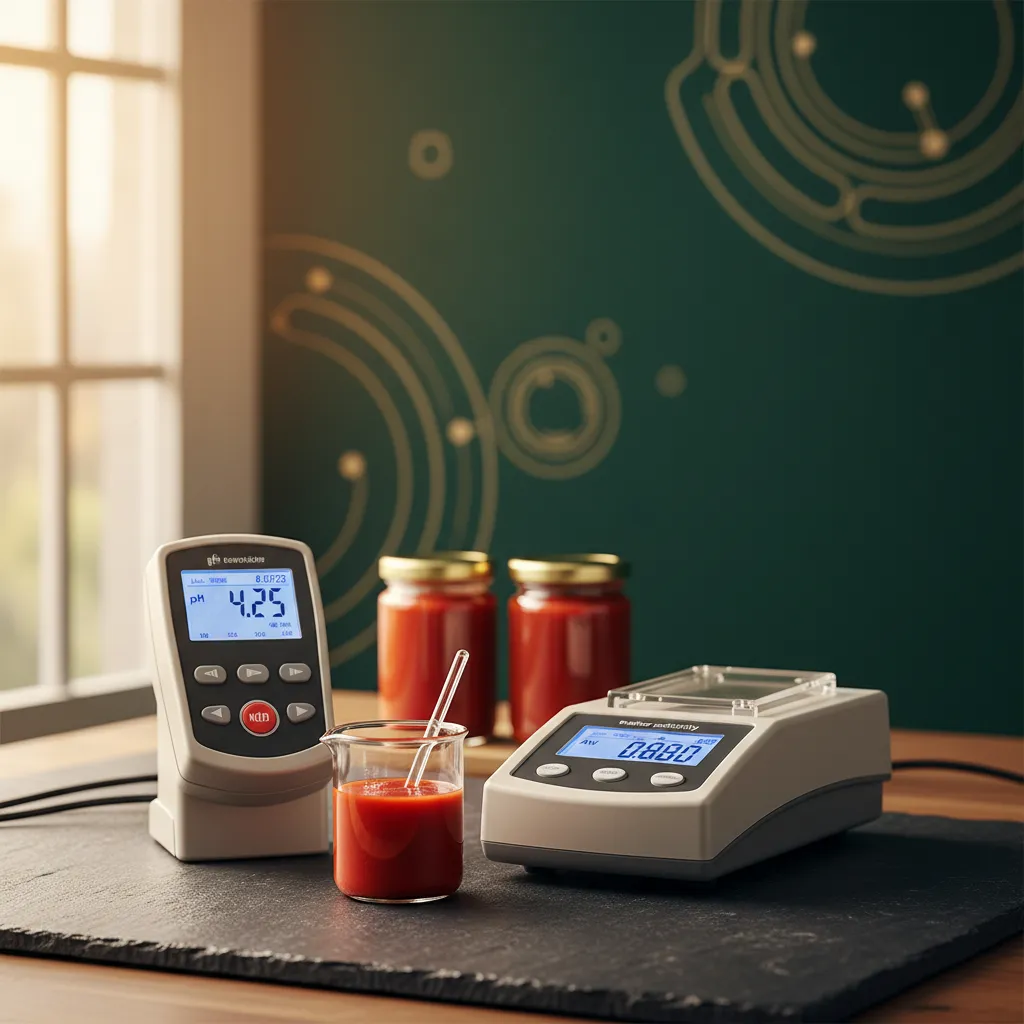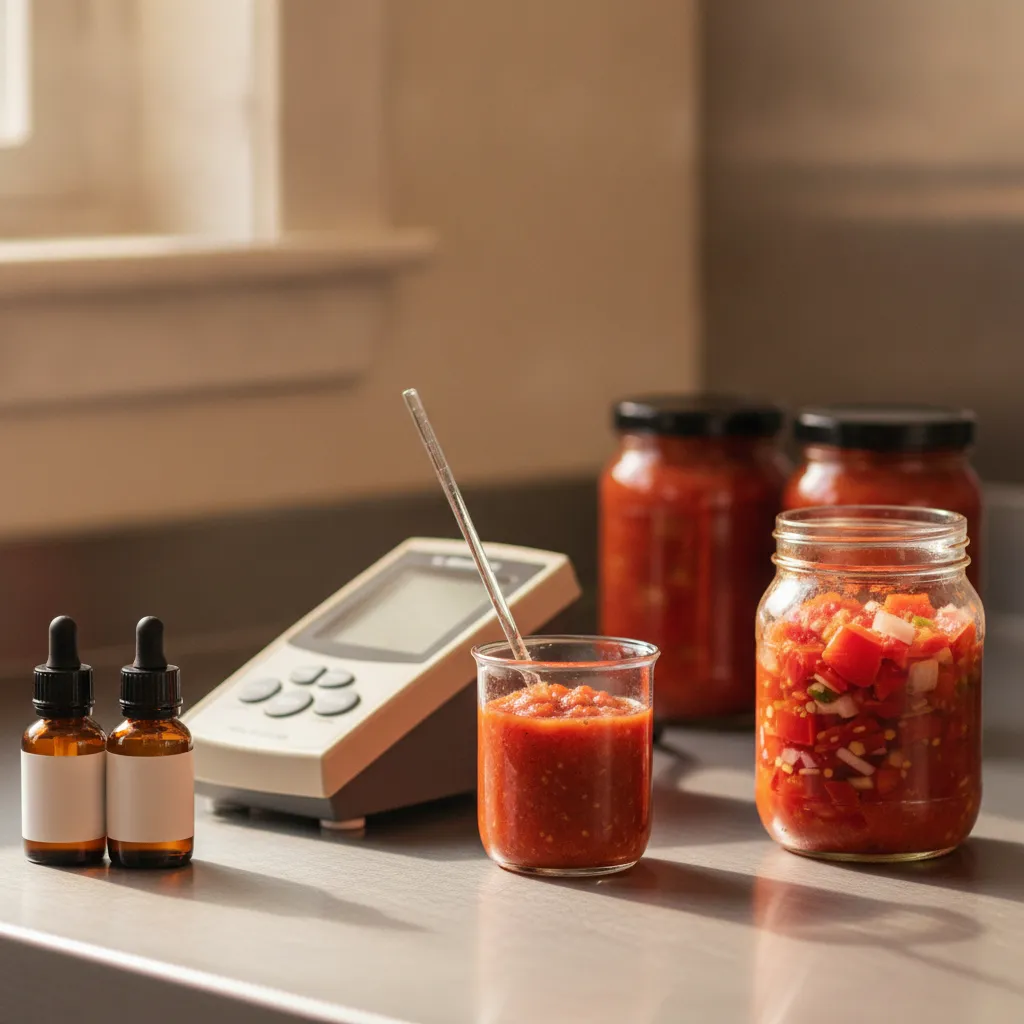
Say your salsa reads 4.1 on the line the day it is made. Two weeks later you blend a retained jar, bring it to room temperature, and it reads 4.3. Maybe nobody made a mistake. The meter may be fine, the plant may have followed the process to the letter, and the jar simply finished doing what it was always going to do.
I call that movement pH migration. Others call it drift. It is the reason the number on your spec sheet sits lower than the number in the rules, and the reason a product that passed on production day can be uncomfortably close to the line by the time it reaches a shelf. This article is about that moving number: why it moves, how to watch it, and what to do when your product lives too near the edge.
For the groundwork, I covered what pH and water activity each control in water activity vs pH and shelf stability, and the scheduled process and the letter itself in my primer on process authority letters for acidified foods.
The Number in the Rules and the Number on Your Spec
For acidified foods in the United States, the line is a pH of 4.6, under 21 CFR Part 114. The wording of the regulation is worth reading slowly. It defines acidified foods as having a finished equilibrium pH of 4.6 or below, and it requires that this pH be achieved within the time designated in the scheduled process and maintained in all finished foods. Two words in there carry this whole article. Equilibrium means the pH the product settles at once everything in the jar has evened out. Maintained means it has to stay there.
In my experience, most process authorities (the qualified experts who review your formula and process and set your scheduled process) and most co-packers want a finished pH of 4.0 to 4.3 at the max, to cover pH migration. That is not a number from the regulation. It is a working cushion. A product that reads 4.5 on the line has no room left for any of the causes below, and the plant running your product answers, alongside you, for every jar it fills. When a co-packer asks you for more margin, they are protecting their line and your brand at the same time.
One caveat: not every sauce is an acidified food. The definition in Part 114 excludes certain acid foods, including some dressings and condiment sauces that contain only small amounts of low-acid ingredients and whose finished pH is not significantly different from that of their main acid ingredient. Which category yours belongs to is a call for your process authority. Drift still matters outside that category, because a pH that moves takes flavor, texture, and spoilage resistance along with it.
Why the Reading Moves After the Run
There is rarely a single cause. Four live in the product itself, and a fifth lives in the way it was measured.
The pieces are still catching up
When you acidify a sauce with pieces in it (diced onion, peppers, tomato, beans, corn, roasted vegetables), the liquid around those pieces is acidified right away. The centers of the pieces are not. Over the following hours and days, acid moves into each piece and the piece's own low-acid juices move out. The liquid's pH creeps up, the pieces' pH comes down, and eventually they meet. That meeting point is the equilibrium pH, and it is the number that counts.
So if the line reading was taken on the liquid alone, or on a jar filled ten minutes earlier, you measured the most acidic part of the product at its most acidic moment. Bigger pieces, denser pieces, pieces with skins, and pieces added late in the cook all take longer to catch up. A salsa built with staggered additions for texture, the approach I described in kettle-cooked salsa manufacturing, is exactly the kind of product where this matters, because the last chunks into the kettle have spent the least time in the acid.
The regulation itself recognizes this. The methodology section of Part 114 describes foods made of liquid and solid parts that differ in acidity, and it lays out measuring the liquid, the solids, and a blend of the two, each brought to a standard temperature.
Ingredients that push back
Some ingredients resist a change in pH. The trade word is buffering: you add acid, the reading moves less than you expected, and those ingredients can keep nudging the pH back up as the product sits. Protein-rich ingredients, beans, nut and seed bases, dairy or dairy-style ingredients, and concentrated vegetable purees tend to be strongly buffered. A dip or a creamy dressing built on any of them often needs more acid than a thin vinegar sauce to reach the same reading, and it can take longer to settle.
Buffering is also why a substitution that looks harmless can move your finished pH: a tomato paste at a different concentration, a different bean, a new supplier for a nut base. Produce changes with the season, too. The acid strength of your vinegar and the pH of a concentrate are usually on the supplier's paperwork, which is one more reason to read each certificate of analysis against your spec instead of just filing it.
Acid that leaves during the cook
Acetic acid, the acid in vinegar, is volatile, which means some of it leaves with the steam. In a long, open kettle cook, the point where the vinegar goes in can change how much acid is left in the finished product. This drift happens before the fill rather than after it, but it shows up the same way: the line reading sits higher than the bench version did. It belongs written into the process notes, not left to whoever is running the kettle that day.
Something alive in the jar
A properly processed shelf-stable product should not have active microbes in it. When it does, the pH moves on its own. Some microbes produce acid and push the pH down, often with gas, haze, or an off smell along with it. Molds and some yeasts can consume acid and push the pH up, which is the more dangerous direction. Either way, a pH that keeps moving in storage, or moves again after it has settled, is not a formula tweak. It is a signal that goes to the plant's food safety team and your process authority straight away.
If your formula includes a fermented ingredient, such as a fermented chile mash, ask your process authority how its acidity is accounted for, because a fermented ingredient's own acidity can vary from lot to lot.
And sometimes, the measurement
Before you blame the product, check how it was measured. pH readings change with temperature, so a hot sample off the filler and a cooled sample the next morning are not comparable unless the method accounts for it. Meters drift and need calibrating against standard buffer solutions. Oil coats the electrode, which matters for dressings, chili oils, and anything with a fat layer. Strips are not the tool here: for a finished equilibrium pH above 4.0, Part 114 calls for a potentiometric method, which in plain words means a pH meter. And a liquid-only reading and a blended whole-jar reading are two different numbers, so write down which one your spec means.
Day One, Week One, Week Two: A Simple Drift Log
I already taste every new product at these three points, since a sauce needs about two weeks to settle and I judge the settled version. pH belongs in that same routine, and the same jars serve both purposes.
Here is the framework:
- Pull retained jars from across the run. Start, middle, and end, not three jars from the same minute. Label each with the lot code and the time it was pulled.
- Use one method every time. Blend the whole jar to a uniform paste, bring it to the same temperature, calibrate the meter that day, and take more than one reading. If your product has large pieces, also measure the liquid and the blended solids separately at each time point, so you can see how far apart they start and how fast they close the gap.
- Measure at day one, week one, and week two. Taste and look at the same jars at the same time points.
- Record the numbers, not a pass or fail. A column of checkmarks hides the one thing you are looking for, which is the direction of travel.
Then read the shape of the line:
- Flat from day one. Typical of a smooth, well-blended sauce with little to equilibrate. Good.
- Rises, then levels off. That is usually equilibration, and in a chunky product it shows most clearly in the liquid reading as it climbs toward the blended one. The level-off point is your real number, and it is the one to compare against the ceiling your process authority set. In a chunky product the climb can continue past week two, which is one reason your process authority may ask for readings at a time point of their choosing.
- Keeps rising in the blended whole-jar reading, or moves again after it leveled off. Do not wait to see where it stops. As above, that goes to the plant's food safety team and your process authority. If instead each new lot levels off a little higher than the last, look for a buffered ingredient that changed, and talk to the plant.
- Falls in storage. Do not read this as "even safer." A falling pH in a jar that should be stable can mean something is growing. Plant and food safety team, same day.
Run the log on the first production runs of a SKU, after any ingredient or supplier change, after any process change, and from time to time as a check. It does not replace the plant's own pH checks during production, which are part of their scheduled process and their records. The plant runs QC. Your log tells you what the product does after it leaves the line, and it pairs naturally with asking the plant for a sample from every batch so you can test it yourself.
When Your Product Sits Too Close to the Line
You know you are too close when the line reading already sits near the top of your range, when the week-two reading touches or crosses your ceiling, when your process authority asks for changes, or when your co-packer hesitates to schedule you. All of them are a reason to fix the formula on the bench, not on the plant floor.
The first rule: nobody improvises an extra bucket of vinegar into a production batch. Changing the acid level in your formula is a formula change, and a formula change can mean a new process authority review. A batch that is already out of range is handled by the plant's food safety team under its scheduled process, with the process authority where the rules call for it, not by the brand on the phone.
On the bench, these are the levers I work with. Usually the answer is a combination.
- More acid, with the flavor rebuilt around it. Acid alone usually makes a sauce taste sharper and thinner. Sweetness, salt, fat, and aromatics have to move with it, or you trade a pH problem for a flavor problem. Reformulate; do not just add more.
- A different acid, or a different blend of acids. Different acids taste different at the same pH. Some read bright, some read soft, some read like pickles. Acidic ingredients such as citrus juice or tomato bring acid too, but their acidity varies from lot to lot, so they are harder to lean on for the safety margin.
- Where the acid goes in. Adding a volatile acid at a different point in the cook can leave more of it in the jar.
- The pieces. Smaller cuts equilibrate faster. Part 114 also lists blanching ingredients in acidified solutions as one way to acidify. Whether either fits your product, and how, is a conversation for your process authority, because both change the texture and the process.
- The buffering load. Sometimes the honest fix is to reduce or replace the ingredient that is pushing back, or to tighten its ingredient spec so its concentration and acidity stop wandering.
- The texture side effects. A lower pH changes how starches and gums behave, and a long hot hold in acid can break some starches down, as I described in why your kettle batch doesn't match your stovetop. A thickener picked for the old acidity may not behave the same way at the new one, so a pH change can mean revisiting it as well.
Then rewrite the spec so the next person reads the same number you do. A useful pH line has a target, an acceptable range, a ceiling that triggers a hold, the method (blended or liquid, at what temperature, with what instrument), and when it is measured: on the line, and again on the retained jar at week two. The ceiling should be one your process authority agrees with. Take the revised formula and your drift data back to your process authority, run it on the bench, then at pilot scale, and only call it done when the week-two numbers and the week-two tasting both hold.
The Calibration Belongs to Your Formula
Equilibrium, buffering, volatile acid, clean measurement, a cushion below 4.6: that framework is shared knowledge in this industry. What is not generic is the calibration. How much acid your flavor can carry before it tastes like a different product, which acid suits it, where in the cook it belongs, how fine the pieces can go before the texture is lost, and which ingredient is quietly pushing the pH back up. That gets worked out on your formula, with your process authority and your co-packer at the table, and it is the part I do inside client projects rather than on a blog.
Sources: eCFR, 21 CFR Part 114, Acidified Foods · eCFR, 21 CFR 114.3, Definitions · eCFR, 21 CFR 114.80, Processes and controls · eCFR, 21 CFR 114.90, Methodology · FDA, Acidified and Low-Acid Canned Foods Guidance Documents and Regulatory Information
Need Help With Your Formulation?
Whether you're scaling your first recipe or reformulating an existing product, let's talk about how to get it right.
Book a Free Discovery Call