The Ingredient You Pick Last That Decides Your Shelf Life First
Most founders choose their oil almost as an afterthought. The flavor system gets months of attention, the pepper blend gets obsessed over, and then near the end someone asks "what oil are we using?" and the answer is "whatever the kitchen recipe called for." That oil is often one of the largest ingredients by weight in a dressing, an emulsion, or a chili crisp, and it becomes the biggest driver of whether the product tastes bright at month one or like wet cardboard at month eight.
Rancidity is the most common silent shelf-life failure I see in oil-forward products. It does not make anyone sick, so it never shows up in a food-safety review. It just slowly ruins the flavor you worked hard to build, and by the time a customer notices, the jar is already on their counter with your name on it. And the oil is doing real work while it lasts: carrying fat-soluble flavor compounds to the palate, building mouthfeel, and, in an emulsion, forming half the structure. You can nail flavor, pH, and viscosity and still lose the product to an oil that turns early. Choosing the right one means balancing four things at once: what it contributes to flavor, how it survives your process, how it holds up over shelf life, and what it costs per pound.
Start With What the Oil Contributes to Flavor
My bias, and Molly Mills Creative's bias generally, is to solve problems with real, recognizable food first. So the first question is not "what is cheapest" or "what is most shelf stable." It is "what does this oil bring to the flavor, and does it earn its place?" Oils fall into two camps: character oils that add flavor, and neutral oils that stay out of the way so other ingredients lead.
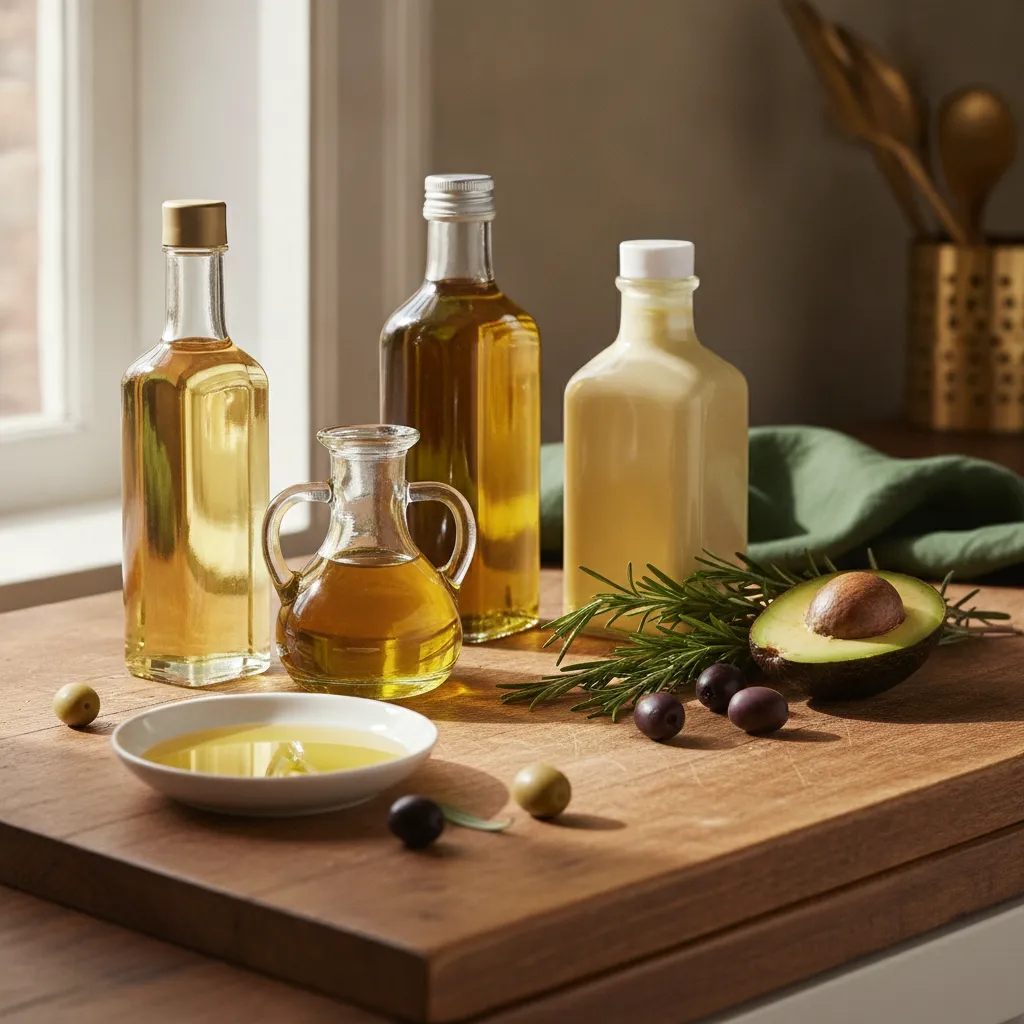
Extra virgin olive oil
Peppery, grassy, sometimes bitter, unmistakably itself. Wonderful in a Mediterranean dressing or as a finishing oil where you want the olive character up front. The trade-offs are real: it is expensive, its flavor varies by harvest, and the polyphenols that make it taste alive also make unrefined olive oil sensitive to heat and light. Refined or "pure" olive oil trades some character for a higher smoke point and more consistency, often the right call for a cooked product.
Avocado oil
Buttery, mild, faintly green when unrefined and nearly neutral when refined. It reads clean and premium, and refined avocado oil is one of the more heat-tolerant real oils available, a favorite when you need both a good label story and a high smoke point. The catch is cost and the well-documented adulteration problem in the avocado oil supply, so supplier verification matters more here than anywhere.
High-oleic sunflower and safflower oil
Clean, light, and nearly neutral, these are workhorses when you want the other ingredients to lead. The important word is high-oleic, for reasons the next section covers; on flavor, they give you a stable, unobtrusive base with no assertive taste of their own.
Toasted and infused oils
Toasted sesame oil, chili-infused oil, garlic oil, and the fried-aromatic oils at the heart of a chili crisp are flavor ingredients first. They are also frequently the most oxidation-prone parts of the recipe, because the toasting and frying that build the flavor also expose the oil to hard heat. When a chili crisp goes off, it is usually the aromatic oil that turns first.
Canola and other neutral commodity oils
Canola, expeller-pressed or refined, is genuinely neutral, inexpensive, and functional: a reasonable base when the recipe does not need the oil to contribute flavor and the budget is tight. The honest caveats are its label optics in the natural channel and a fatty-acid profile that carries a meaningful fraction of the more fragile polyunsaturated fats, which the next section explains.
The Fatty-Acid Profile Is What Governs Rancidity
Here is the chemistry behind most oil shelf-life outcomes. Rancidity is mostly oxidative: oxygen attacks the fat molecules and breaks them into the small compounds we perceive as cardboard, paint, crayon, or fish. It attacks fats at their double bonds, and different fatty acids carry very different numbers of them.
Monounsaturated-dominant oils are more stable
Oleic acid is a monounsaturated fat with a single double bond, so it gives oxygen fewer places to attack, and oils high in oleic acid resist oxidation meaningfully better. This is why "high-oleic" versions of sunflower, safflower, soybean, and canola exist: plant breeding pushed the oleic content up and the fragile polyunsaturated content down to buy shelf life. In accelerated testing, high-oleic oils commonly show substantially longer induction periods than their conventional counterparts, a longer window before off flavors appear.
Polyunsaturated-heavy oils oxidize faster
Linoleic acid has two double bonds and alpha-linolenic acid has three. Every added double bond is another vulnerable site, and the oxidation rate climbs steeply, not linearly. Conventional (not high-oleic) sunflower and safflower are linoleic-heavy. Soybean and conventional canola carry a notable fraction of alpha-linolenic acid, the most oxidation-prone of the common fatty acids and the reason some soybean-oil products develop a painty or fishy note. The takeaway: when two oils are otherwise interchangeable for your flavor and process, the more oleic one almost always gives a longer, more forgiving shelf life.
Smoke Point and Process Fit
The oil also has to survive your process. Smoke point, the temperature at which an oil begins to break down and generate acrid compounds, matters most when the oil is heated hard: a chili crisp that fries aromatics, or any product where the oil sees real heat, needs a smoke point that comfortably clears the process temperature, with margin.
Refined oils have higher smoke points than their unrefined versions, because refining removes the free fatty acids and particulates that scorch first. Refined avocado, refined high-oleic oils, and refined olive oil sit at the higher end and handle a hot process well; extra virgin olive oil and unrefined specialty oils sit lower and are better reserved for cold applications or added after the hot step as a finishing oil. For a cold-process dressing or emulsion, smoke point is largely irrelevant. Match the oil to the actual thermal profile of the cook, and confirm that profile with your co-packer, since their kettle or fry step may run hotter than your kitchen version did.
Controlling Oxidation the Real-Food Way First
Once you know rancidity is the risk, the instinct is to reach for an additive that stops it. Before you do, spend your effort on the levers that need no additive at all, because they are more effective than most founders expect.
First, pick an inherently stable oil. A high-oleic base is oxidation control you buy once, at the ingredient level, and never have to dose or declare. Second, control the pro-oxidants: oxygen, light, heat, and trace metals (copper and iron especially). That means minimizing headspace oxygen, considering a nitrogen flush at fill, using darker or UV-protective glass where the brand allows it, and keeping product out of warm sunny warehouse corners. A well-packaged product in the right glass can outlast a poorly packaged one by months with no additive at all.
Natural antioxidants from real sources
When the base oil and packaging still are not enough, the first additives I reach for come from recognizable foods and read cleanly on a label.
- Rosemary extract. From rosemary, carrying the antioxidant compounds carnosic and rosmarinic acid. It is one of the most effective natural oil stabilizers available, and in head-to-head testing it frequently matches or outperforms the common synthetic antioxidants. Use levels are low, often around a tenth of a percent, and a deodorized version exists for when you do not want any herbal note. It labels simply as "rosemary extract," which most natural-channel buyers accept comfortably.
- Mixed tocopherols. Natural vitamin E, typically sourced from vegetable oils. Mixed tocopherols outperform a single alpha-tocopherol, and they pair well with rosemary extract, the two often working better together than either alone.
- Ascorbyl palmitate and green tea extract. Fat-compatible vitamin C and polyphenol-rich green tea extract, sometimes used as synergists that reinforce the primary antioxidants. Recognizable, food-derived, and clean-label friendly.
The honest note on all of these: they slow oxidation, they do not stop it, and they cannot rescue a fragile oil in bad packaging. Verify any antioxidant's permitted use for your specific category and market with your co-packer or a regulatory resource, since additive rules vary.
The synthetic options, honestly
The synthetic antioxidants exist and they work: BHA, BHT, TBHQ, and propyl gallate are potent, cheap, and effective at tiny doses. But they are not my default, and for a premium or clean-label brand they are usually the wrong call. They read as exactly what they are on an ingredient panel, most natural-channel retailers restrict or reject them, and the natural options above generally perform as well or better. Treat synthetics as a last resort for a problem the real-food toolkit genuinely could not solve, not the easy first answer.
Cost Per Pound and the COGS Reality
Oil is often a top-three ingredient by weight, so its cost per pound lands directly on your margin. The rough hierarchy, which moves with commodity markets and should be re-quoted rather than assumed: commodity canola and soybean oil at the low end, high-oleic sunflower and safflower in the middle, and olive and avocado oil at the premium end, sometimes several times the price.
The trap is optimizing cost in isolation. The cheapest oil that oxidizes before its shelf life is up is not cheap: rancid inventory, slow reorders, and customers who quietly do not come back cost far more than the few cents you saved. When I help a founder work on COGS, the oil line gets judged on total delivered value, price per pound weighed against oxidative stability, flavor, and label. Often the right move is a high-oleic version of a cheaper oil, which buys most of the stability of a premium oil at a fraction of the price. Make that swap carefully, so flavor does not shift, before you lock the recipe.
Label Optics and Channel Fit
The oil also talks to your customer directly from the ingredient panel. "Olive oil" and "avocado oil" read premium and clean and support a natural-channel story. "High-oleic sunflower oil" and "high-oleic safflower oil" read clean and modern and rarely draw objection. "Canola oil" and "soybean oil" are perfectly functional and legal but carry more baggage with the clean-label crowd. The one category I steer founders away from is partially hydrogenated oil, which introduces trans fats and is both a regulatory and a reputational problem.
Let label optics inform the decision, not dominate it. A gorgeous "avocado oil" callout does nothing if the product tastes flat by month four. Pick the oil that serves flavor, process, and shelf life, then let the label story follow from an honest, real ingredient.
Related Reading
For the broader picture on how oil fits into a stable condiment system, see condiment formulation for flavor and shelf stability, how to run shelf-life testing on a food product, and cutting COGS without changing flavor.
Frequently Asked Questions
How do I know if my oil has gone rancid, other than tasting it?
Sensory is the fastest first check: rancid oil reads as cardboard, paint, crayon, putty, or fish. To put numbers on it, labs measure peroxide value (primary oxidation) and p-anisidine value (secondary oxidation), and accelerated tests like the oil stability index estimate how long an oil lasts before it turns. Pair a sensory panel with periodic lab pulls across your shelf-life study, and confirm the right test panel with your lab.
Is olive oil too fragile for a shelf-stable product?
Not inherently. Olive oil is oleic-rich and reasonably stable when handled right: protected from light and heat, packaged with attention to oxygen, and not subjected to a hot process it is not suited for. Where founders get burned is using unrefined extra virgin in a high-heat step or in clear glass on a bright shelf. If you want olive flavor in a cooked product, use refined or pure olive oil for the cook and a touch of extra virgin as a finishing note.
Can I just add rosemary extract and stop worrying about rancidity?
No. Rosemary extract is excellent, but it slows oxidation rather than stopping it, and it works best as one part of a system that also includes a stable base oil, good packaging, and sane storage. It extends a well-built product; it does not rescue a fragile oil in the wrong package.
Should I switch from conventional sunflower to high-oleic sunflower?
For most shelf-stable products, yes, if the price and supply work. High-oleic sunflower has a similar neutral flavor but a much more oxidation-resistant fatty-acid profile, usually meaning a longer, more forgiving shelf life for a modest cost difference. Run a side-by-side to confirm flavor does not shift, then keep the more stable option.
Where the Oil Decision Becomes Real Work
Choosing an oil looks like a single line on a recipe, but it is really a negotiation between flavor, process, shelf life, cost, and label, and the right answer changes with the product in front of you. A cold vinaigrette, a high-heat chili crisp, and a delicate emulsion each want a different oil and a different oxidation-control plan. Getting that right the first time, with real ingredients doing as much of the work as possible and additives kept to what the food genuinely needs, is exactly the kind of problem I solve with founders inside an engagement. Book a Free Discovery Call if you want a hand picking the oil and building the system that keeps your product tasting the way you intended all the way to the last jar.
Need Help With Your Formulation?
Whether you're scaling your first recipe or reformulating an existing product, let's talk about how to get it right.
Book a Free Discovery Call