Why Multiplying Your Recipe Doesn't Work at Scale
Every food entrepreneur hits the same wall. Your hot sauce is incredible in a 2-quart batch. Customers at the farmers market can't get enough. So you think: I'll just multiply everything by 250 and make it in a 500-gallon kettle.
It doesn't work that way. I've scaled over 300 recipes from kitchen to commercial production, and I can tell you that linear scaling fails almost every time. The physics of cooking change when you increase volume. Heat transfer behaves differently. Water evaporation rates shift. Ingredient interactions that were negligible in a small pot become dominant forces in a steam-jacketed kettle.
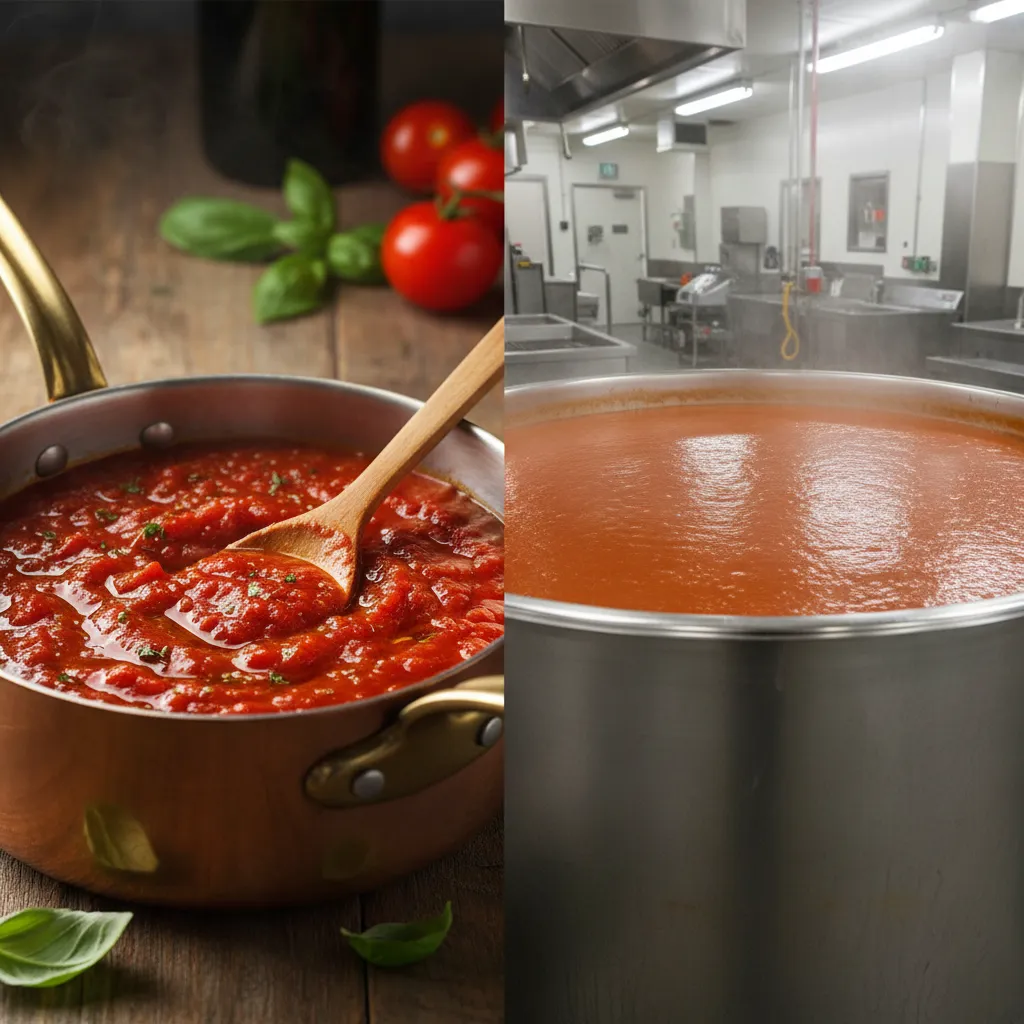
Here's a simple example: in your kitchen, you reduce a tomato-based sauce by simmering uncovered for 20 minutes. At that scale, the surface-area-to-volume ratio allows rapid evaporation. In a 200-gallon kettle, that same sauce has a dramatically different ratio. You might need 90 minutes to hit the same concentration — and in that extra time, you've changed the Maillard reactions, the caramelization profile, and potentially the pH stability of your product.
Scaling a recipe for commercial manufacturing is a translation exercise, not a math problem. You're translating the sensory outcome your customers love into a different physical system. That requires understanding both what makes your recipe work and how industrial equipment behaves.
The Critical Variables That Change at Scale
Heat Transfer and Cook Times
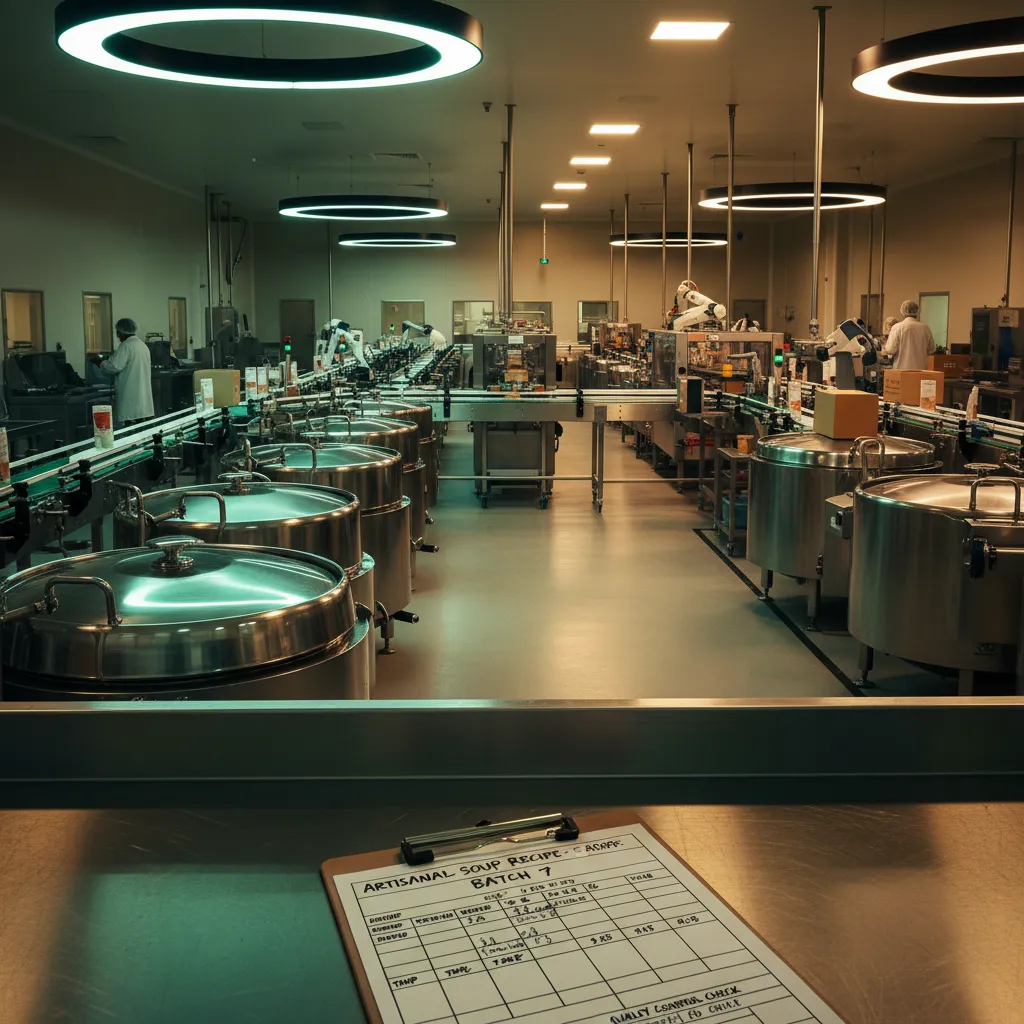
In your kitchen, a burner delivers heat through the bottom of a pot. In commercial production, you're typically working with steam-jacketed kettles that heat through the walls. The heat distribution is more even, but the total thermal mass is enormous. Getting 300 gallons of sauce from 70F to 190F takes real time, and every minute at elevated temperature affects your product.
I always calculate the thermal load for a recipe before the first production trial. How many BTUs does this kettle deliver? What's the specific heat of this particular formulation? How long will the ramp-up take? These calculations prevent the most expensive mistake in scale-up: guessing cook times and ruining a $4,000 batch of ingredients.
Evaporation and Concentration
Your kitchen recipe probably doesn't account for evaporation losses because they're small and consistent. At commercial scale, evaporation can change your final product's Brix, viscosity, and flavor intensity by significant margins. Open kettles lose more water than closed systems. Longer cook times mean more evaporation. And if your co-packer's kettle has a different geometry than the one you tested on, all your evaporation assumptions change.
I build an evaporation factor into every scaled formula — typically 3-8% for kettle-cooked sauces, depending on cook time and whether the vessel is open or closed. This isn't a guess; it's measured during pilot runs.
Ingredient Behavior at Volume
Spices don't scale linearly. A tablespoon of cayenne in a quart of sauce delivers a certain heat level. But capsaicin extraction is time-and-temperature dependent, and when your cook time triples at scale, you're extracting more heat from the same proportional amount of pepper. Most scaled hot sauce recipes need 15-30% less cayenne than linear math would suggest.
The same principle applies to aromatics like garlic and onion, acidulants like vinegar, and thickeners like xanthan gum. Each ingredient has its own scaling curve, and part of my job as a recipe developer is knowing those curves so we can get them right on the first production run, not the fourth.
pH and Food Safety
This is the one that keeps food safety auditors up at night. Your kitchen recipe might sit at pH 3.8 consistently. But at scale, variations in ingredient lots, water chemistry, and cooking conditions can push your pH around. If your product is an acidified food (pH below 4.6 with added acid), you need to demonstrate that your process consistently achieves the target pH with every batch.
I always build a pH safety margin into scaled recipes. If the FDA threshold for your product category is 4.6, I want to see your production batches consistently hitting 4.2 or below. That margin accounts for ingredient variability, measurement uncertainty, and the inevitable slight differences between batches. This is where making your recipe truly production-ready becomes a food safety conversation, not just a quality one.
The Step-by-Step Process for Scaling a Recipe
Step 1: Document Your Kitchen Recipe Precisely
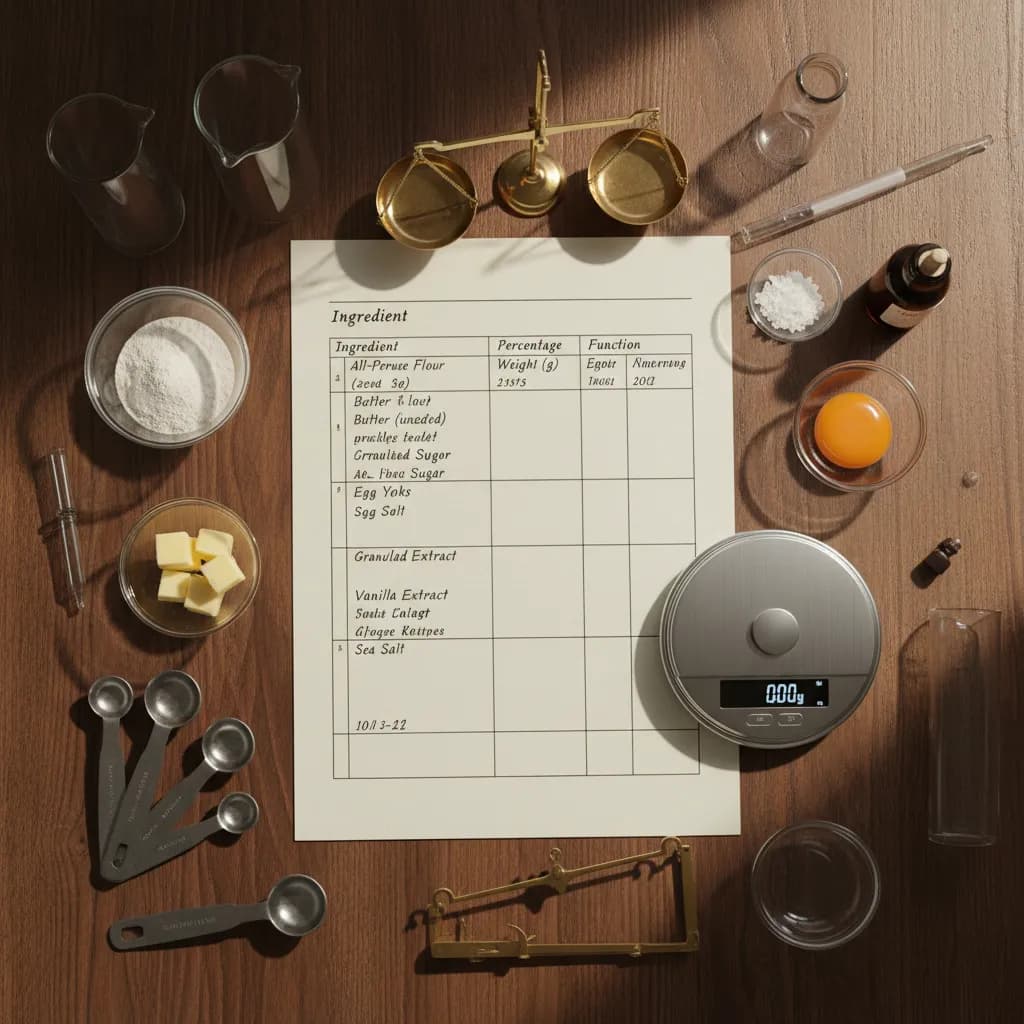
Before scaling anything, I need your recipe in weight-based measurements (grams or pounds), not volume. "Two cups of diced onion" is meaningless in manufacturing — how much does that weigh? And how finely is it diced? This documentation phase also captures things you do intuitively: how dark do you cook the onions? When exactly do you add the vinegar? What does "simmer" mean in terms of temperature?
Step 2: Identify the Critical Quality Attributes
What makes your product your product? Is it the smoky depth that comes from charring the peppers first? The creamy mouthfeel from a specific emulsion technique? The bright acidity that cuts through at the end? I identify these critical quality attributes (CQAs) before scaling because they're what we're trying to preserve. Everything else can flex.
Step 3: Convert to Percentages
Every ingredient becomes a percentage of the total batch weight. This is your master formula, and it's equipment-agnostic. Whether you're making 50 gallons or 500 gallons, the percentages stay the same (with adjustments for the scaling factors I mentioned above). This is also the format that co-packers expect to receive when you bring them a recipe.
Step 4: Run Pilot Batches
Never go straight from kitchen to full production. Pilot batches at 10-50 gallons reveal most scaling issues without the financial risk of a full production run. I typically run 2-3 pilot batches, adjusting the formula between each one based on sensory evaluation and lab testing.
Step 5: Validate with Lab Testing
Every pilot batch gets tested for pH, water activity (aw), Brix (soluble solids), viscosity, and any other parameters relevant to your product's safety and quality. These numbers become your production specification — the targets your co-packer will aim for on every batch.
Step 6: Write the Manufacturing Procedure
The final deliverable isn't just a formula; it's a complete manufacturing procedure that specifies ingredient addition order, temperatures at each stage, mixing speeds, hold times, and quality checkpoints. This document is what ensures batch-to-batch consistency, regardless of who's running the kettle that day.
Common Pitfalls and How to Avoid Them
Pitfall #1: Skipping the pilot batch. I've seen founders spend $15,000 on a full production run of a recipe that was never pilot-tested. The sauce was too thin, the flavor was off, and 2,000 jars went to discount liquidation. A $500 pilot batch would have caught every issue.
Pitfall #2: Not accounting for ingredient variability. Your farmers market habaneros and the habaneros your co-packer sources from a commercial supplier are not the same product. Scoville units vary by variety, growing region, and season. Build your formula to handle that variability. More on this in my article on common mistakes when scaling sauce recipes.
Pitfall #3: Ignoring the water. Municipal water varies in mineral content, chlorine levels, and pH. If water is a significant component of your product (and in most sauces, it is), you need to know how your co-packer's water affects the formula. Some facilities use reverse osmosis water; others use tap. It matters.
Pitfall #4: Treating your recipe as sacred. Your kitchen recipe is the inspiration, not the blueprint. The goal at scale is to replicate the eating experience — the flavor, texture, aroma, and mouthfeel your customers love. The ingredient list and process may need to change to achieve that same experience in a different production environment.
When to Bring in a Recipe Developer
Some founders successfully scale their own recipes, particularly if they have a food science background and access to pilot equipment. But for most food entrepreneurs, the cost of trial-and-error at scale far exceeds the cost of professional recipe development.
A skilled recipe developer brings three things you probably don't have: knowledge of how ingredients behave at scale, relationships with co-packers and ingredient suppliers, and the lab equipment to validate formulations before committing to production. I've seen founders burn through $30,000-$50,000 in failed production runs trying to figure out scaling on their own — money that would have more than covered professional development.
If you're serious about scaling, the investment in getting your recipe right before production isn't a luxury. It's the single highest-ROI decision you'll make in the first year of your food business.
Frequently Asked Questions
Can I just multiply my kitchen recipe ingredients to make larger batches?
No. Simple multiplication fails because the physics of cooking change at scale. Heat transfer rates, evaporation percentages, spice extraction levels, and ingredient interactions all behave differently in large vessels. A recipe that works perfectly at 2 quarts will almost certainly need reformulation at 200 gallons. The underlying percentages are your starting point, but every ingredient needs to be evaluated for its scaling behavior, and the process (temperatures, times, mixing speeds) typically requires significant adjustment.
How many pilot batches does it take to get a scaled recipe right?
For most sauce and condiment products, I budget 2-4 pilot batches to dial in the formula. Simple products with few ingredients (like a two-ingredient hot sauce) may only need one or two. Complex formulations with emulsions, multiple spice blends, or precise texture requirements can take more. Each pilot batch costs a fraction of a full production run, so this is always money well spent.
What's the difference between scaling a recipe and making it production-ready?
Scaling addresses the formula and process — getting your recipe to taste right at volume. Making a recipe production-ready goes further: it includes creating manufacturing specifications, establishing quality control checkpoints, ensuring regulatory compliance, defining shelf-life parameters, and writing documentation that any competent co-packer can follow. You can read more about this in my full guide on what makes a recipe production-ready.
How long does the recipe scaling process typically take?
From initial kitchen documentation to a validated, production-ready formula, the process typically takes 4-8 weeks. That timeline includes formula analysis, pilot batching, lab testing, and documentation. Rushing the process almost always costs more in the long run — failed production batches, products that don't meet shelf-life requirements, or recipes that a co-packer can't consistently reproduce.
Do I need to scale my recipe before approaching co-packers?
Ideally, yes. Bringing a co-packer a kitchen recipe and asking them to figure out scaling is risky. Most co-packers are operators, not product developers. They're excellent at running equipment and following procedures, but recipe development isn't their core competency. Arriving with a tested, scaled formula in percentage-based format with documented processing parameters will get you better results, faster production timelines, and often better pricing because you've reduced their risk. Learn more about how to work effectively with co-packers.
Need Help With Your Formulation?
Whether you're scaling your first recipe or reformulating an existing product, let's talk about how to get it right.
Book a Free Discovery Call