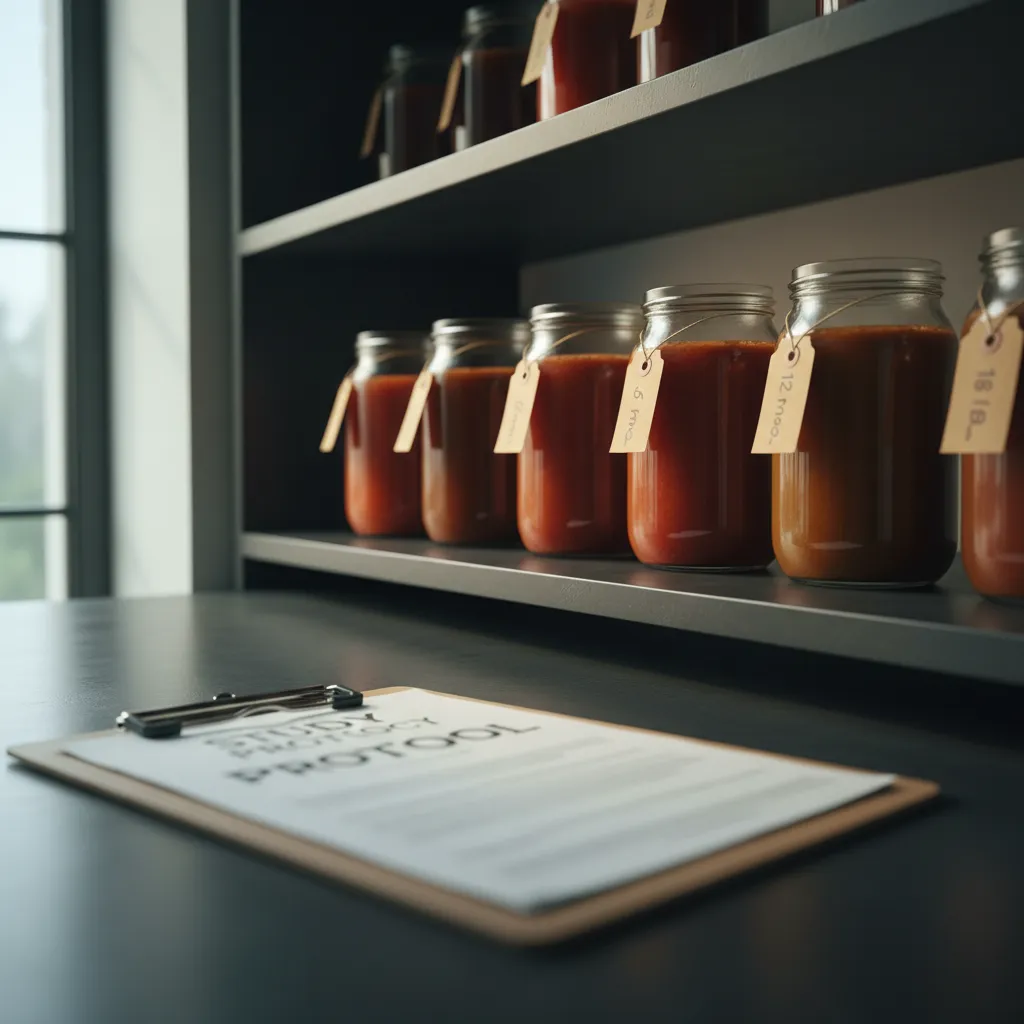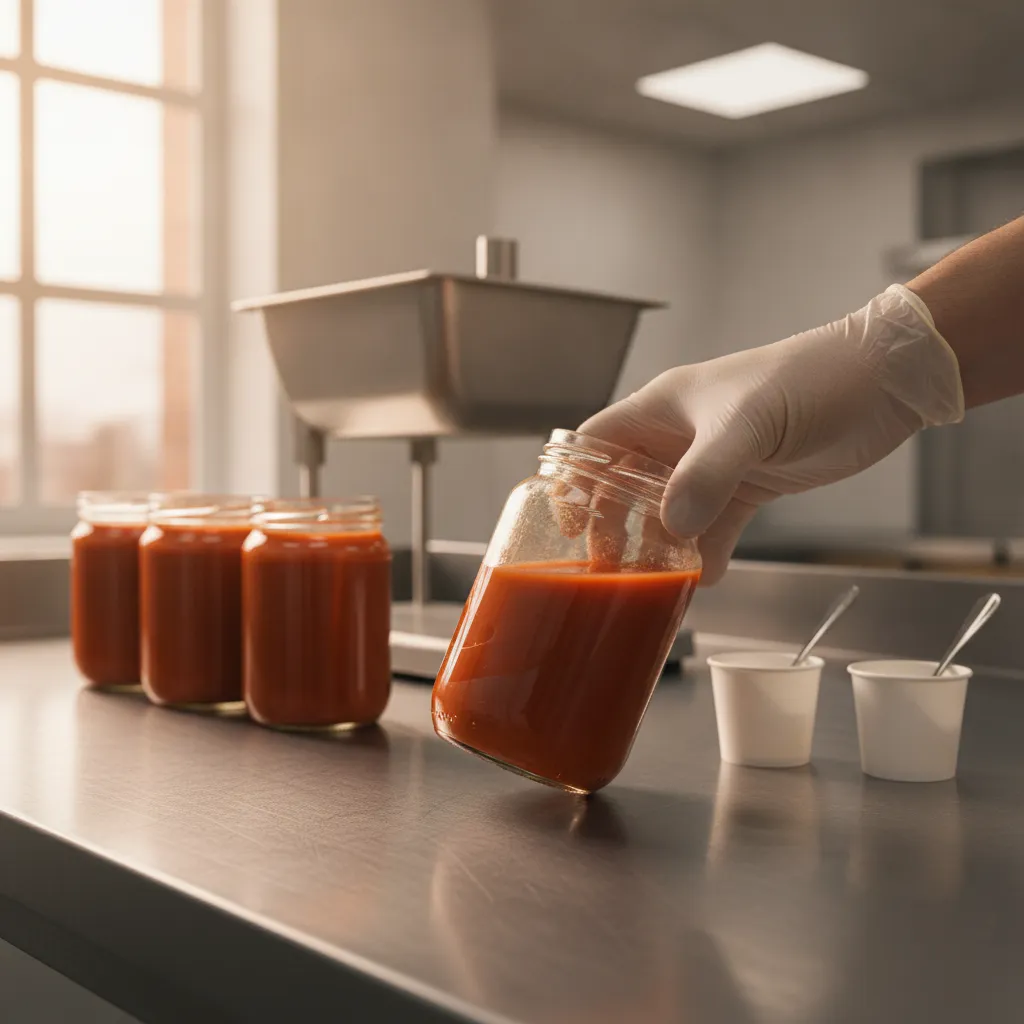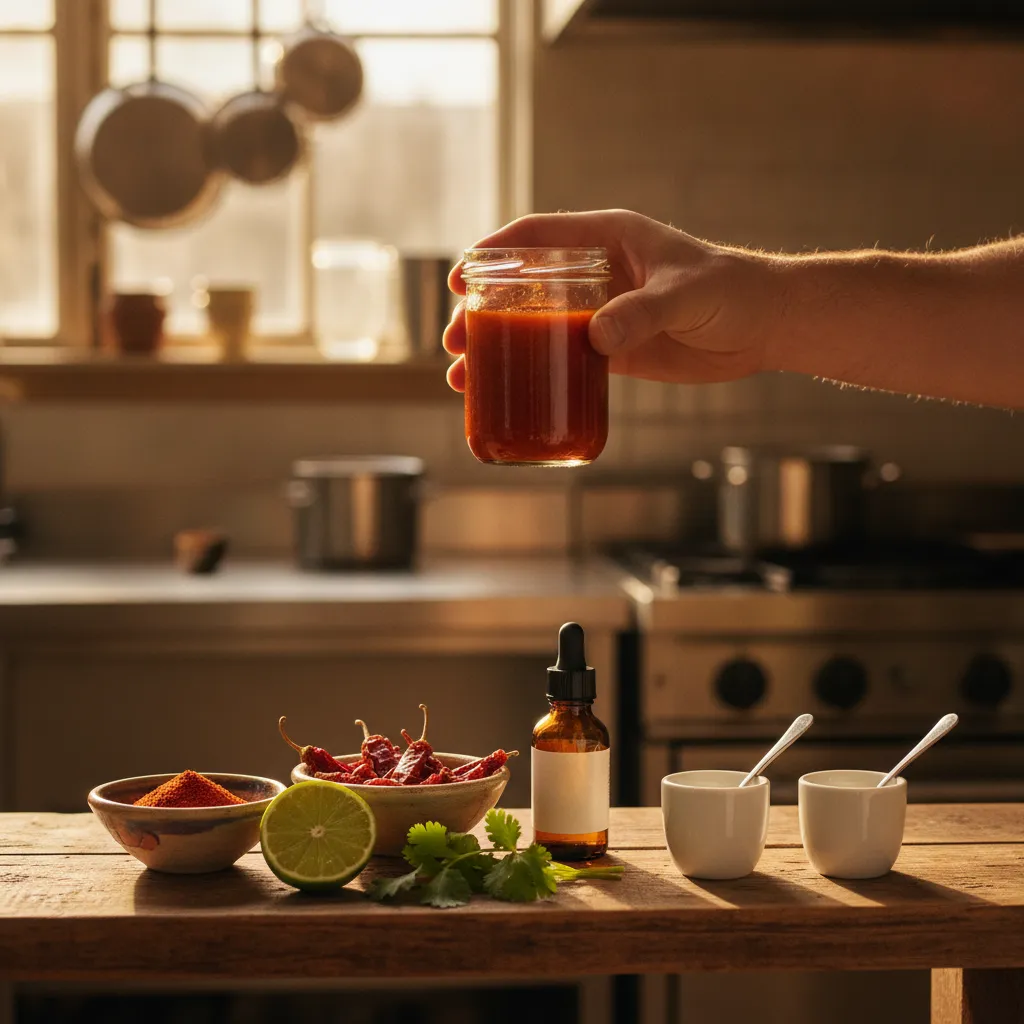
I do not judge a new batch on the day it is made. I taste it that day, again at one week, and again at two weeks, checking acidity, salt, texture, and color along with flavor, because a sauce settles over about two weeks. The raw edges soften, the spices knit together, and the week-two version is the honest one. That is the version I approve.
But week two is where a product starts its life, not where your customer meets it. Depending on how fast you sell through, the jar a customer opens may be four months old, or ten, or in the last weeks of its code date. If the product only tastes and looks right at week two, a good share of your customers are buying something other than what you approved.
Fade is rarely dramatic. Few customers call to say the sauce went bad. It gets a little flatter, a little duller, a little browner, and some of them quietly stop buying it. Here is what actually changes in the jar after week two, how to tell which change you are looking at, and how to design a formula for the last day of its code date instead of the first.
What You Taste Holds, What You Smell Fades
Start with the most useful single idea about fade: the parts of flavor you taste on your tongue are mostly stable, and the parts you smell are not. Salt does not fade. Sugar does not fade. The acid from your vinegar or citrus juice is still there at month twelve. Capsaicin, the compound that makes chiles hot, is fairly stable. What fades is aroma, the volatile compounds that rise into your nose and carry most of what you would call the flavor's character: the lime in a salsa verde, the toasted cumin, the fresh garlic, the smoke, the basil.
So a faded product does not simply get weaker. It drifts toward its skeleton. A citrus sauce reads sour but not lemony. A hot sauce reads as just hot. A dressing reads as vinegar and salt. A barbecue sauce reads as sweet. When a customer says a sauce "tastes different," this is often what they are tasting, and it is why the fix is rarely more salt or more acid. The bones are fine. The aroma that dressed them is gone.
Five Things Changing in the Jar
1. Top notes evaporate and break down
The brightest aromas are often the lightest and the most reactive. Some are lost in the kettle, which is why the timing of late additions matters. The rest keep changing in the jar. Citrus is the classic case: the compound behind lemon's signature aroma is unstable in acid and breaks down into notes that read stale or faintly medicinal, while orange and lime oils oxidize toward harsh, turpentine-like notes. Fresh herb aroma fades, and the raw bite of fresh garlic turns rounder and then duller. In plastic packaging, some aroma compounds, citrus oils especially, can be absorbed into the bottle wall or the cap liner, which the trade calls flavor scalping.
2. Ground spices lose their aroma
A ground spice is a small package of volatile oil, and the clock on that oil starts the day the spice is milled, not the day your batch is made. In the jar, some of that aroma moves into the oil phase of the sauce, some oxidizes, and some simply fades. A spice that was already tired when it went into the kettle has less to give from the start. Heat follows its own curve, and keeping heat levels consistent across a mild, medium, and hot range covers why perceived heat shifts even when the capsaicin is still there.
3. The oil oxidizes
If your product contains oil, oxidation eventually announces itself: cardboard, paint, crayon, or a fishy edge. It tends to creep along slowly and then speed up, which is how a product can taste fine at month three and clearly off at month six. Oxygen, light, warmth, and trace metals drive it, and toasted or fried aromatic oils, like the ones at the heart of a chili crisp, often turn first. When a stale note appears late in the code date, taste the oil on its own if you can separate it, because that is often where the stale note lives.
4. Browning makes it darker
Browning in a sealed, hot-filled jar is usually not the enzyme-driven browning of a cut apple, because the process heat has largely shut those enzymes down. It is chemical, and usually a mix: the slow Maillard reaction between sugars and amino acids (the building blocks of protein), the same reaction that browns toast, running at room temperature over months; the breakdown of vitamin C in fruit and tomato products; and, in acidic sweet sauces, sugars slowly breaking down in the acid. Which one leads depends on the product. All of them are strongly driven by temperature, so a case that spends the summer in a hot warehouse ages faster than one kept cool. Tomato, fruit, and sweet sauces darken, and the flavor usually goes with the color: cooked, dull, sometimes faintly bitter or prune-like. One point that surprises people: adding vitamin C as an antioxidant does not automatically protect color, because in some products the vitamin C itself contributes to browning as it breaks down.
5. Pigments fade and make it lighter
The opposite direction. The red-orange of paprika, chile, and annatto comes from carotenoids, which oxidize and bleach, faster under light. Herb greens shift toward olive in acid and heat and keep drifting. The reds and purples from beet, purple carrot, and similar sources lose strength with time and warmth. What matters here is the slope: how much of the color you started with is left by the end of the code date.
Light and Headspace Oxygen Speed Up Most of It
Two packaging factors push nearly every change above. Light drives pigment bleaching and oil oxidation, and green herbs make it worse, because chlorophyll acts as a photosensitizer: it captures light energy and hands it on in a form that speeds up oxidation of the oil around it. Headspace oxygen, the air trapped between the product and the lid, together with air whipped into the product during mixing and filling, is the fuel for oxidation. A good hot fill, a sensible fill height, and a closure that seals properly keep that fuel low, while a plastic bottle that lets oxygen through slowly keeps adding fuel for the whole shelf life. Glass shows off a beautiful product. It also shows the product to the light every hour the store is lit.
Reading an Aged Jar
When a month-six retain does not match, a few side-by-side comparisons usually tell you which change you are looking at, and that decides where the fix goes. One exception first: a sudden change with gas, a domed lid, off odors, or visible growth is not fade. Hold that product and take it to the plant's food safety team and your process authority.
- Compare it to its own week-two notes, not to this week's batch. A fresh batch from a different ingredient lot can differ for reasons that have nothing to do with fade. The question is how far this lot moved from where it started, which is one more reason to ask for a sample from every batch and write down what it tasted like at week two.
- Darker or lighter? Darker and duller usually points to browning and heat. Lighter and washed out usually points to pigment loss, often driven by light.
- Lost or replaced? If something is missing, such as the lime or the cumin, and nothing new has arrived, you are probably looking at aroma loss. If something new has arrived, such as cardboard, paint, or a bitter or medicinal note, you are probably looking at oxidation or a breakdown product, and the oil and the citrus are the first places to look.
- Dark versus lit, cool versus warm. Store matched jars from one batch in the dark and under light, at room temperature and somewhere warm. If the lit jars fade and the dark ones hold, light is your problem. If the warm jars darken and the cool ones hold, temperature is. A shelf-life lab can track the color change with an instrument instead of by eye; how a shelf-life study is set up walks through that structure.
- Is the texture moving too? A sauce that thinned or separated can taste flatter even when the aroma is intact. If the jar also looks different, start with diagnosing a shelf texture failure.
Oleoresins and Extracts: Holding the Notes That Matter
Once you know which notes fade, the next question is what form those ingredients should take. This is where oleoresins earn their place. An oleoresin is a concentrated extract of a spice such as paprika, black pepper, or chile, carrying the spice's flavor and, depending on the spice, its color or its heat, in a thick, oil-soluble form. In my experience, oleoresins hold flavor, heat, and color more steadily over shelf life than ground spices do.
The reasons are practical. An oleoresin is usually sold standardized, so you dose to a known strength instead of to whatever was left in a bag of ground spice that sat in a warehouse. Once properly dispersed, it is spread evenly through the product instead of riding on particles. It can often go in later in the cook, so less is lost in the kettle. And for color, paprika oleoresin gives you a known amount of pigment at the start, which makes the fade more predictable.
They are not magic, and they are not a reason to strip real spices out of a product. Oleoresins can taste narrower than the whole spice, because some of the toasted, earthy character of real ground cumin or chile does not come along. They are potent and oily, so they need a dispersion plan the plant can repeat, usually a carrier or a premix step. Extracts built from the most fragile top notes, citrus oils especially, are still fragile in extract form. And when an extract is doing a color job as well as a flavor job, how it appears on your ingredient list is a question for whoever reviews your labels.
The approach I often reach for is both: real ground spice or whole aromatics for character and visual texture, with an extract carrying the notes that have to last to the end of the code date. Roasted, caramelized, and fermented flavors help too, because they are already the products of heat and time and tend to hold well; balancing bold flavor with shelf stability goes into that side.
Designing for the Last Day of the Code Date
Here is the shift in thinking. The target is not "great at week two." The target is "unmistakably yours from week two through the end of the code date." Those are two points on a curve, and the formula has to stay inside your acceptable range at both ends.
- Name what has to survive. Every product has two or three hero notes, the things a customer would name if you asked what it tastes like. A background spice that drifts a little does not change the product. A hero note that is gone by month six does.
- Find out which of those are fragile. Citrus, fresh herbs, fresh garlic, smoke, toasted spice, and anything carried in oil deserve a closer look. Aged retains from past batches are the cheapest data you have.
- Choose the form and the moment of addition. Extract or ground, fresh or dried or roasted, early in the cook or near the end of it, within what your scheduled process allows. This is where most fade gets designed in or out.
- Set the starting point with the slope in mind, within limits. Where a note fades gently, starting a little higher can land it on target in the middle of the shelf life. There is a ceiling, though. If the week-two product has to taste wrong, too garlicky or too lemony, to have enough left at month twelve, the curve is too steep, and the fix is slowing the fade rather than overloading the start.
- Protect it with packaging and process. Light, headspace oxygen, fill temperature, and the closure belong in this conversation, not just the formula. Any change here, or to ingredients, can touch your scheduled process, so bring in your process authority and the plant's food safety team before it goes to production.
- Match the code date to the evidence. If the product holds beautifully for nine months and then falls off, a shorter code date may be the honest answer until the formula changes. Your shelf-life data should set the date, not the other way around.
- Write it into the spec. Describe the product at week two and what is still acceptable at the end of the code date, with a color reference and sensory notes for both, so you and the plant have something to check against besides memory. Using the finished product spec as release criteria covers how those targets decide whether a batch ships.
Calibrating Against Your Own Aged Retains
Your aged retains are where this starts. Lined up next to fresh product, they show which hero notes slip first and how fast. From there the decisions are specific to your sauce: which form each ingredient should take, how much of the profile rides on extracts and how much on real spice, when each goes into the kettle, and how steep a fade your brand can live with. I work those out with brands at the bench inside a project, with their own ingredients and process notes on the table. Done well, the customer who opens a jar in the last week of its code date gets something very close to the sauce you approved at week two.
Need Help With Your Formulation?
Whether you're scaling your first recipe or reformulating an existing product, let's talk about how to get it right.
Book a Free Discovery Call