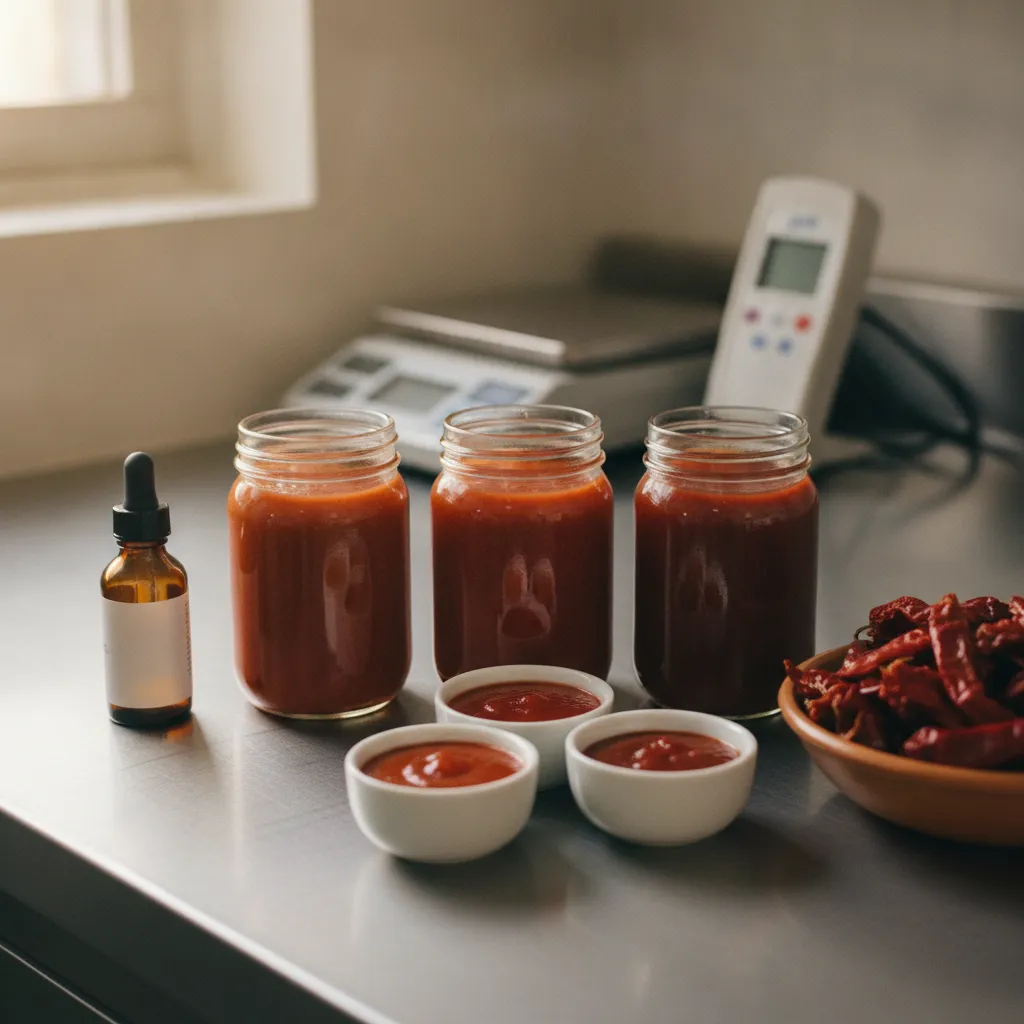
A heat ladder is three promises printed on three labels. Think about the person who buys your medium every month. She is not buying "a hot sauce." She is buying a particular amount of heat inside a flavor she already loves, and she expects to find exactly that next time. If the medium she picks up in spring is hotter than the hot she tried last fall, the ladder has failed, even if every batch passed pH and every ingredient arrived in spec.
A mild, medium, and hot range breaks in two ways. The rungs drift, so medium is not the same medium from one batch to the next. Or the rungs stop belonging together, so the hot tastes like a different sauce with chiles dumped in and the mild tastes like the base with nothing to say. This article covers both.
If you are still choosing peppers and building the flavor itself, start with developing a signature hot sauce. This picks up once the flavor exists and you need it at three heat levels, every run.
Why the Heat Moves When Nothing on the Batch Sheet Changed
Chile heat comes from capsaicinoids, a small family of compounds (capsaicin is the best known) concentrated in the pale inner ribs that hold the seeds. How much a pepper carries depends on its variety, the weather it grew through, its ripeness at harvest, and how it was dried or processed. Two lots of the same chile, from the same supplier, under the same name, can land at noticeably different heat. Dried and ground chiles add more variables: the grind, how much rib and seed ended up in the blend, and the age of the powder.
So a batch sheet that says "8 pounds of chile" quietly assumes the chile is a constant. The weight is constant. The heat is not.
The process moves heat too. Heat comes out of chile pieces and into the sauce over time and temperature, so the longer heat-up and hold of a big kettle can pull more heat from the same weight of chile than your test batch did (more on that in scaling a kitchen recipe for commercial manufacturing). Where the chile goes into the cook, and how long it stays there, belongs in the process notes for every rung.
Consistent heat takes three things: an agreed definition of each rung, heat sources you can measure or standardize, and a correction step the plant is allowed to make.
Define Each Rung Before You Formulate It
"Hotter" is not a spec. Before you touch the formula, write down what each rung should feel like, in words a tasting panel at the plant can use:
- Onset. Does the heat arrive with the first taste, or build a few seconds later?
- Where it lands. Lips and the front of the tongue, or the back of the throat?
- Length. Gone in a few seconds, or still there at the next bite?
- Flavor before heat. What you taste before the heat shows up. This should read the same on all three rungs.
Then decide the spacing. A ladder works when the steps feel even, so the jump from mild to medium feels about as big as the jump from medium to hot. An easy mistake is a mild and a medium that are hard to tell apart, followed by a hot that leaps past both. Customers move up and down a ladder they trust. A lopsided one leaves them guessing.
Give the mild extra attention. Heat covers a lot, so take most of it away and you find out whether the flavor can carry the jar alone. Decide early whether mild means no heat or a gentle warmth, because that choice sets the spacing for the other two.
Last, decide what the hot is made of. More of the same heat source keeps it in the family. A different chile, say a fruity, floral one, makes it a different flavor wearing a heat label. That can be a fine product, as long as it is a choice.
Give the Chiles Two Separate Jobs
In most chile sauces, the chiles do two jobs at once: they bring flavor (roasted, smoky, fruity, earthy) and they bring heat. On a single product, one chile can do both. On a ladder, it pays to split the jobs.
- The flavor chiles stay fixed. Same type, same amount, same preparation, on all three rungs. A roasted poblano, ancho, or guajillo, for example, carries a lot of character without much heat. This layer is the family resemblance.
- The heat source is the dial. It is the one thing, or very nearly the only thing, that changes from mild to hot.
Once the jobs are separate, a lot of chiles that runs hot no longer changes your flavor, only your heat, and heat is the part you planned to adjust. It also settles a tempting shortcut, making the mild by cutting the hot with plain base. That works only if the heat source is the sole difference between them. Otherwise dilution thins the flavor along with the heat.
Standardized heat ingredients
An oleoresin is a concentrated spice extract. Capsicum oleoresin is made from chiles and sold standardized to a stated heat strength, so each lot arrives close to the same strength and the supplier's paperwork says what it is. In my experience, oleoresins can also hold flavor, heat, and color more steadily over the shelf life than ground spices do. The trade-offs:
- They are potent, weighed precisely in small amounts, and the plant will have its own handling rules for them.
- They are oil based. In a water-based sauce they must be dispersed properly, or you get hot spots: one jar fierce, the next tame, from the same batch.
- They bring heat with very little chile flavor. That makes them a clean dial, and it is why they should not be the whole heat story.
- They appear on your ingredient list. How an extract is named there is a question for your labeling resource; how it sits with your clean label promise is a question for you.
My approach is real chiles for flavor and, where it helps, a standardized heat ingredient to level the heat across lots. Chile powders and mashes sold to a stated heat range are a middle option, usually with a wider tolerance than an extract but more real chile character. Whichever you choose, switching heat sources later (mash to extract, or the reverse) is a formula change. It can shift pH and solids, so your co-packer and your process authority hear about it before it runs, and they decide whether it needs a fresh review.
Measured whole and dried chiles
If your heat comes from whole or dried chiles, you need heat data on every lot. Ask your supplier to put it on the spec and the certificate of analysis (my COA cheat sheet covers how to read one). Labs usually measure capsaicinoid content with an instrument method and can report it as Scoville heat units. That number tells you where a lot sits against the last one. It does not tell you how the lot will taste in your sauce, which is why the next step exists.
Calibrate Every New Lot Before It Reaches the Kettle
Your co-packer runs its own receiving checks and quality control. What the plant needs from you is a method and a window: how a new lot gets checked, which ingredient may move, by how much, and who signs off outside the range. The framework:
- Read the supplier's number, remembering it was measured on their sample, not your batch.
- Taste the new lot against the last accepted lot in the same neutral carrier, at the same amount and temperature, with the same tasters. Not in the finished sauce, where sweetness, acid, and aromatics hide small differences.
- Adjust inside the approved window. The heat ingredient has a target amount and an allowed range, written as weight against batch weight, so the correction is a number on the batch sheet, not a judgment call on the floor. If the heat ingredient is a mash or puree that can move pH, your process authority should see that window before the plant uses it.
- Check a small test against that rung's gold standard before the full batch is committed.
- Record the lot, the adjustment, and the result. After a few seasons, the record shows how much each supplier's lots move, and the window can be set on facts instead of memory.
The window matters as much as the target. Too narrow, and good lots get rejected. Too wide, and a medium can wander into hot territory without breaking a single written rule.
Sugar, Fat, Acid, and Temperature Change How Hot It Tastes
The same amount of capsaicin can taste very different depending on what surrounds it.
- Sugar rounds heat off, so a sweeter rung tastes milder than its chile content suggests. Sweeten the mild to make it friendlier and you have changed its flavor and its heat at once. It works the other way too: trim sugar across the line later and every rung may read hotter, a balancing act I cover in reducing added sugar in sauces and condiments.
- Fat and oil matter because capsaicin dissolves readily in fat and oil and barely in water. An oil-rich sauce often reads softer up front, and if oil separates in the jar, some of the heat can go with it.
- Acid changes how heat lands too. A brighter rung can read sharper at first bite, so taste for it rather than assume the rungs will line up.
- Temperature and texture play in too. A sauce eaten warm usually reads hotter than the same sauce cold, and a thick sauce clings and lingers longer than a thin one.
The lesson for the ladder: keep everything except the heat dial the same across the rungs. Same base, sweetness, acid, oil, and texture. Then your tasting panel is comparing heat to heat, not heat to sweetness.
Each rung still gets its own measured pH and Brix. A heat source added as a chile mash or puree can move pH: fresh chile is a low-acid ingredient that can nudge it upward, and a fermented or acidified mash brings acidity of its own. An extract used in tiny amounts barely moves it. Measure each rung on its own. For why the number keeps moving after a batch is made, see why pH drifts after production.
Judge the Heat at Week Two, Not on Fill Day
I taste a new product on fill day, at one week, and at two weeks, and only the last tasting decides anything, because a sauce needs about that long to settle.
Heat is part of that settling. On fill day it often reads raw, sitting on top of the flavor instead of inside it. Over the next two weeks it integrates. Depending on the product, it can read stronger as chile pieces keep releasing heat into the liquid, or softer as the acid and aromatics round out around it. You learn which way yours goes by tasting it at all three points, rung by rung.
Two rules follow. Set each rung's gold standard at week two. And do not adjust a production batch's heat based on its fill-day taste unless your records show how that rung moves over two weeks. Chasing fill-day heat is a quick way to overcorrect a whole run.
Over a long shelf life, heat tends to hold while the aromas around it fade, so late in the code date a sauce can taste "just hot." Taste retained samples of each rung near the end of the code date, too.
Keep All Three Rungs Tasting Like One Sauce
Line the three up, mild to hot, with water and something plain between tastes, and ask a few blunt questions:
- Before the heat arrives, do all three taste the same?
- Does the hot still taste like your sauce, or has the heat erased the flavor?
- Does the mild have enough character to stand on its own?
- Do they look like siblings? Heat from chile matter can deepen the color, while heat from an extract barely changes it. If you want the hot to look a shade deeper, decide that on purpose.
On the production side, two habits are worth asking the plant about: running the mildest rung first and the hottest last, so carryover heat is less likely to creep into the mild, and adding the heat ingredient at a defined point with a defined mixing time, so every jar gets its share.
Put the Ladder in Writing
All of this only holds if it lives in the spec your co-packer runs, rung by rung. For each heat level, the spec states:
- The heat target, as a sensory description against that rung's gold standard, plus a lab number if you use one.
- The acceptable range, and what counts as outside it.
- The heat ingredient, its own ingredient spec, its allowed adjustment window, and when it goes into the cook.
- That rung's own pH, Brix, and viscosity targets.
- The checks: the plant's quality control on every batch, plus a sample from every batch of every rung sent to you, tasted against your retained samples.
- What happens on a miss: hold, adjust, or reject, and who decides.
Quality control is mostly the plant's job. You still want that sample from every batch, because you are the one tasting all three rungs against your own idea of the family. For which numbers decide whether a batch ships, see the finished product spec as release criteria. And if you print heat numbers on the label instead of a descriptive scale, remember that every printed number is a promise you have to back with lab data, lot after lot.
Where the Calibration Actually Happens
The framework fits in an article: define the rungs, give the chiles separate jobs, calibrate every lot, judge at week two, and write it down. The calibration does not. Which heat source suits your sauce, where it goes in the cook, how wide the window can be before the family breaks, and how your sauce moves over its settle all depend on the product in front of me. That is bench work, done with all three rungs side by side, and it ends in a spec your co-packer can hold without guessing.
Need Help With Your Formulation?
Whether you're scaling your first recipe or reformulating an existing product, let's talk about how to get it right.
Book a Free Discovery Call