Your house sauce can go into a jar, but not as the recipe your kitchen makes tonight. Before a plant can bottle it, the sauce has to be rebuilt as a written, shelf-stable formula, because that jar has to taste right months from now, sitting at room temperature instead of in your walk-in. Nothing in it was prepped that morning, and nobody from your line is going to be standing over it to fix the salt.
You're still making the sauce your regulars ask for by name, but almost everything underneath it gets rebuilt. I've spent more than 25 years in kitchens as a professionally trained chef, and I also write the specs factories run, so I know what a line quietly does for a sauce that no plant will do for it.
What Your Sauce Gets From the Restaurant That a Jar Can't Give It
A restaurant sauce is made to be eaten within days, sometimes within minutes of being finished, on a plate your kitchen built. Here's what it leans on in each place.
| What it relies on | On your line | In a jar |
|---|---|---|
| Who corrects it | A cook tastes it and fixes the salt and acid every batch | Nobody tastes and fixes it. The formula has to be right as written. |
| How it's measured | By eye, by feel, off the spoon | By weight, with numbers for acidity, sugar and thickness |
| Fresh prep | Herbs, garlic and citrus cut that morning | Ingredients that hold up through cooking, filling and months of storage |
| The finish | Butter or cream swirled in at the pass | Nothing. It's sealed as it is. |
| How long it keeps | Days in the walk-in, rotated by date | Months on a shelf at room temperature |
| How it's eaten | Hot, on a dish built around it | Cold from the fridge or reheated, on whatever the buyer has |
None of the middle column is written down anywhere, because your kitchen just does it, and the formula has to pick up every row.
Making the batch bigger comes after this, and scaling a kitchen recipe for commercial manufacturing is a different job, with surprises around heat and evaporation.
First, Write Down the Sauce Your Kitchen Actually Makes
Your house sauce probably lives in the hands of one or two cooks. The card taped inside the lowboy says "salt to taste" and "reduce until it coats the spoon," and the cook who makes it best knows what that means on a Tuesday when the tomatoes came in pale. If what's in that cook's head never gets written down, nobody can rebuild the sauce, me included.
The rebuild starts in your kitchen, before you talk to a single plant. Have your best cook make a normal batch while someone else weighs every ingredient as it goes in, including the last pinch of salt and the splash of vinegar added because it tasted flat. Weigh the pot before and after the reduction, so "until it coats the spoon" becomes a weight of water cooked off. Write down which onions, vinegar and tomatoes went in, how fine the garlic was cut, and when each thing was added.
On a busy night, your best cook fixes that sauce a little every time they taste it. A jar gets fixed once, the day it's made, and then it sits for months with nobody tasting it.
Do it more than once, with each cook who makes it. You may find two or three slightly different sauces living under one name, which is normal on a line. A plant needs one version, so you pick which one is the real sauce, and every test jar gets tasted against it.
What Happens to Fresh Herbs, Garlic and Citrus in a Jar
Some of the brightest notes in a restaurant sauce come from that day's prep, like cilantro chopped at the station or a lemon squeezed over the pan as the plate goes out. Many shelf-stable sauces are cooked in a kettle and filled into jars hot, so everything in the jar gets cooked. A green herb sauce drifts toward olive. Fresh lemon juice loses its perfume and tastes cooked. Raw garlic turns sweet and mellow. Then months on a shelf take more of the aroma away.
You rebuild those flavors from forms of the same real ingredients that hold up. That might mean cooking the garlic into the base on purpose, so the jar already tastes of cooked garlic, or letting a dried herb carry part of what the fresh one did. Either way it's still real garlic and real herbs, which is where I'd rather start. Where ground spice won't last, an oleoresin (a concentrated spice extract, such as paprika oleoresin) can hold flavor, heat and color more steadily over a long shelf life.
Some fresh ingredients also raise bigger safety questions in a sealed jar at room temperature than they do in a deli quart in the walk-in, and fresh garlic or herbs held in oil are the best-known example. Those questions go to a process authority, a food safety expert qualified to review a product's formula and process and say what it needs to be made safely.
Butter, Cream and Anything Finished to Order
Say your sauce finishes with a knob of cold butter swirled in at the pass. That butter is what makes it glossy and round, and it causes two problems in a jar. A sauce mounted with butter is an emulsion built to hold only until the plate reaches the table. And butter sets up solid in the fridge, so an opened jar comes out firm and dull the next day.
Cream is harder still. A sauce built on cream or other fresh dairy usually isn't a candidate for a shelf-stable jar at all. Fresh dairy is low in acid and delicate under heat, which puts it at odds with the way most shelf-stable sauces are made. The cream sauces you do see in jars on a store shelf were designed for that shelf from the start, often around a heavier heat process that many sauce plants don't run. I'd rather tell you that now than after you've paid for development. If your house sauce is one of these, talk to a process authority before you spend anything.
Sometimes there's a better jar hiding inside the sauce. A pan sauce might become the reduction that goes under the butter, sold for the home cook to finish with butter at the stove, which keeps your flavor in the jar and moves the fragile step to their pan. Treat that base as a new product, with a new formula and a new review.
Seasoned for a Hot Plate, Eaten Cold From the Jar
Your cook seasoned that sauce by tasting it hot, for a hot dish with char on the protein and a lime wedge on the side, and nobody at home is going to rebuild that plate around it. It gets spooned cold onto a sandwich or warmed in a pan, and it has to taste complete on a plain spoon.
Cold mutes flavor, sweetness especially, and fat that feels silky at the pass can feel waxy straight from the fridge. A sauce that pours just right from a hot pan can sit stiff on a cold spoon. So taste your test jars the way your customers will: cold from the fridge, and on the foods they tell you they put it on.
Months on a Shelf Instead of Days in the Walk-In
Your walk-in and a fast turnover keep the restaurant batch good, but a shelf-stable jar has to stay safe and taste right for months at room temperature, then a while longer in a customer's fridge once it's open, with nothing but the sauce itself carrying it.
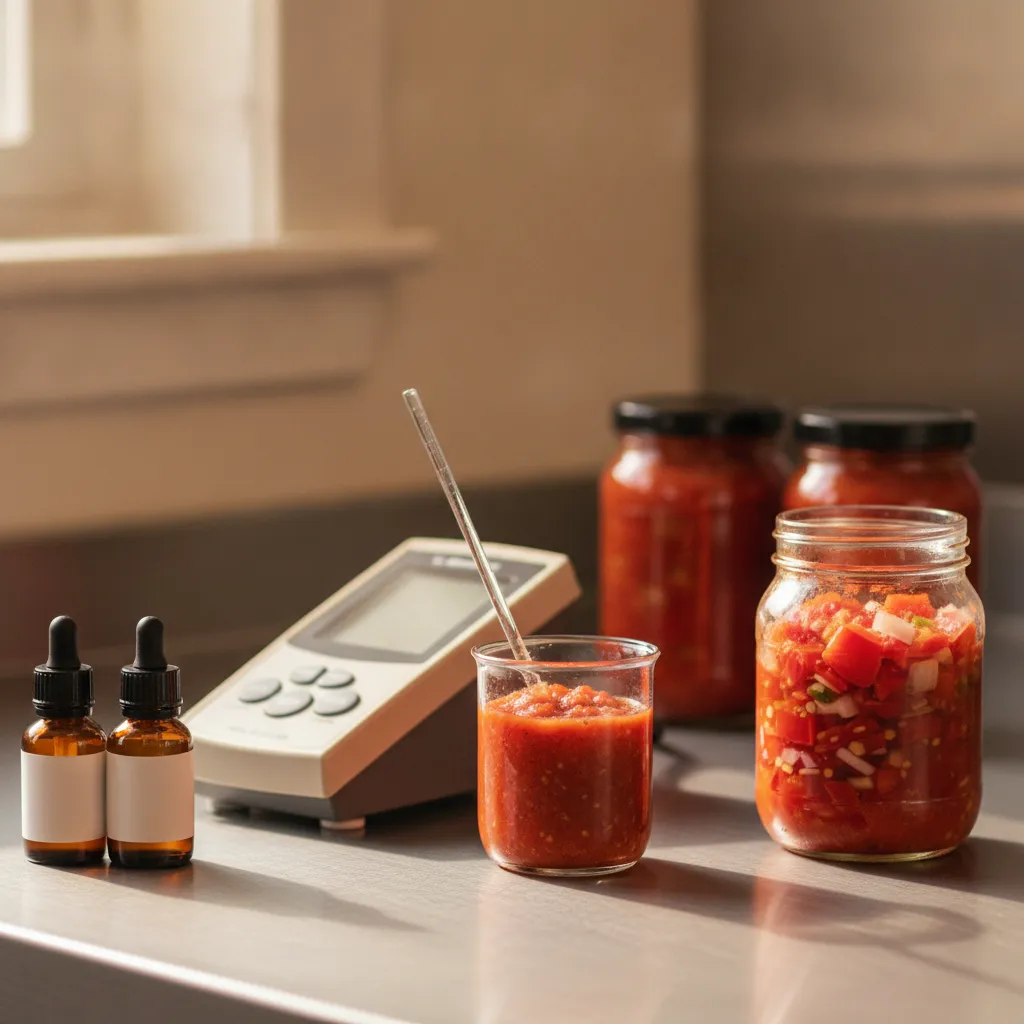
There's usually no preservative you can just stir into the restaurant version. For most sauces in my lane, shelf stability comes from the formula and the process designed together, with acidity doing much of the work. Acidity is read as pH, where a lower number means more acid. The federal rules for acidified foods (low-acid foods kept safe by added acid) require a finished pH of 4.6 or below, and you'll want a cushion under that, because pH can drift after production. From what I've seen, the process authority and most co-packers, the plants that make and jar food for other brands, will ask for 4.0 to 4.3 at most.
A sauce built to taste rich and round on a plate may sit well above that range. Just adding vinegar until the number drops gives you a sharper, thinner sauce, and anyone who knows it would taste the difference. The sweetness, salt, fat and aromatics have to be rebalanced around the new acidity so the sauce still tastes like itself.
Sometimes the plant arranges the process authority review and sometimes the brand does, so ask early, get the answer in writing and budget for it. Do the same for the shelf-life test, which is what tells you how long the jar actually lasts.
Flavor moves in the jar too. I check each test batch for taste, acidity, salt, texture and color the day it's made, at one week and at two weeks, because the flavor takes about two weeks to settle. The week-two jar is the one I judge, next to a fresh batch of the restaurant version made from your written sheet, and if the two don't taste like the same sauce, the formula goes back for another round.
What the Plant Needs in Place of Your Cooks
A good sauce plant is built to make exactly what the paperwork says. Nobody on that line has tasted your sauce on a Friday night, and the line isn't set up to adjust it by taste the way your cook does. Running to the numbers is the whole reason to use a plant, since that's how you get the same jar batch after batch, and it means the written formula has to do your cook's job.
- Every ingredient by weight, described by what it is and what it does, so the plant can buy the same thing instead of hunting for the brand on your shelf.
- Targets with ranges for pH, for Brix (dissolved solids, mostly sugar, read with a refractometer) and for thickness, which the plant reads as viscosity at a set temperature, plus how far a batch can stray before it's held.
- The process in steps: what goes in when, at what temperature, and for how long.
- A thickener chosen for that plant. Your reduction judged by eye becomes a thickness target. If the sauce needs a starch or gum for body, it's chosen for the sauce's acidity, for the heat and hold time of the plant's equipment, and for its shear, which is how hard the kettle's agitator works the sauce, so the texture survives the process and holds up on the shelf.
- A description in words of how the finished sauce should look and taste, so anyone tasting a batch knows what right is.
Check the Name Before You Lock the Formula
Some names carry a standard of identity, a legal definition of what a product must contain to use that name. Mayonnaise is one, so a "house mayo" that doesn't fit it may need a different name on a retail jar, even after years on your menu. Run the name past regulatory counsel or a labeling specialist.
Finding a Plant Once the Formula Is Written
Once the formula's written down and tested, that's when you go looking for a plant that runs sauces like yours. That plant's trial batches are where the thickener and the process get checked on the equipment that'll actually make your sauce. Specialty ingredient suppliers often know which plants buy what they sell, and your process authority may know plants that run products like yours. Trade associations, food trade shows and co-packer directories turn up more.
Our sister company, Co-Packer Match, is a directory of U.S. co-packers you could add to that list. It doesn't name the plants (you see each one as a state and a code), and you can browse by process, like co-packers that run kettle-cooked products, or start from its sauce, condiment and dressing co-packers. Fill out the spec sheet there and you get an email with up to five co-packers that fit and how to reach each one. Each plant sets its own price and minimums.
Once you've got names, vet each co-packer before you commit to one. Those first conversations can run on a short product brief that describes the sauce, its targets and your expected volume, without the recipe. Hold the full formula until you're close to signing and have an NDA in place. If you're already filling jars in a rented commercial kitchen, there's a separate call to make about when to move from a commissary kitchen to a co-packer.
Where My Part of the Work Starts and Stops
I'm not a co-packer. I don't bottle sauces or pick the plant for you, and regulatory filings and label work belong to other specialists. My team and I work on the sauce itself, rebuilding the version your kitchen makes as a shelf-stable formula and writing the spec sheet a plant can run as written.
This next part I can't do in a blog post. How much acid your sauce can carry before it stops tasting like itself, and which forms of your fresh ingredients make it through a sealed jar, get worked out at the bench, in test batches tasted next to a fresh pot of the real thing.