Why Your Kettle Batch Reads Different on the Spoon
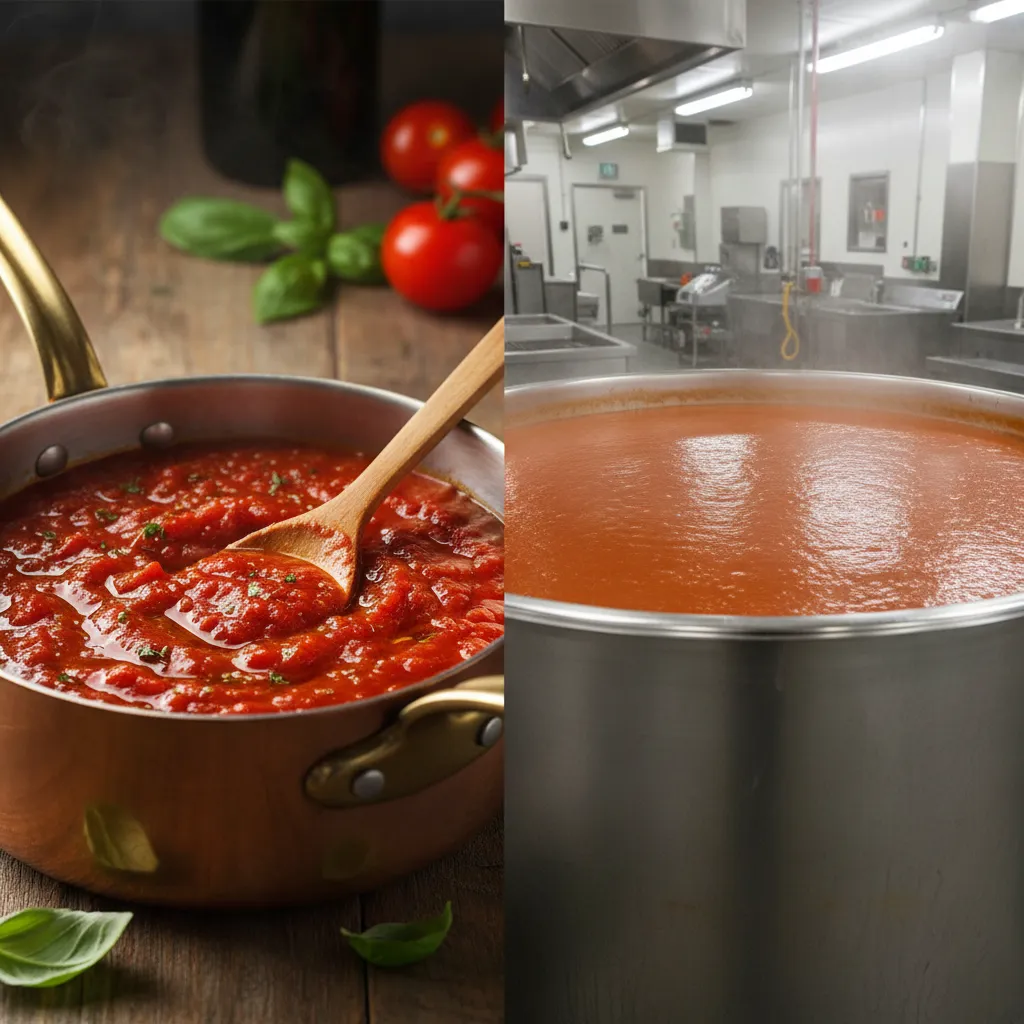
You spent months dialing in the sauce on a stovetop. Texture is exactly where you want it. The body holds on a chip without sliding off, the gloss reads premium under store lighting, and your sample audience can't stop talking about the mouthfeel. Then you run it in a 100-gallon steam-jacketed kettle for the first time and the result is, frankly, off. Maybe it's thinner. Maybe it's thicker. Maybe it sets up overnight in the jar in a way the stovetop version never did.
This is one of the most common scale-up surprises I work through with founders, and the cause is almost never a bad recipe. It's a physics problem hiding inside what looked like a culinary one.
Heat Transfer Is Not the Same in a Kettle
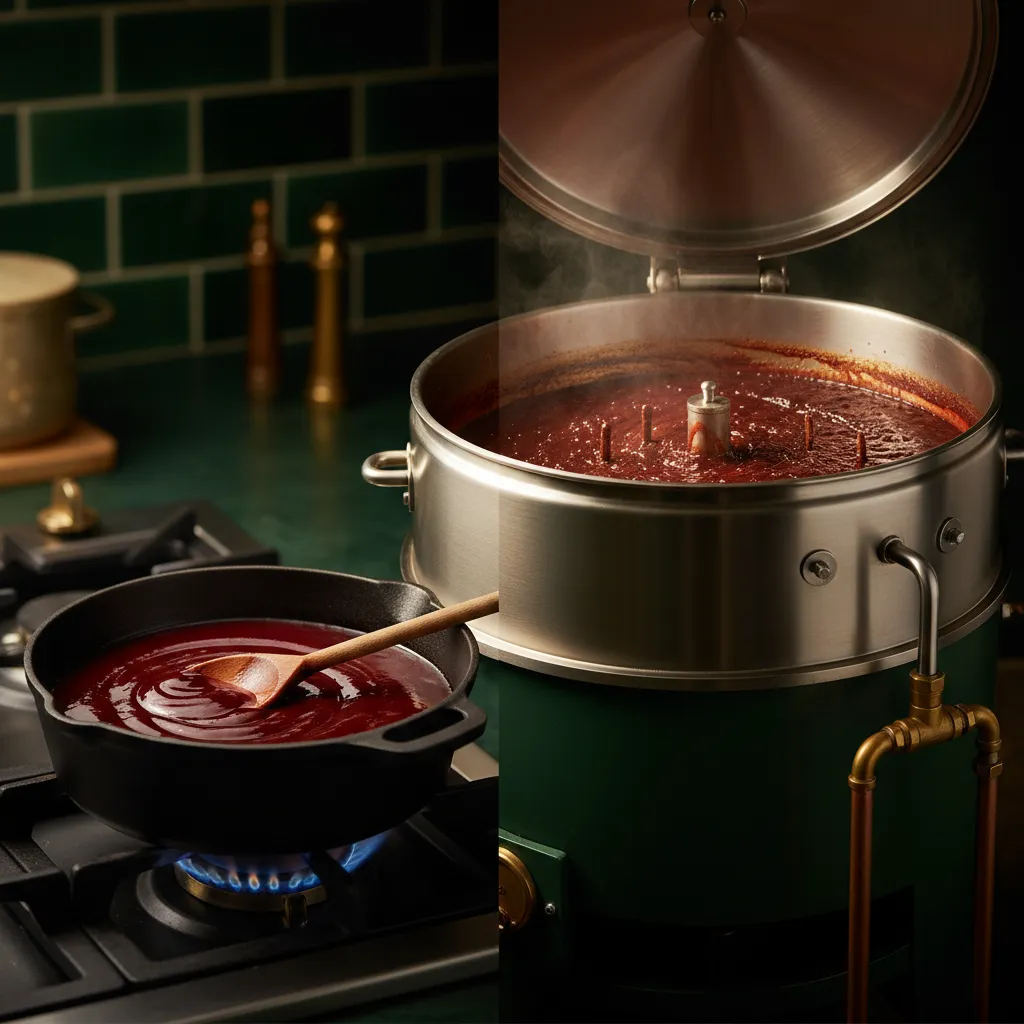
A stovetop pot heats from a single contact point on the bottom. The cook builds a vertical temperature gradient, you stir it out, and the sauce reaches target temperature unevenly across short distances. A steam-jacketed kettle, by contrast, heats from the entire jacketed surface area: bottom, sides, sometimes upper walls depending on the jacket geometry. That changes three things at once.
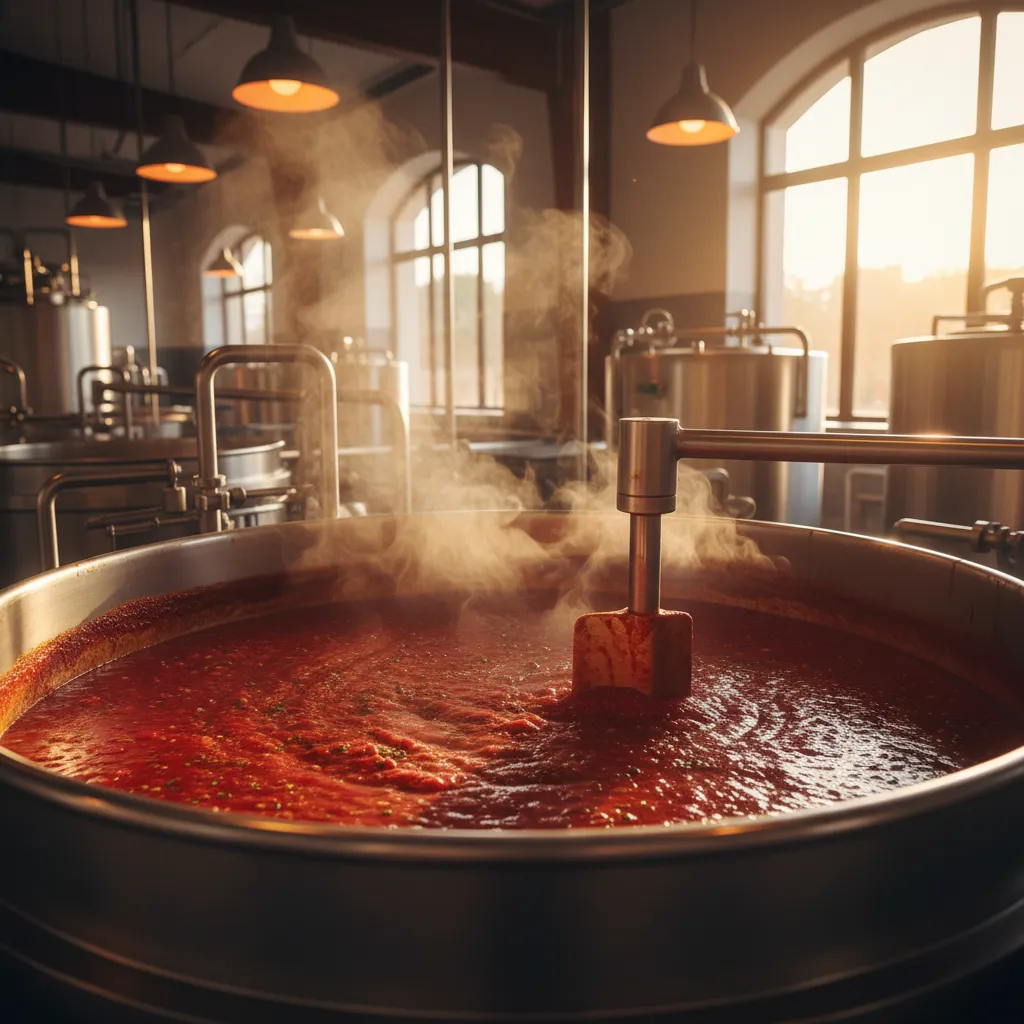
First, total energy delivery is much higher. A 100-gallon jacketed kettle running at 30 psi steam can move a batch from 70 to 200 degrees Fahrenheit in a fraction of the time a stovetop can. Second, the rate of evaporation is wildly different. Surface area to volume ratio drops as you scale, so a kettle batch evaporates a smaller percentage of its water per unit time than a stovetop batch. Third, the shear environment changes. A scraped-surface agitator in a kettle imparts mechanical work that can break delicate emulsions, fragment vegetable particulates, or release starch you didn't intend to release.
All three of these change viscosity at the finished line, and they don't change in the same direction.
The Evaporation Math Most Founders Miss
Stovetop reduction is generous. You can simmer a sauce for 90 minutes uncovered, lose 30 percent of your water, and watch the body thicken visibly. The same recipe in a covered or partially covered kettle, cooked for the same total time, may lose 8 to 12 percent of its water, a meaningfully thinner finish. Conversely, an uncovered kettle running aggressively can over-reduce and pull the body past your target.
The fix isn't longer cook times. It's specifying finished moisture, not finished cook duration, in your production sheet. A spec like "reduce until 22 to 24 percent solids" or "hold at temperature until viscosity reads X on a Bostwick" gives a co-packer something measurable. "Simmer 45 minutes" gives them a guess.
Starch Behavior Changes With the Cook Profile
If your sauce uses any starchy ingredient (tomato, corn starch, modified food starch, certain root vegetables, even some pepper purees), the viscosity you see depends on how those starches gelatinize, swell, and then either hold or break down. Three patterns are worth knowing.
Starch gelatinization happens in a temperature window, typically 140 to 180 degrees Fahrenheit depending on the starch. Hit that window and hold there briefly and the starch granules absorb water and swell, contributing body. Blow past it too fast in a hot kettle and the granules can over-swell and rupture, releasing amylose and dropping viscosity rather than building it. This is why a recipe that thickens beautifully on the stove can thin out in a kettle that ramps too aggressively.
Acid hydrolysis is the other quiet variable. Long cooks in an acidic medium (think vinegar-forward BBQ or hot sauce) progressively break starch chains. A stovetop batch that cooks for 30 minutes total might lose almost no starch viscosity. A kettle batch that holds at temperature for 90 minutes can lose noticeable body purely from acid breakdown of native starch, even before any other variable kicks in.
Retrogradation is the third. After cooling, certain starches re-associate over hours or days, causing post-fill thickening or even gel formation in the jar. This is why an overnight sit can move the product, and why your QC pull at hour zero looks different from the customer experience at week six.
Choosing Your Hydrocolloid for the Real Cook Profile
If native starch alone won't give you stable viscosity at scale, you reach for a hydrocolloid. The choice matters more than founders usually realize. Each one behaves differently under heat, shear, and acid.
Xanthan gum
Workhorse for cold-process viscosity. Hydrates at almost any temperature, holds well across a wide pH range, and produces a clean shear-thinning viscosity (it stays thick at rest, thins when you pour, then rebuilds). Where founders get into trouble: too much xanthan reads as slimy, gummy, or "salad-bar dressing" texture. Typical use range in sauces and dressings is 0.05 to 0.30 percent. Above 0.40 percent in most applications you've gone past the point of clean.
Pectin
Excellent for fruit-forward sauces, glazes, and high-Brix products. Requires sugar and acid in specific ratios to set, which makes it ideal for jams and BBQ glazes but tricky for low-sugar formulations. Low-methoxyl (LM) pectin works in lower-sugar systems by relying on calcium for set. Pectin gives a softer, fruit-pulp-like body, not the slick mouthfeel of xanthan.
Modified food starches
The category most often blocked from clean-label retail (see the natural-channel writeup). For brands willing or required to use them, modified starches deliver consistent viscosity through aggressive thermal cycles, freeze-thaw, and acid environments where native starches break down. The trade-off is label transparency and natural-channel placement.
Tapioca starch and tapioca flour
Often a clean-label compromise: native, recognizable, and reasonably stable through hot fill. Less robust than chemically modified starches in long-shelf or high-shear applications, but acceptable in many sauce categories.
Chia, flax, and seed-based mucilages
Used in some clean-label dressings and condiments for body and texture. Effective at small percentages but visible in finished product (you can see the seeds), which works for some brand stories and not others.
The right hydrocolloid for your product depends on your pH, your thermal process, your shear environment, and your label promise. There's no universal answer.
How to Actually Measure Viscosity
If your spec is going to mean anything in production, you need a measurement that anyone on the line can repeat. Two instruments handle the vast majority of sauce and condiment work.
Bostwick consistometer
A simple stainless trough with a gate. You fill the reservoir, lift the gate, and read how many centimeters the sauce flows in 30 seconds. Sauces are typically specified in centimeters at a fixed temperature (often 20 degrees Celsius). Ketchup is famously around 3 to 6 cm. BBQ sauce ranges 5 to 10. Hot sauce 8 to 14. The Bostwick is cheap (a few hundred dollars), durable, and the de facto standard for retail-grade sauces. Its weakness is that very thick or chunky products don't flow well in the trough.
Brookfield (rotational) viscometer
A spindle-and-motor system that measures resistance to rotation. Reports in centipoise (cP) or pascal-seconds. More expensive (a couple thousand dollars and up), more sensitive, and more reproducible across batches and labs. The standard for dressings, mayos, and any product where Bostwick is too crude.
Whatever you choose, write the method into the spec. "Bostwick 7 cm at 20 degrees C, 30 seconds" is a real specification. "Thick like the kitchen sample" is a way to find out, the hard way, that everyone has a different mental picture.
Dialing the Recipe to a Number
Once you have a target reading, the loop becomes straightforward. Run a small kettle pilot. Measure viscosity at the line, at one hour, at 24 hours, and at one week. Compare to the target. If you're under, options are: longer reduction, slightly more hydrocolloid, lower water in the formulation, or a hydrocolloid swap. If you're over, the inverse.
The trap to avoid is changing two variables at once. If you increase xanthan and shorten cook time in the same iteration, you can't tell which one moved the needle. Move one lever per iteration, and your scale-up converges fast.
For related deep dives, see common mistakes when scaling sauce recipes, why kettle cooking produces better sauces, and what makes a recipe production-ready.
Frequently Asked Questions
Why does my sauce thicken in the jar after I fill it?
Most often, native starch retrogradation. The fresh fill at hot temperature is fully gelatinized; over hours and days, starch chains re-associate as the product cools and sits, building viscosity. Either reformulate to a starch system that doesn't retrograde, or specify your viscosity target as a 24-hour or 1-week reading rather than a fill-line reading.
My kettle batch is thinner than the stovetop. What's the most common cause?
Under-evaporation. A covered or partially covered kettle holds water that an open stovetop loses. Check finished solids; that number is usually the culprit.
Is xanthan really clean label?
Most natural-channel retailers accept xanthan gum, though some category-specific guidelines vary. Whether it fits your brand depends on the story you're telling. Many premium clean-label brands avoid all hydrocolloids when they can; many pragmatic clean-label brands use xanthan at low levels because the alternative is a worse customer experience.
Can I just match my Bostwick reading and call it done?
Bostwick is one input, not the whole picture. A product can hit the right Bostwick at fill and then drift over shelf life as starch retrogrades, oils separate, or pectin sets up. Specify viscosity at multiple time points, not just at fill.
Where This Turns Into Real Work
Viscosity scale-up is a chain of calibrations, not a single fix. The right hydrocolloid for your label, the right cook profile for your kettle, the right finished-solids spec for your shelf life, these are tied together, and the wrong combination will keep biting you in production. If you've already had one batch that didn't match the kitchen sample, this is exactly the kind of work I solve with founders inside an engagement. Book a Free Discovery Call if you want a hand on the next pilot.
Need Help With Your Formulation?
Whether you're scaling your first recipe or reformulating an existing product, let's talk about how to get it right.
Book a Free Discovery Call