It is a good problem to have. Orders grew, and the plant wants to move you. Say you have been running in a 150-gallon kettle and the production manager suggests the 500-gallon kettle down the line, or a different cook room with a faster filler. The formula has not changed. The ingredients have not changed. Everyone assumes the product will not change either.
It might not. It might also come back a shade darker, a little thinner, hotter than usual, or with the diced peppers broken down to flecks, and nobody will be able to point to a mistake, because nobody made one. A bigger batch is a different cook, even at the same plant with the same people.
This is a different problem from the first move out of a kitchen, which is covered in how to scale a kitchen recipe for commercial manufacturing. Here the product is already a commercial formula that runs well. What is at risk is the part nobody wrote down: how much of its character came from the kettle it grew up in.
Your Formula Moves Easily. Your Process Notes Do Not.
If your formula is written in percentages by weight, it scales cleanly on paper. A 500-gallon batch uses the same percentages as a 150-gallon batch. That part is fine.
The trouble is usually in the process notes. Suppose yours read something like "add garlic at the start, cook 40 minutes, add vinegar, hold 10 minutes, fill." Every one of those times was tuned, knowingly or not, to how fast that particular kettle heats, how much it evaporates, and how long that particular filler takes to empty it. The minutes were stand-ins for what was happening in the pot, and on different equipment they stop meaning what they used to.
So the first job before a scale-up is reading your own process sheet line by line and asking one question of each step: is this written as an endpoint (a temperature, a Brix reading, a viscosity, a visual stage) or as a clock? Every step written as a clock is a step that may need rewriting for the new kettle. The exception is any time or temperature that is part of the product's scheduled process (more on that below): that is a safety step, not a habit, and only the process authority changes it.
What Changes When the Batch Gets Bigger
Heat-up time
A bigger kettle usually holds more product for each square foot of heated surface around it, so a full batch tends to take longer to come up to temperature, even with a bigger jacket. Anything added at the start spends longer in the heat before the batch reaches its cook temperature. Garlic and onion cook further. Spices extract more, so heat and bitterness can climb. Sugars brown more, so color darkens. Nothing in the formula changed. The product simply spent longer getting there.
The fix is often in the process rather than the formula: tie each addition to a temperature or a stage instead of a time, and move heat-sensitive or fast-extracting ingredients later where the product and the process authority allow. Sometimes the heat ingredient itself does need adjusting. That is a formula change, and it gets handled like one (more on that below).
Evaporation and the endpoint
Reduction behaves differently in a larger vessel. There is less open surface per gallon, the new kettle may be covered when the old one was not, and steam pressure and agitation may differ. If your old process reduced for a set time, the bigger kettle may land thinner and lower in Brix (a reading of dissolved solids, mostly sugar) after that same time, or an operator will cook it longer to get there, which brings back every heat-up problem above.
Cooking to a measured endpoint (Brix, viscosity, or finished solids) rather than a clock keeps the product consistent. The yield then floats a little from batch to batch, which is the trade-off explained in where a kettle batch actually goes. If the new equipment heats by injecting steam directly into the product rather than through a jacket, ask about it, because the condensed steam adds water and can move both Brix and pH.
Shear, hold time, and your starch
Shear is the mechanical working a product gets from agitators, pumps, and pipes. A bigger kettle usually means a bigger agitator running for longer, and often a different pump and a longer transfer line to the filler. Add the extra time at temperature in an acidic product, and a thickening system that held up beautifully in the old kettle can start to break down.
A starch or hydrocolloid (a plant gum or fiber that thickens and stabilizes) only performs if it is matched to four conditions: the acidity it sits in, how hot it cooks, how hard the equipment works it, and how long it is held. Move to new equipment and you have likely changed at least two of those four. The symptom is not always visible at the filler, either: a starch that has been worked harder can look fine on run day, then thin out or weep weeks later, which is the failure pattern in sauce separation and texture failure on the shelf. For the fill-day side of viscosity, the mechanics in why a kettle batch does not match the stovetop apply just as well between two kettles.
Particulates
If your product has pieces (diced peppers, onion, tomato, beans, vegetables in a soup), they take more punishment in a bigger system. More agitator passes, a longer cook, and a pump that is not gentle with solids can turn a chunky salsa into a smooth one with flecks. A larger batch also gives pieces more time to settle or float while the kettle empties, so the first jars and the last jars can carry a different share of solids.
What helps: a particle size and a particulate weight per container written into the spec, so damage shows up as a number instead of an opinion; adding the most fragile pieces as late as the process and the process authority allow; and asking about pump type and agitator speed before the trial.
The fill window and fill temperature
This is the change people tend to forget. A bigger batch takes longer to fill. As an example, not a benchmark: if your old batch emptied in well under an hour and the new one takes most of a shift, the last jar off the line has spent hours longer hot in the kettle or the filler hopper than the first jar. It has been cooked longer, and it may be darker, thinner, or flatter in flavor.
It can also run the other way. If product cools in the kettle or the lines during a long fill, holding the fill temperature the process requires gets harder. Hot-filled products depend on that temperature, and the plant's food safety team controls and monitors it. Your part is recognizing that a longer fill window is a real change and making sure it is discussed before run day, not discovered during it. If the quality spread from first jar to last turns out too wide, the answers are usually process changes, and those belong to the plant to design, with the process authority in the picture.
Cool-down after filling
More product means more cases coming off the line hot. If the cooling step (a tunnel, a water spray, or simply air around stacked cases) was comfortable for your old run size, a bigger run can leave cases in the middle of a pallet warm for longer, and that extra time hot keeps cooking the product. Ask how the plant will cool the larger run, and ask for samples from the middle of a pallet as well as the outside.
If it is a different line, not just a bigger kettle
Sometimes the move is to another line entirely, one that heats product continuously as it flows through a heat exchanger instead of cooking it in a kettle, or that runs a different filler at a different speed. The same questions apply, often more sharply, because heat-up, shear, and hold time all change at once. Treat it as a bigger change than a kettle swap, not a smaller one.
Why the Process Authority May Need to See It Again
A shelf-stable acidified product runs on a scheduled process: the documented process, set by a process authority (the qualified expert who evaluates and establishes a safe process for the product), that the plant follows on every batch. It was set for a specific formula, process, and container, and changes to batch size, equipment, fill temperature, hold, or cooling can all bear on it. Some equipment and batch-size changes need a new review and some do not. That call is not yours and it is not mine. It belongs to the process authority and the plant's food safety team, so ask them before the first run on the new equipment, with a clear written description of what is changing.
Find out early who is arranging it. Sometimes the co-packer handles the process authority review and other verifications; sometimes they ask the brand to. Get the answer in writing and budget for it, so a review is not the reason your first big run slips.
Running the Scale-Up Trial With the Gold Standard in Hand
A scale-up trial is not the pilot batch you ran before your first launch. You are not proving the recipe works; you are proving the bigger system makes the same product. The structure in the pilot batch protocol still applies (a data sheet, targets and ranges agreed in advance, a go or no-go decision), but the questions are narrower, and the reference is your gold standard: approved product from the current kettle, judged after its two-week settle. Here is how I would run it.
- Bring the gold standard, and make it current. Pull retains (samples kept back from each batch) from a recent good run in the old kettle.
- Change one thing. Run the same formula, ideally from the same ingredient lots, on the new equipment. Do not let the move become the moment you also switch a supplier, tweak the salt, or change the jar. If the product changes, you want to know why.
- Decide what "the same" means before you taste. Write down the range that counts as a match for each number, and who on your side signs off on flavor. Deciding after you have tasted is how a slightly-off product quietly becomes the new normal.
- Write endpoints, not clocks. Before the trial, rewrite the process steps outside the scheduled process as temperatures, Brix, viscosity, and stages, and record how long the new kettle actually takes to reach each one. Those recorded times become the starting point for the new kettle's process sheet.
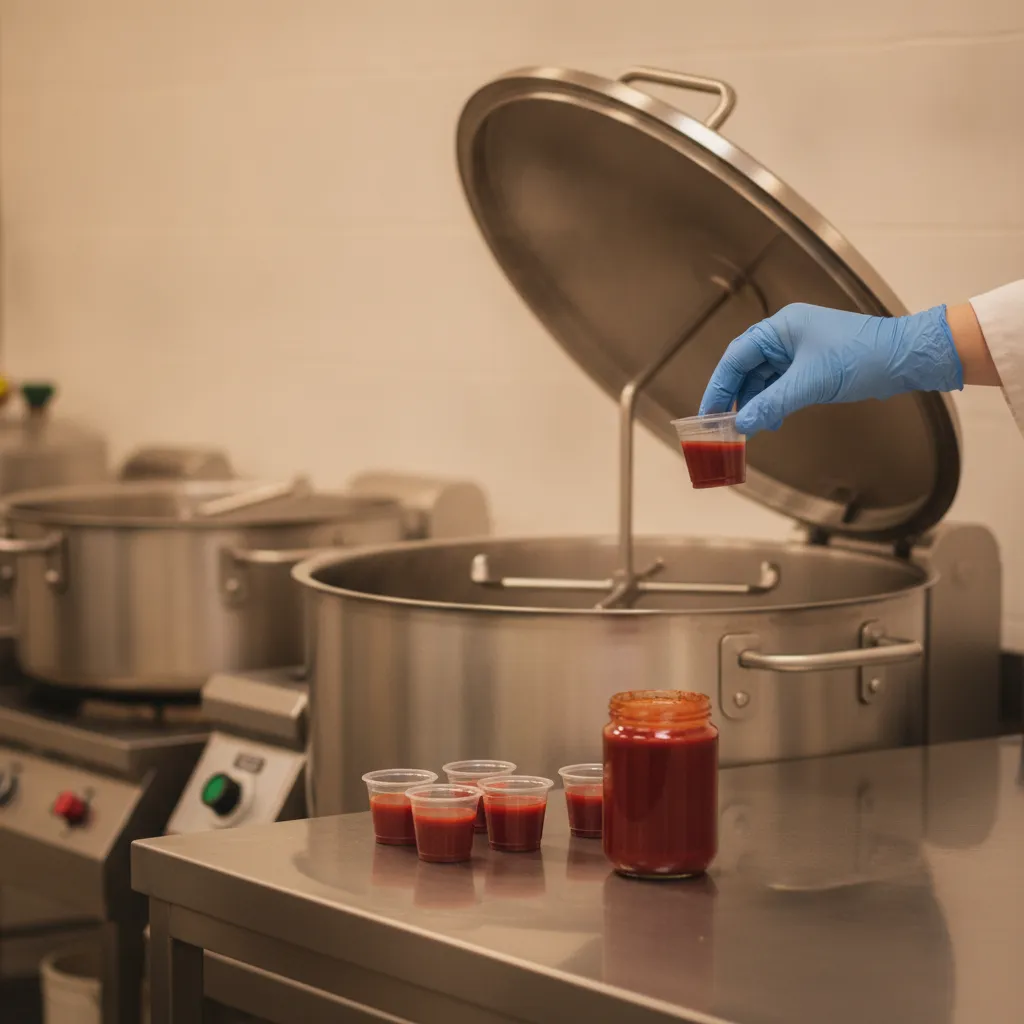
- Sample across the fill. Have containers pulled from the start, middle, and end of the run. Measure pH, Brix, viscosity, particulate weight, and color on each, and taste them. The spread inside one batch tells you as much as its average. Any pH reading outside range is a food safety matter for the plant first, not a flavor question.
- Taste over two weeks. Put the trial beside the gold standard at matched ages while it settles, and decide on the week-two comparison.
- Keep the samples coming. Ask for a sample from every batch on the new equipment and test it against the gold standard yourself. The plant runs quality control on every batch; this is your own check, and it is worth keeping long after the trial.
When the Bigger Batch Does Not Match
When the trial comes back different, the cause usually sits in one of three places. I check them in this order, cheapest first.
- Measurement. Is everyone measuring the same way? Viscosity read at a different temperature, pH taken at a different point in the process, or a different instrument in a different room can make two identical products look different. Rule this out before anything else.
- Process. Scale-up differences usually live here: longer heat-up, a different endpoint, more shear, a long fill window, slower cooling. These get fixed by rewriting the process sheet for the new equipment, together with the plant.
- Formula tolerance. Some formulas have no margin. A thickener chosen right at the edge of what the old kettle allowed, or a heat ingredient whose strength depended on the old cook time, may need to change. That is a real formula change, so it gets a new version number, a record of what changed and why, and a check on whether it touches the label, allergens, or the process review. The routine is laid out in formula change control.
Sometimes the honest answer is that the product runs better as more batches in a smaller kettle than as one large batch. Whether that is workable is a scheduling and cost conversation between you and the plant. My part is telling you what the formula will tolerate, so that conversation starts from facts.
What the Spec Looks Like Afterward
The lasting fix is structural. I split the documentation into two layers.
- A master formula with finished product targets that do not depend on equipment: percentages by weight, ingredient specs written by function rather than by brand name alone, and targets with ranges for pH, Brix, viscosity at a stated temperature, particulate size and weight, and color.
- A process sheet for each piece of equipment the product runs on: the old kettle, the new kettle, a second line if there is one. Each sheet describes how that equipment reaches the endpoints in the master spec. The endpoints are the rule and the recorded times are guidance, except where the scheduled process sets a time or temperature.
Written that way, the next move (and if volume keeps growing, there usually is one) is a new process sheet and a trial rather than a scramble, and everyone is aiming at the same numbers instead of the same clock.
The Calibration Behind the Checklist
That is the framework. The fine tuning is specific to your product: which ingredients are sensitive to a longer cook, how much margin your thickening system really has, and how to rewrite a process sheet so the new kettle lands on the same product as the old one. That calibration happens with your formula and the plant's batch data in front of me, inside client work. A product that already sells deserves to taste the same at twice the volume.
Need Help With Your Formulation?
Whether you're scaling your first recipe or reformulating an existing product, let's talk about how to get it right.
Book a Free Discovery Call