The Most Common Complaint in Food Manufacturing
You've spent months — maybe years — perfecting your recipe. You've found a co-packer, handed over your formula, run a trial batch, and then... it doesn't taste right. The flavor is muted, the texture is off, the color has shifted, or something indefinable is just different. This is the single most common complaint I hear from food entrepreneurs, and after developing 300+ commercial formulations, I can tell you: it's almost never the co-packer's fault.
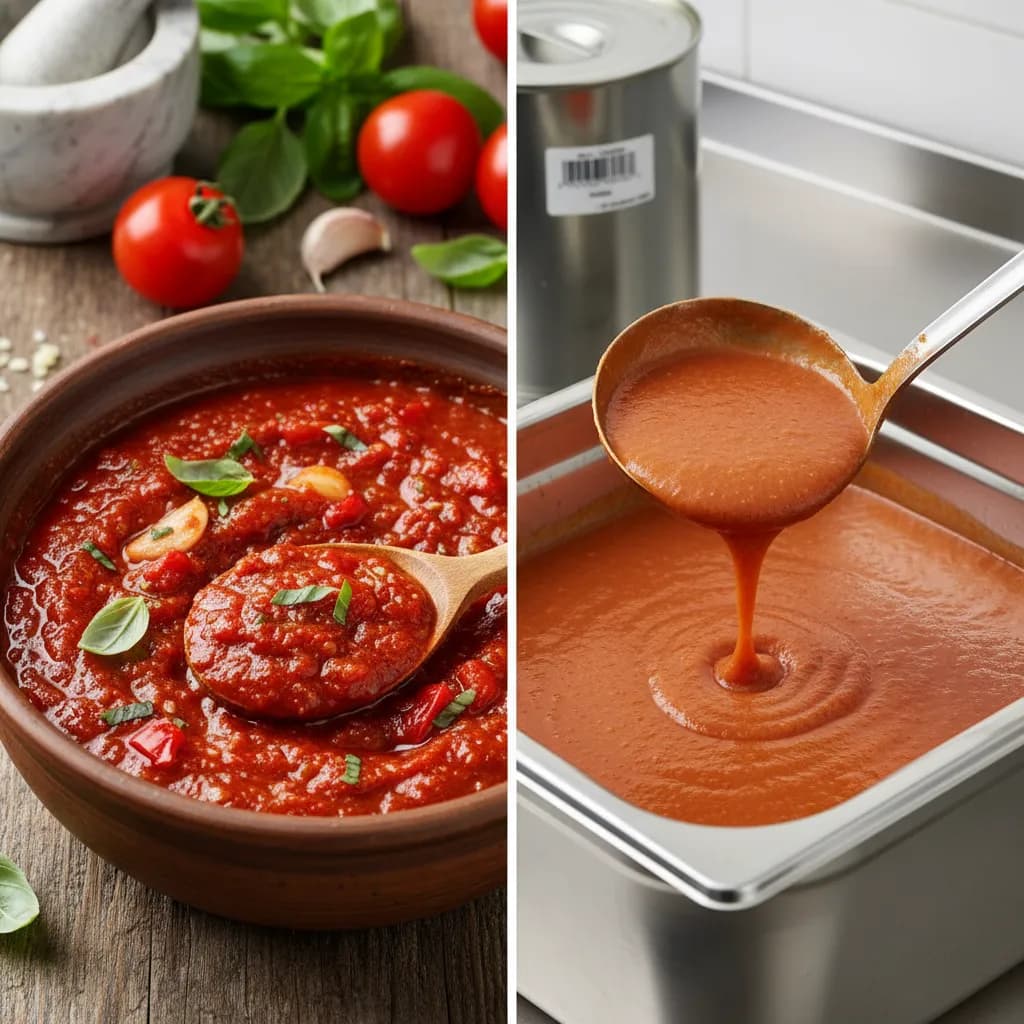
The gap between your kitchen version and the co-packer's version is a formulation problem, not a manufacturing problem. Your co-packer is executing what you gave them. The issue is that what you gave them was a home recipe, not a production formula — and those are fundamentally different things.
Understanding why the flavor changes gives you the power to fix it. And in most cases, it's fixable. Let's break down the real reasons your product tastes different coming out of a commercial facility.
Heat Transfer and Cook Time: The Physics of Flavor
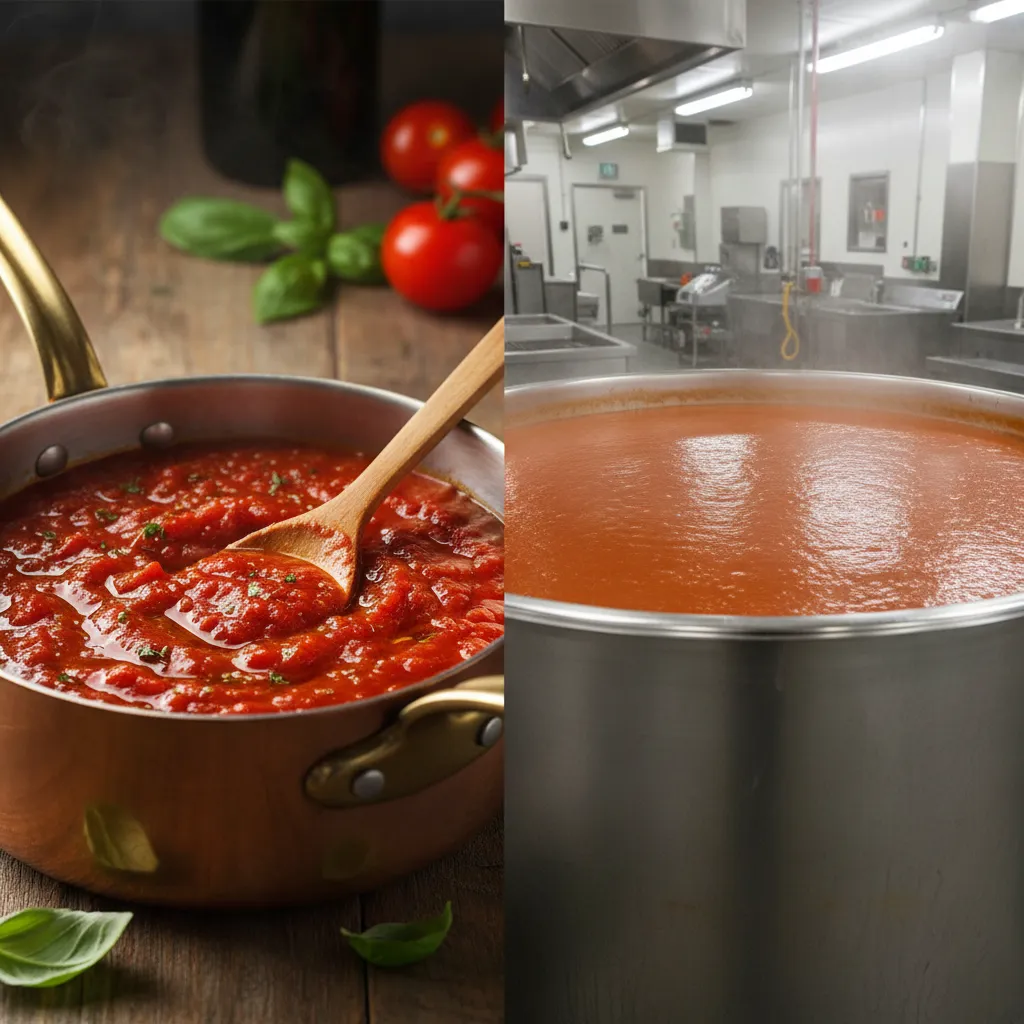
This is the number one cause of flavor difference in kettle-cooked products, and it's pure physics. When you make a sauce in a 4-quart pot on your stove, heat transfers quickly and relatively evenly through a small volume. Your sauce reaches temperature fast, cooks for the time you've dialed in, and comes off heat quickly when you turn off the burner.
In a 200-500 gallon steam-jacketed kettle, everything changes:
Ramp-up time is longer. It might take 30-45 minutes to bring a large batch to your target cooking temperature, versus 5-10 minutes at home. During that extended ramp-up, volatile flavor compounds — the aromatic molecules that give your product its distinctive character — are evaporating. Garlic, fresh herbs, citrus, and spice aromatics are particularly vulnerable.
Cool-down is slower. A large kettle retains heat far longer than a small pot. Even after you stop cooking, the product continues to cook. This carryover cooking can add 10-20 minutes of additional heat exposure, which affects caramelization levels, Maillard browning, and the degradation of heat-sensitive ingredients.
Mixing dynamics differ. Your wooden spoon at home provides gentle, frequent stirring. A commercial agitator provides consistent but different mechanical action. This affects how ingredients incorporate, how emulsions form, and how particulates break down. A chunky salsa that stays chunky with hand stirring may become a smooth sauce under commercial agitation.
The fix isn't to make the kettle behave like your stovetop — it's to reformulate your recipe for the kettle's behavior. That might mean adding aromatics later in the process, adjusting spice levels upward to compensate for volatile loss, or changing your cooking temperature to achieve the same Maillard profile at a different time/temperature combination.
Ingredient Differences You Didn't Account For
Your home recipe probably calls for ingredients by brand name or by how you shop: "2 cans of San Marzano tomatoes," "1 cup of apple cider vinegar," "3 tablespoons of local honey." In commercial manufacturing, ingredients come from industrial suppliers, and they're not identical to retail versions.
Tomato Products
The canned San Marzano tomatoes you love have a specific Brix (sugar content), acidity, and flavor profile. Your co-packer's bulk tomato paste or diced tomatoes come from a different supplier, different growing region, potentially different tomato variety, and definitely different processing. The Brix can vary by 2-4 points between suppliers, which changes sweetness, viscosity, and how much you need to use.
Vinegars and Acids
Not all apple cider vinegars are created equal. Industrial vinegars may have different acidity levels (grain strength), different flavor profiles, and lack the complexity of the artisanal vinegar you use at home. A 5% acidity ACV from one supplier can taste noticeably different from another at the same acidity level.
Spices and Seasonings
The ground cumin from your local spice shop and the bulk cumin from a commercial spice supplier can taste remarkably different. Freshness, grind size, origin, and essential oil content all vary. If your recipe relies heavily on a specific spice for its signature flavor, you may need to specify the spice by origin, mesh size, and volatile oil content in your production specification.
Sweeteners
Honey varies dramatically by floral source. The wildflower honey from your local beekeeper and commercial clover honey are different products. If your recipe's character depends on a specific sweetener's flavor contribution, you need to either source that exact ingredient for production or reformulate to achieve the same flavor profile with available commercial ingredients.
For a comprehensive look at ingredient quality trade-offs, see our article on working effectively with co-packers.
Process Authority Requirements Change Your Formula
If you're making a shelf-stable product — which includes most sauces, condiments, and dressings sold at ambient temperature — your formula has to comply with FDA regulations for acidified or low-acid canned foods. This means a process authority (a qualified food scientist) reviews your formula and prescribes a thermal process to ensure safety.
That process authority may require changes to your formula:
pH adjustments: Your product needs to maintain a pH below 4.6 throughout its shelf life to prevent Clostridium botulinum growth. If your home recipe hovers near 4.4-4.6, the process authority may require you to add more acid as a safety margin. More vinegar or citric acid changes the flavor.
Extended thermal processing: The prescribed cook time at a specific temperature may be longer than what you do at home. More heat exposure means more flavor change — see the heat transfer section above.
Ingredient restrictions: Some ingredients behave unpredictably in terms of pH buffering. Dense particulates (chunks of meat, large vegetable pieces) may require more aggressive processing to ensure the center of each particle reaches a safe temperature. The process authority may ask you to reduce particle size or change the ratio of solids to liquid.
These aren't optional suggestions — they're food safety requirements. But they don't have to ruin your product. A skilled developer can reformulate around these constraints while preserving your product's essential character. That's exactly what production-ready formulation means.
The Measurement Problem: Volume vs. Weight
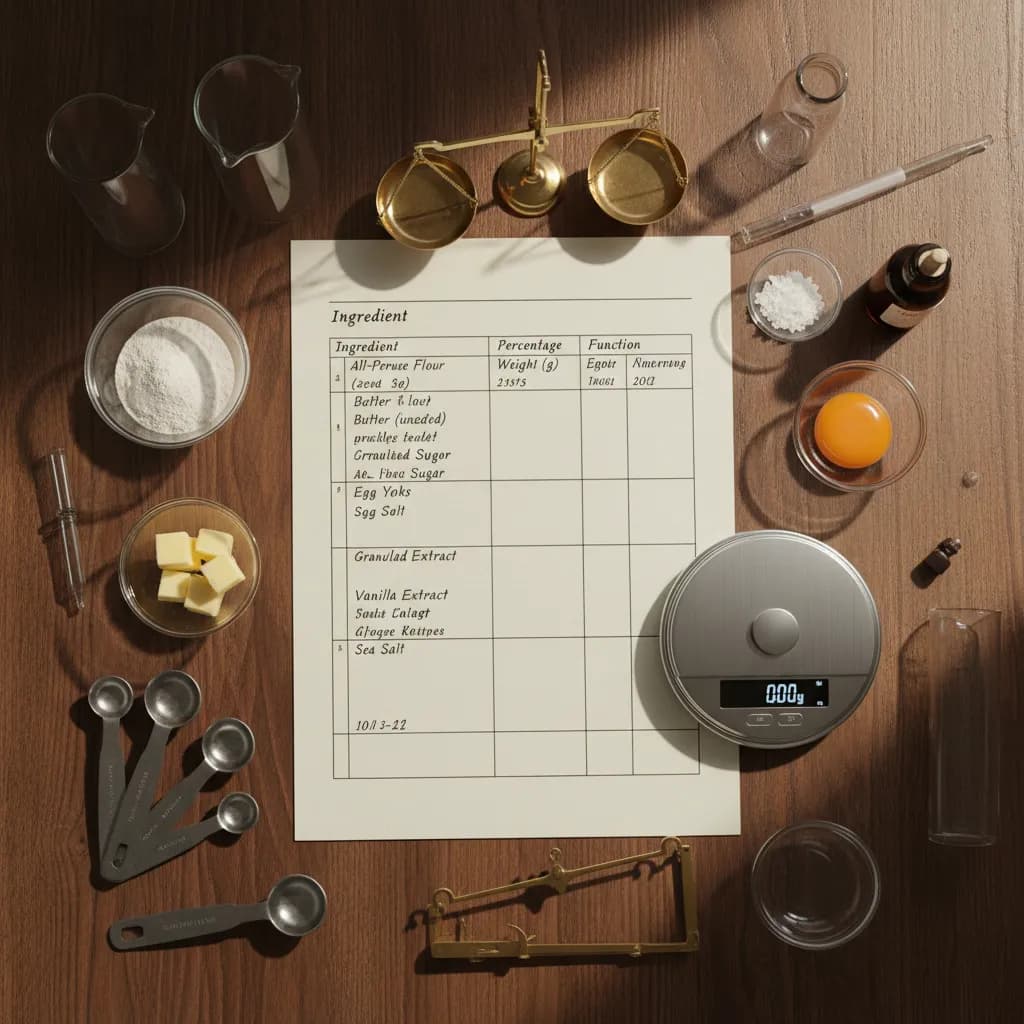
This one is embarrassingly common, and it causes more failed trial runs than people realize. Home recipes are written in volume measurements: cups, tablespoons, teaspoons. Commercial formulas must be in weight — and the conversion isn't straightforward.
A cup of diced onion can weigh anywhere from 115-170 grams depending on how finely it's diced and how tightly it's packed. A tablespoon of ground cayenne pepper weighs about 5 grams, but a tablespoon of garlic powder weighs about 10 grams. When you convert a volume-based recipe to weight percentages — which is what your co-packer needs — small measurement errors compound across a large batch.
If your cayenne conversion is off by even 1 gram per tablespoon, that error multiplied across a 500-gallon batch could mean the difference between pleasantly spicy and painfully hot. Or noticeably bland.
The solution: develop your production formula in weight from the start. Convert your home recipe, then test the weight-based version at small scale to verify it matches your original. Adjust as needed before ever sending it to a co-packer.
How to Fix the Flavor Gap
If you're already in this situation — you've done a trial run and the product doesn't taste right — here's a systematic approach to fixing it:
Step 1: Make your home recipe side-by-side with the co-packer sample. Do a blind tasting with 3-5 people and document specific differences. Not "it tastes wrong" but "the garlic is muted," "it's too acidic," "the texture is thinner," or "the smokiness is missing."
Step 2: Audit the ingredient supply. Request specification sheets for every ingredient your co-packer used. Compare Brix levels, acidity, mesh sizes, and origins to what you use at home. Identify any mismatches.
Step 3: Review the process log. Ask your co-packer for the time and temperature log from your trial run. How long was the ramp-up? What was the cooking temperature and duration? How long did cool-down take? Compare this to your home process.
Step 4: Reformulate, don't just "add more." The temptation is to say "just double the garlic." But if garlic flavor is being lost to extended heat exposure, doubling the garlic might give you a harsh, sulfurous flavor instead of the roasted garlic character you want. The solution might be adding garlic at a different point in the cook, or using a combination of roasted garlic paste and garlic oil instead of fresh garlic. Learn about common pitfalls in scaling sauce recipes.
Step 5: Run a focused trial. Don't make 8 changes at once. Change 1-2 variables per trial run so you can isolate what's actually making the difference. Yes, trial runs cost money — $2,000-$5,000 each is typical. But three focused trials are cheaper and more productive than six unfocused ones.
Prevention: Getting It Right Before the First Trial
The best approach is to prevent the flavor gap from occurring in the first place. This means investing in proper production formulation before you ever book a trial run at a co-packer.
A qualified recipe developer will:
Convert your recipe to weight-based percentages and verify the conversion produces an identical product at small scale. Identify ingredients that will behave differently at commercial scale and reformulate proactively. Specify ingredients by commercial supplier specifications, not retail brand names. Account for heat transfer differences in their processing parameters. Build in the pH and safety margins your process authority will require. Create a comprehensive specification document that leaves nothing to interpretation.
This upfront investment — typically $5,000-$12,000 depending on product complexity — eliminates most of the trial-and-error cycle that causes founders to spend $15,000-$25,000 on repeated failed trial runs. It's the most cost-effective step in the entire commercialization process.
Frequently Asked Questions
How many trial runs should I expect before my co-packer's version matches mine?
With a properly developed production formula, 1-2 trial runs is typical. Without one — if you're handing a co-packer a home recipe — expect 3-6 trials, and some brands never quite get it right. Each trial run typically costs $2,000-$5,000, so the math strongly favors investing in formulation first.
Should I switch co-packers if the product doesn't taste right?
Usually not. If the problem is in your formula (which it almost always is), switching co-packers just resets the trial-and-error cycle at a new facility. Fix the formula first. The exception is if your co-packer's equipment genuinely can't handle your product — for example, they don't have the agitation capability for a proper emulsion, or their kettle doesn't reach the temperature you need for Maillard development. In that case, you need a different facility, not a different formula.
Can I bring my own ingredients to the co-packer?
Some co-packers allow customer-supplied ingredients, but many prefer to source through their own supply chain for consistency and food safety traceability. If a specific ingredient is critical to your product's identity (a particular honey, a specific chili pepper variety), discuss this with your co-packer upfront. They may be willing to accommodate it, or they may be able to source something equivalent through their channels. The key is to specify it in your production agreement, not assume.
Why does my sauce taste different batch to batch from the same co-packer?
Batch-to-batch variation usually comes from ingredient variation (especially with natural ingredients like produce and honey that change seasonally), slight process variations (cook time, temperature), or operator differences between shifts. The solution is tighter specifications — not just a recipe, but target ranges for pH, Brix, viscosity, color, and organoleptic (taste/smell) quality checks at multiple points during production.
Is it worth hiring a consultant just for one trial run fix?
Absolutely. If you've already done one or two failed trials at $2,000-$5,000 each, spending $3,000-$7,000 on a consultant to diagnose the issue, reformulate, and support a corrected trial is almost certainly cheaper and faster than continuing to iterate on your own. A good co-packer relationship combined with a solid production formula is the fastest path to a product you're proud of.
Need Help With Your Formulation?
Whether you're scaling your first recipe or reformulating an existing product, let's talk about how to get it right.
Book a Free Discovery Call