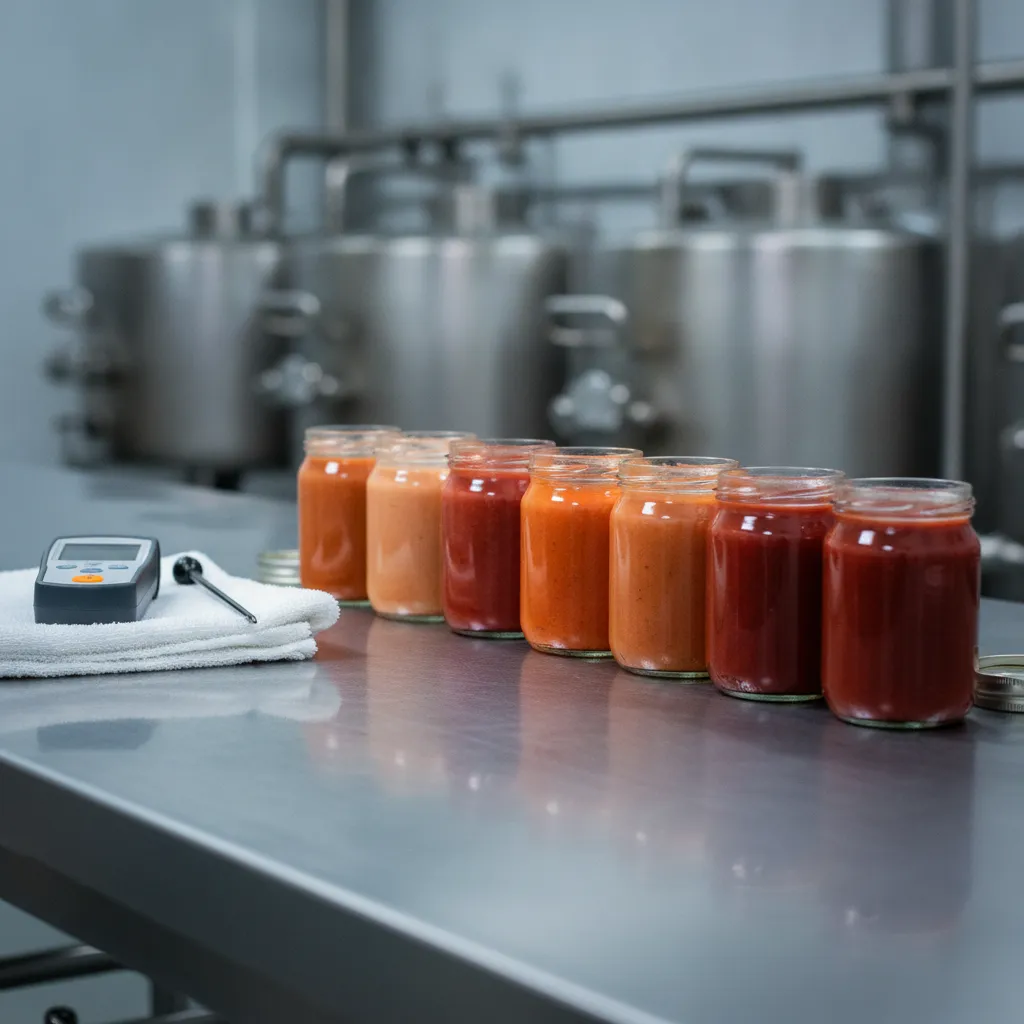
Picture a stack of batch records from the last few months. Lot 0311 was a touch thin. Lot 0318 was right. Lot 0402 came out sweet, with Brix high but inside the range. Lot 0409 was hotter than anyone expected. Lot 0416 was fine, though a buyer said the color looked darker. No batch failed. None would have been held. And yet a customer who buys your sauce three times this year may get three noticeably different products.
That is batch-to-batch variation, and it is a different problem from a bad run. A bad run is one batch that clearly went wrong, with a cause you can usually trace in its own records (see what to do when a production run comes back wrong). Chronic variation is a spread. Every batch is a little different in a different direction, nothing is dramatic enough to trigger a hold, and the cause rarely shows in any single batch. You find it by looking at many batches side by side. A spread has a shape, and the shape usually tells you where to look.
Why the Spread Matters When Every Batch Passes
It is tempting to leave it alone: every batch shipped and nothing is unsafe. But a wide spread costs you in quieter ways.
- Your regulars notice first. "It's not as good as it used to be" often means "the last jar was different from the one before."
- The spec bends to fit the product. When batches keep landing at the edges, the easy fix is to widen the range until they pass. Do that a few times and the spec no longer describes your product.
- Safety margin gets spent on variation. On an acidified product, plants and process authorities usually want a cushion well under the 4.6 line, partly to absorb movement after production. If your pH wanders from batch to batch, the high end of that wander is the number that matters. More in why pH drifts after production.
Start a Batch Log Before You Change Anything
The first instinct is to change something: a new supplier, a tweak to the salt, a tighter range. Hold off until you can see the pattern, or you risk fixing the wrong thing and adding a new source of variation on top of the old one.
A batch log is one row per lot, kept over time, that puts the plant's records and your own observations in one place. Much of it already exists in your co-packer's batch records; your job is to ask for it consistently and line it up. Useful columns:
- Identity: lot code, make date, batch size, and which kettle, line, and shift made it.
- Ingredient lots: supplier lot numbers for the ingredients that carry your product (the tomato base, the chiles, the vinegar, the oil, the thickener), with the key numbers from each lot's certificate of analysis, such as Brix, acidity, moisture, or heat level.
- Process records: time to reach cook temperature, actual cook temperature and hold time, when key ingredients went in, any water added, how long the finished batch waited before filling, and fill temperature.
- Finished readings: pH, Brix, viscosity, salt, and color, each with its method, its temperature, and whether it was read hot from the kettle or later from a filled jar.
- Your tasting: notes on the sample you get from every batch, tasted against your reference once settled, as described in the gold standard jar and retained samples.
- What happened after: complaints, buyer comments, or returns tied to that lot code.
A spreadsheet is fine. What matters is that the same columns get filled for every lot, long enough that one odd batch can't fool you. A handful of batches is a start; a full season of production is better.
Line the Batches Up and Look for the Shape
Once you have enough rows, sort and chart the finished readings and tasting notes, and ask one question: what does the variation move with?
- If it moves with ingredient lots (the sauce shifts whenever a new delivery of chiles or paste arrives), look at raw materials.
- If it moves with the kettle, the shift, or the day (one kettle runs thick, one shift runs hot), look at unwritten process steps.
- If it moves with who measured, or when (readings jump when a new technician starts, or hot readings disagree with cooled ones), look at the measurement method before you look at the sauce.
- If it wanders with no pattern and nobody can say for sure whether a batch is right, look at the spec. It may not have ranges.
- If it moves slowly in one direction over months, look for gradual change: a supplier quietly changing its source, an instrument drifting out of calibration, or your reference jar getting old.
Real products often show more than one of these. Start with the strongest pattern and work down.
Four Places Variation Hides
1. Raw materials that vary more than the formula assumes
Chile heat changes with the crop, tomato solids with the season, fruit acid and sugar with the weather. Designing around that (target-based specs, lot blending, standardized real-food forms, correction levers) is covered in managing ingredient seasonality.
What the batch log adds is evidence. Put each ingredient lot's certificate numbers next to the finished readings and you can see whether a high-Brix paste lot really shows up as a sweeter batch. The other raw-material trap is an ingredient specified by brand name instead of by what it has to do. When the usual item is out and purchasing buys a reasonable equivalent, the "same" ingredient changes and nobody broke a rule. An ingredient spec that names the function and the acceptable numbers (acidity, Brix, grind size, heat range) closes that gap.
2. Process steps that were never written down
This is the one that shows up as kettle, shift, or day patterns. Plant operators are skilled, and they fill gaps in your instructions with sound judgment, but two skilled operators can fill the same gap two different ways. Common gaps:
- "Cook until thick" instead of an end point with a number attached.
- No stated addition point for aromatics, so garlic or herbs go in early on one shift and late on another.
- No limit on how long a finished batch can sit hot in the kettle, under agitation, waiting for the filler.
- Water added by eye to make up for evaporation.
- A starch or spice blend added a different way each time, sometimes well dispersed and sometimes clumping.
Hold time deserves special attention in thickened products. A starch or hydrocolloid (a thickening gum) can only take so much heat, stirring, and time in an acidic product. A thickener working near the edge of what it tolerates may hold when a batch fills right away and thin out when the same batch waits an extra hour in an agitated kettle. On paper, those are the same batch.
3. Measurement methods that disagree
Sometimes the sauce is steadier than the numbers. Viscosity changes a lot with temperature, so a hot reading from the kettle and one from a cooled jar describe two different things. Brix moves with temperature unless the refractometer compensates for it. An uncalibrated pH meter drifts. A sample from the top of the kettle is not one from a filled jar, and a product read on make day often reads differently once it has settled.
None of this means anyone did anything wrong. A method was simply never pinned down. Write it into the spec for every number that matters: where the sample comes from, at what temperature, with which kind of instrument, calibrated how, and how long after production. The guide to Brix targets shows what a fully specified reading looks like for one attribute.
4. A spec with targets but no ranges
"pH 3.8. Brix 30. Viscosity medium-thick." Nothing on a spec like that says how far is too far, so every batch becomes a judgment call, and judgment calls vary by person and by day. Some attributes, often heat and color, may have no target at all. They aren't controlled; they just happen.
A usable spec gives every attribute that matters a target, a range, a method, and an action for when a batch lands outside it, which is the job of a finished product spec used as release criteria. For a variation problem, the key point is that the quality ranges come from your batch log: what your product actually does when it is made well, not what you wish it did. Safety limits, such as the pH ceiling, come from your process authority, not from the log.
Is the Formula Fragile, or the Process Loose?
Across many batches, the key question is whether the plant is doing different things, or the formula is turning normal, reasonable differences into a noticeable change in the jar. Some formulas are simply fragile.
Signs the formula is fragile:
- It lives near an edge. A pH close to its limit, a thickener near its tolerance for heat or shear, a salt level right where seasoned tips into salty. Small, normal swings push it over.
- One ingredient carries everything. If a single fresh chile provides all the heat and most of the flavor, the product swings as hard as that crop does.
- Every batch needs fixing. If the plant routinely adjusts at the end of each batch to bring it back, the formula is not landing on its own.
Signs the process is the bigger factor: the spread follows kettle, shift, or hold time rather than ingredient lots; batches made exactly as written come out consistent; or the product held steady early on and the spread grew as volume, staffing, or scheduling changed.
When the log can't settle it, test the formula on purpose at the bench. Make it with ingredients from the high and low ends of their normal range, with a shorter and a longer hold, and measure and taste the results against the reference. If the product barely moves, the work belongs in the process notes. If it swings, the formula is the problem, and discipline on the plant floor alone is unlikely to fully fix it.
The answers to a fragile formula are things I try to build in from the start: more margin from the edges, heat and flavor carried by more than one ingredient, standardized forms such as an oleoresin (a concentrated spice extract, which can hold heat, flavor, and color more steadily than a ground spice or fresh chile), and a thickening system chosen for the plant's real conditions rather than a stovetop's.
Giving the Plant a Spec That Narrows the Spread
The plant runs its own process and quality control, and it should. What you can give it is a spec worth holding to. One built to narrow variation usually adds six things:
- Ranges drawn from real data. A target and range for every attribute that matters, including the ones customers notice but nobody measured.
- The method for every reading, so two people measuring the same batch get the same answer.
- The steps that matter, written with numbers. End points instead of "until thick", addition points for sensitive ingredients, a maximum hold before filling, and a fill temperature, each with a short reason, so operators know which steps are critical. Where a step is part of the scheduled process, the number comes from your process authority.
- Ingredient specs by function. What each critical ingredient must measure on arrival, so an equivalent really is equivalent.
- Approved correction rules, if any. If the formula allows an end-of-batch adjustment, say which ingredient, which direction, what limit, and when to stop and call instead. Anything touching acid, pH, or another factor in the scheduled process needs your process authority's review first.
- The reference. A labeled gold standard and a written sensory description at the plant, so the tasting check near the line matches yours.
Two cautions. Don't tighten a range past what the process can currently hold; a range the plant can't hit only produces holds and frustrated phone calls. Tighten in steps as the spread narrows. And change one thing at a time, so the log shows which change did the work.
Bring the Plant Into It
A variation problem is easier to solve as a shared one. A co-packer is running many products for many brands, and inside that system the spec is what speaks for yours. A clearer spec helps the plant's quality team too, because it replaces judgment calls with answers. Share the batch log, show the patterns, and ask what they see; the people who run those kettles know things no spreadsheet will tell you. Then agree on a standing review of the log, so the next drift shows up as a trend, not a complaint.
One exception to that collaborative pace: if the pattern involves pH or any reading tied to your scheduled process, treat it as a food safety question first and bring in the plant's food safety team and your process authority right away.
What the Log Can't Decide for You
A batch log and a better spec can take you a long way, and you can start both this week. The judgment underneath them is specific to your product: how wide a range can be before a customer tastes the difference, whether a fragile formula should be rebuilt or protected with tighter process notes, and which adjustments a plant can safely make on its own. That calibration happens inside the work, with the formula, the log, and the plant's process on the table together. Until then, keep logging. The spread is telling you something, and it is usually more specific than "the batches are inconsistent."
Need Help With Your Formulation?
Whether you're scaling your first recipe or reformulating an existing product, let's talk about how to get it right.
Book a Free Discovery Call