Brix Is the Most Useful Number Most Founders Don't Track
If you're making BBQ sauce, ketchup, hot sauce, dressings, fruit glazes, or any product with meaningful sugar or soluble-solid content, there's one measurement that quietly controls a lot: Brix. Most founders don't track it explicitly. They reduce by time, taste, and gut feel. That works at home. It does not work consistently at 100 gallons a batch with a co-packer who needs a number to hit.
Brix is the number that lets you ship the same product run after run.
What Brix Actually Measures
Brix is a measurement of soluble solids in a liquid, expressed as a percentage by weight. A reading of 28 Brix means roughly 28 percent of the dissolved mass is solids (sugars, acids, pectins, salts, and other dissolved compounds) and 72 percent is water.
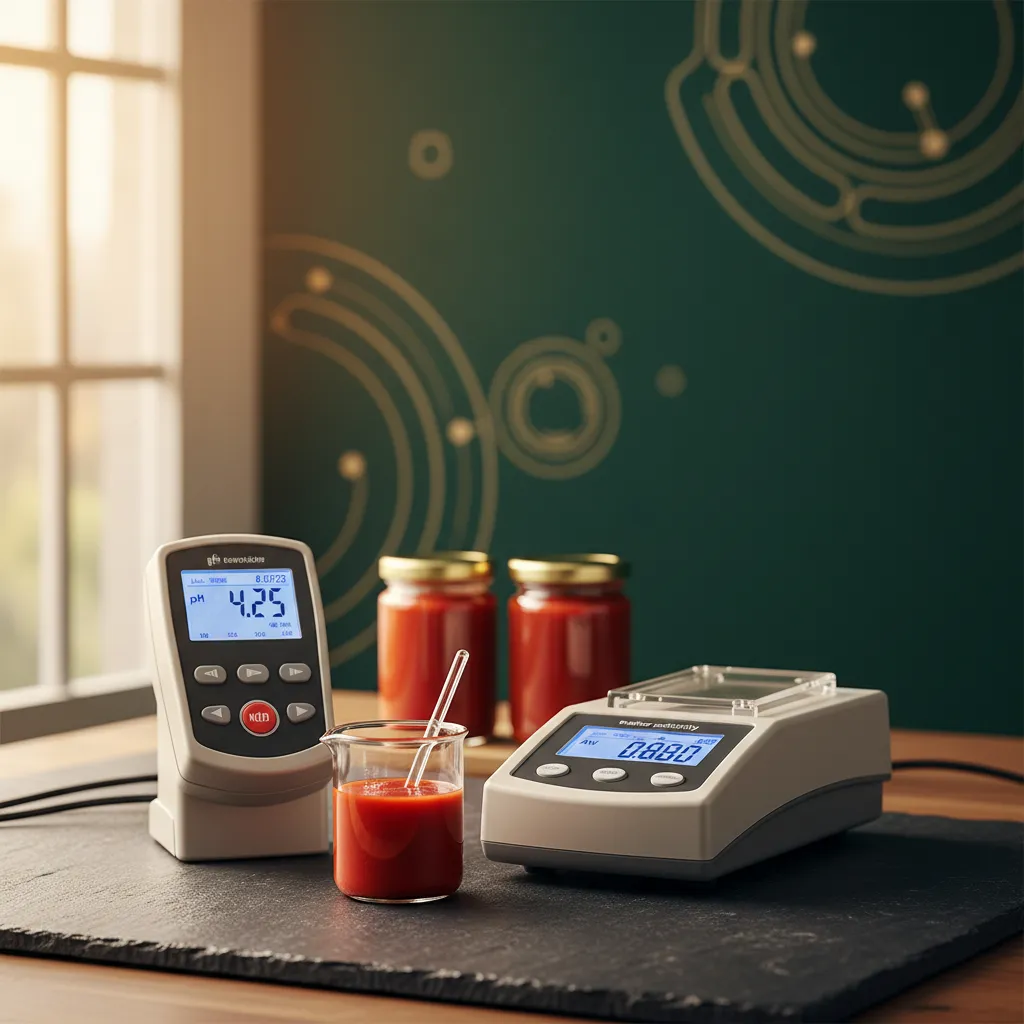
The instrument that measures it, a refractometer, uses the fact that light bends differently when it passes through liquids of different solid content. Hand-held and benchtop refractometers calibrate to the sucrose scale, which is why you'll sometimes hear Brix expressed as "degrees Brix" or "percent sugar." For most sauces and condiments, the dominant soluble solids are sugars, so the reading is a reasonable proxy for sugar content. For products with significant non-sugar solids (a ketchup with high tomato solids, a thickened savory glaze), the reading captures the total, not just sugar.
The practical value isn't theoretical chemistry. It's that Brix is fast, cheap, and reproducible. A batch operator with a refractometer can read finished Brix in under 30 seconds and decide whether the cook is done.
Typical Brix Ranges by Category
These are working ranges I see in real products. Yours may sit inside or outside, depending on positioning, sweetness, and recipe.
BBQ sauce
Most commercial BBQ sauces land between 30 and 50 Brix. Sweet, mass-market BBQ sauces (Kansas City style) often hit 40 to 50. Vinegar-forward, Carolina-style BBQ sauces sit lower, sometimes 20 to 30. The number reflects sweetness, body, and shelf-stability strategy.
Ketchup
Standard ketchup is typically 28 to 32 Brix for retail-grade. Premium ketchups can run to 35. The U.S. Standard of Identity for ketchup defines specific Brix and consistency ranges for grades A, B, and C.
Hot sauce
Vinegar-and-pepper hot sauces are usually 5 to 12 Brix, mostly water and acid. Sweeter hot sauces, peach habanero, mango, agave-sweetened products, can run to 25 or higher.
Dressings and vinaigrettes
Wide range. Vinaigrettes can sit at 10 to 20 Brix. Sweet dressings, honey mustard or French, climb to 30 to 40. Creamy dressings with significant non-sugar solids have less direct Brix correlation.
Fruit glazes and reductions
Often 50 to 70 Brix. High enough that water activity drops meaningfully and the product becomes more shelf-stable on the moisture side, less reliant on acid alone.
How Brix Connects to Shelf Stability
Soluble solids tie directly to water activity (Aw), the measurement that controls microbial growth in a finished product. As Brix climbs, the available free water that microorganisms can use to grow drops. This is why a fruit jam at 65 Brix is shelf stable on the moisture hurdle alone, even at a relatively neutral pH, while a low-Brix sauce relies on acid (pH) for its safety.
For a deeper look at how this works alongside pH, see water activity vs pH.
The practical implication: if your sauce is built on a multi-hurdle system (pH plus Aw), shifting Brix shifts the Aw side of the equation. A reformulation that drops Brix to reduce sweetness can quietly compromise shelf stability if you don't compensate elsewhere.
How Brix Connects to Mouthfeel
Sugars carry body. So do other dissolved solids. A Brix shift of 4 or 5 points is something a tasting panel can usually detect, often in the form of "thinner" or "less rich." You can compensate with hydrocolloids, with oil, or with non-sugar bulking agents, but each substitution has trade-offs in label and texture profile.
This is where Brix becomes a design lever rather than a final spec. Choosing a target Brix early, before you optimize the rest of the recipe, saves a lot of reformulation later.
Hitting Brix: Sugar Adjustment vs Evaporation
You have two main routes to a target Brix.
Sugar adjustment
Add or remove sweetener to move Brix. Fastest, cleanest in batch records, and the only practical lever in a cold-process or short-cook product. The constraint is your label promise: a clean-label brand can't always lean on added sugar to hit a number.
Evaporation
Reduce by cooking. Concentrates everything (sugars, acids, salts, aromatics) proportionally. Builds depth of flavor in many savory categories. The constraint is energy cost (evaporating water in a kettle is expensive at scale) and the fact that long cooks degrade aromatics, color, and certain pigments. BBQ sauce founders frequently over-reduce a kettle batch trying to chase a Brix number; the number lands but the flavor goes flat.
The honest answer is that most production recipes use a blend: a target sugar load, a target reduction percentage, and a final Brix check that confirms both fell into spec.
Refractometer Use in Production
A few practical notes founders learn the hard way.
Temperature matters. Refractometer readings drift with temperature. Hand-held units typically include automatic temperature compensation (ATC). Without it, a hot sample reads differently from a cool one. Standardize sample temperature in your QC procedure.
Particulates throw readings off. A chunky salsa or a sauce with visible solids needs to be filtered or pressed for a clean reading. Some refractometers handle particulates better than others; choose the right instrument for your product type.
Calibration drifts. Refractometers should be zeroed against distilled water before each shift, and recalibrated periodically against a sucrose standard. A small habit that prevents drift across runs.
Building Brix Into Your Production Spec
A real spec might read: "Finished Brix 38.0, acceptable range 36.5 to 39.5, rejection below 35.0 or above 41.0, measured at 20 degrees Celsius using ATC refractometer after homogenization." That's a number a co-packer can hit, a QC tech can verify, and a brand owner can defend.
Without a Brix spec, you're shipping a different product every batch and hoping the customer doesn't notice.
For broader formulation and scale-up context, see condiment formulation, BBQ sauce at scale, and what makes a recipe production-ready.
Frequently Asked Questions
Is Brix the same as sugar content?
For most sauces and condiments where sugar is the dominant soluble solid, the two correlate closely. For products with high non-sugar solids (tomato paste, salt-heavy sauces, thickened glazes), Brix overstates the sugar number. Read the label requirements before you lean too hard on Brix as a sugar proxy.
What's a good refractometer for a small CPG operation?
A hand-held ATC digital refractometer in the $50 to $300 range covers most needs for retail-grade sauces and condiments. Benchtop units run higher and offer better repeatability for tight specs.
Does Brix change after the product cools?
The Brix number itself doesn't shift much with cooling; the reading does, because of temperature effects on the refractometer. Use ATC or read at a standardized temperature.
How does Brix relate to shelf life claims?
Higher Brix usually correlates with lower water activity, which generally extends shelf life. But shelf life depends on pH, packaging, thermal process, and oxidation as well. Brix is one input.
Where Brix Becomes a Tool, Not a Number
Specifying Brix is the easy part. Designing a recipe so that the path from ingredients to finished Brix runs the same every batch, that's the work. If you're inheriting a recipe that hits Brix on Tuesday and misses it on Thursday, the fix is upstream of the refractometer. Book a Free Discovery Call if you want a hand finding the upstream variable.
Need Help With Your Formulation?
Whether you're scaling your first recipe or reformulating an existing product, let's talk about how to get it right.
Book a Free Discovery Call