The Day You Find Out You Might Not Own Your Own Recipe
A founder emails me, calm on the surface, quietly panicking underneath. Sales are climbing, a buyer has started sniffing around, and during diligence someone asks a simple question: "Can you show us documentation that you own the formula?" The founder realizes they cannot. The recipe lives in the co-packer's system, the last three reformulations were done by the co-packer's food scientist, and there is no signed NDA, no development agreement, no master spec the founder actually controls. On paper, the most valuable thing the brand owns is the thing it can least prove it owns.
This is one of the most common ownership surprises I work through with founders, and it almost never comes from bad intent. It comes from small, reasonable-in-the-moment decisions: letting the co-packer "clean up" the recipe, never getting a confidentiality agreement signed, treating documentation as busywork. It stays invisible until it matters most: when you switch partners, raise money, or sell. I am a chef and formulator, not an attorney, and nothing here is legal advice. Contracts and ownership terms are a lawyer's domain, so hire a food-industry attorney to paper these relationships. What I can do is show you where ownership actually lands.
Why a Recipe Is Usually a Trade Secret, Not a Patent
Founders often assume the way to own a formula is to patent it. For the overwhelming majority of food brands, that is the wrong tool. In practice, recipes are protected as trade secrets, and understanding why changes how you handle everything downstream.
You can technically patent a food composition or process, but it is hard and usually impractical. A patent requires the recipe to be novel and non-obvious, which most sauces, dressings, and seasoning blends are not in a strict legal sense. And here is the part that stops most food founders cold: a patent requires you to publicly disclose the invention, in exchange for a protection that expires (typically after about 20 years). For a product whose entire value is that nobody else can make it taste like yours, that is the opposite of what you want.
A trade secret works the other way. It protects information that has value precisely because it is not generally known, for as long as you keep it secret. The classic examples (the cola formula, the fried chicken blend) are trade secrets, not patents, for exactly this reason. The catch is that protection is conditional: it only holds if you take reasonable steps to keep the information confidential. So your ownership does not come from a certificate on the wall. It comes from secrecy, documentation, and contracts. Confirm the specifics with an attorney, because trade secret law varies by state and by facts.
Your Formula Versus the Co-Packer's House Base
There is a real difference between your proprietary formula and a co-packer's house base, and the trap is not noticing which one you are building on.
Many co-packers, especially in high-volume categories, work from their own base formulas: a barbecue base, a ranch base, a hot sauce base, reused across many clients. When a founder shows up with a kitchen recipe, the fast, cheap path is to nudge one of those bases toward your flavor. Adjust the sweetness, swap a spice, tweak the acid, call it yours. It tastes close enough and the quote comes back low. The problem shows up later. If your product is really the co-packer's base with your seasoning on top, then in a meaningful sense they own the foundation of your product and you own a tweak. When you try to move, you cannot take the base with you, because it was never yours. You are back to reformulating from scratch, and the recipe you thought you owned turns out to be a paragraph of adjustments.
Renting a platform spot to reach shelf fast is legitimate. The point is to know, in writing, which thing you are buying: independent development of a formula that is yours, or access to the co-packer's proprietary base with cosmetic customization. Only one leaves you owning the product. Ask directly, and get the answer in the agreement.
NDAs and Confidentiality: The Floor, Not the Ceiling
Before you send a co-packer your full formula, there should be a mutual non-disclosure agreement in place, the baseline hygiene of trade secret protection. It signals that you consider the information confidential and gives you recourse if it leaks. Skipping it is one of the most avoidable ways founders erode their own position. A few things that matter in practice, all of which your attorney should tailor:
- Definition of confidential information. It should explicitly cover the formula, ingredient ratios, suppliers, process parameters, and your specification documents, not just "information marked confidential."
- Survival and duration. Trade secrets can last indefinitely, so a confidentiality obligation that expires in two years can undercut you while the secret is still valuable.
- Residuals clauses. Watch for language that lets the other party freely use anything retained in the "unaided memory" of their staff. In a formulation context, that can be a large loophole.
An NDA is necessary, but do not mistake it for full ownership protection. It restricts disclosure. It does not settle who owns work created during the relationship, which is where a lot of value leaks out.
Who Owns the Improvements and Reformulations?
You launch with a formula you developed. Over the next year, the co-packer helps you solve real problems: they fix a separation issue, dial in a more stable viscosity, swap an ingredient to cut cost. Each fix is genuinely helpful, and each one also creates new intellectual property. Unless your contract says otherwise, ownership of that new work is not automatically yours; it generally follows whoever created it. So you can end up in a strange split: you own the original formula, the co-packer owns the better version you actually sell. When you try to leave, they may argue the shipping product is partly their development, and even if you would eventually win that argument, the ambiguity alone can freeze a sale.
The clean structure, which your attorney can implement, is to state up front that all improvements, modifications, reformulations, and derivative works relating to your product belong to you, regardless of who develops them, and that the co-packer assigns any rights they might otherwise have. Co-packers who work fairly with brands are usually comfortable with this, because their business is manufacturing, not owning your recipe. For the mechanics of when and why formulas change over a product's life, see recipe reformulation, when and why.
Work-for-Hire With a Recipe Developer
The same logic applies when you hire an outside formulator, and I will be direct, since this is my own category. When you bring in a developer, the default legal ownership is not what founders assume. "Work made for hire" is a specific legal concept that does not automatically apply to an independent contractor just because you paid them, so the agreement has to do the work. A well-drafted development agreement should spell out that:
- The formula, specifications, and all documentation created in the engagement are owned by you, the brand, on payment.
- The developer assigns all intellectual property rights in the deliverables to you, and agrees to sign anything needed later to perfect that transfer.
- The developer keeps your information confidential and does not reuse your specific formula for another client.
- Any pre-existing tools and general background know-how the developer brings stay theirs, while the product-specific formula they build for you is yours.
That last point is worth understanding rather than fearing. A good developer arrives with general craft: how acids balance, how real umami is built from ingredients like roasted tomato, mushroom, or miso instead of reaching first for synthetic flavor. That expertise is theirs. What becomes yours is the specific formula, the specific ratios, and the production spec built for your product. A formula the founder cannot fully control is not really an asset they can build a company on, so I want them owning it outright. For what that engagement looks like, see when to hire a recipe developer.
The Thing You Actually Own: Your Master Spec
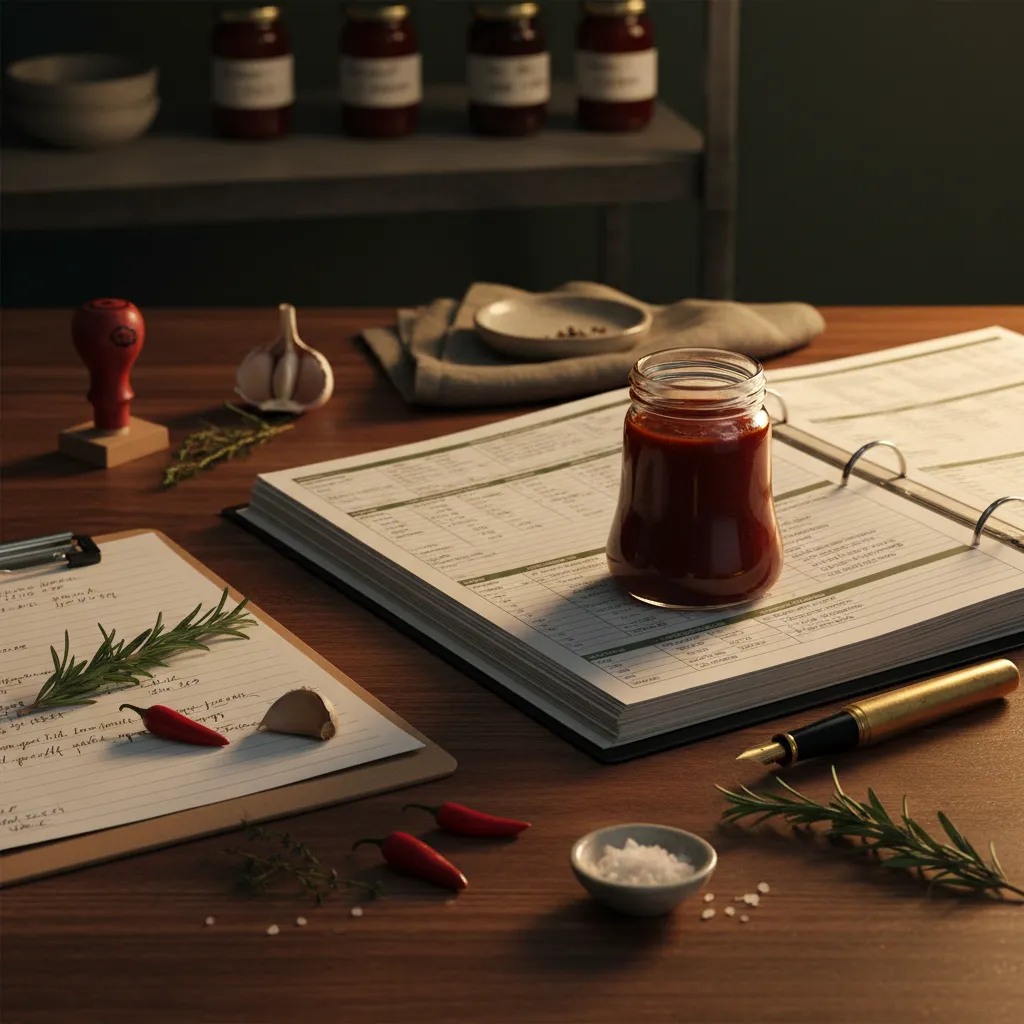
Here is the reframe I give every founder. Stop thinking of the recipe as a card with ingredients on it. The real asset, the thing you own and can move, is a complete, production-grade master specification, the documented, transferable version of your product.
A master spec is not a home recipe scaled up. It is the full production picture: exact ingredient identities and grades (not "tomato paste" but the specific paste at a specified solids level and break type), suppliers and acceptable alternates, ingredient percentages by weight, the process flow with real temperatures and hold times, target specs with ranges and rejection thresholds (pH, Brix, water activity, viscosity, fill weight), packaging, and the quality control checks that prove a batch is right. This is the same document I describe as a co-manufacturing brief, and it is the single most important ownership asset a founder holds.
Why does it matter so much? Because a master spec is portable. If your product lives only in a co-packer's tribal knowledge, then functionally the co-packer owns your ability to make it, no matter what a contract says. If it lives in a spec you hold, one any competent facility could execute, then you own a product that happens to be manufactured by someone. Documentation is not busywork. It is the physical form of ownership. For how a spec earns that label, see what makes a recipe production-ready.
Single-Co-Packer Lock-In and Portability at Exit
The last risk is structural. When one co-packer holds your only working version of the formula, controls the process knowledge, and developed the last several improvements, you are locked in whether you meant to be or not. That is not automatically bad while the relationship is healthy. It becomes expensive the moment you need to leave: a price increase you cannot counter, a quality slide you cannot escape, or a facility that closes.
You reduce lock-in the same way you build ownership. Own the master spec outright. Keep improvements assigned to you. Keep your ingredient suppliers and their contacts in your records, not only the co-packer's procurement system. Consider whether a second qualified co-packer should exist, so you are never a single facility away from being out of business. And keep the documentation current, because a spec that reflected reality two reformulations ago is not portable today. All of this is part of the broader relationship I cover in working with co-packers.
Portability is also valuation. A buyer asks: if we owned this, could we make it, move it, and scale it without the current operator? A brand that owns a clean, assignable formula and can shift production without drama is worth more, and closes faster, than one whose recipe is entangled with a single co-packer's goodwill.
Related Reading
To go deeper on the pieces that turn ownership from theory into a transferable asset, see the co-manufacturing brief template for founders, working with co-packers, and when to hire a recipe developer.
Frequently Asked Questions
Should I patent my sauce recipe to protect it?
For most food brands, no. Patents require public disclosure, are expensive to obtain and enforce, expire after roughly two decades, and are hard to secure for recipes that are not genuinely novel. Trade secret protection, kept alive through confidentiality and documentation, is what most sauce and condiment brands rely on. Confirm the right path with a food-industry attorney.
What happens to my formula if my co-packer improves it?
It depends on your contract. Without a clause assigning improvements to you, the new work can belong to whoever created it, which may be the co-packer's staff, leaving you with the original formula while they own the better version you sell. The fix is a written term, drafted by your attorney, assigning all improvements and reformulations related to your product back to you regardless of who develops them.
Is an NDA enough to protect my recipe?
An NDA is necessary but not sufficient. It restricts disclosure and helps preserve trade secret status, but it does not decide who owns work created during the relationship. Real protection is the combination: a mutual NDA, an agreement that assigns ownership and improvements to you, and a master specification you actually hold. Treat the NDA as the floor, not the whole house.
How do I make my recipe portable to another co-packer?
Own a complete master specification: exact ingredient identities and grades, suppliers and alternates, percentages by weight, the process flow with temperatures and times, target specs with ranges, packaging, and quality control checks. Keep it current with every reformulation, and keep your supplier contacts in your own records. When the product lives in a documented, assignable spec rather than one facility's memory, any competent co-packer can execute it.
Turning Ownership Into Something You Can Prove
The founders who never have the diligence panic treated ownership as something to build, not something to assume: NDA signed before the formula went out, a recipe that was independently theirs, improvement assignment in writing, and a developer agreement that handed them the deliverables outright. Above all, they held a real, current master spec, the one document that makes a formula portable and worth what the brand is really worth. The legal architecture belongs to a food-industry attorney, and you should hire one to paper it. The spec, the technical asset actually worth owning, is what I build with founders. If you are not certain you truly own and can move your formula, fix that before you need to. Book a Free Discovery Call and let us make sure the most valuable thing your brand owns is something you can prove.
Need Help With Your Formulation?
Whether you're scaling your first recipe or reformulating an existing product, let's talk about how to get it right.
Book a Free Discovery Call