The Blend That Was Perfect in the Bowl and Wrong in the Bag
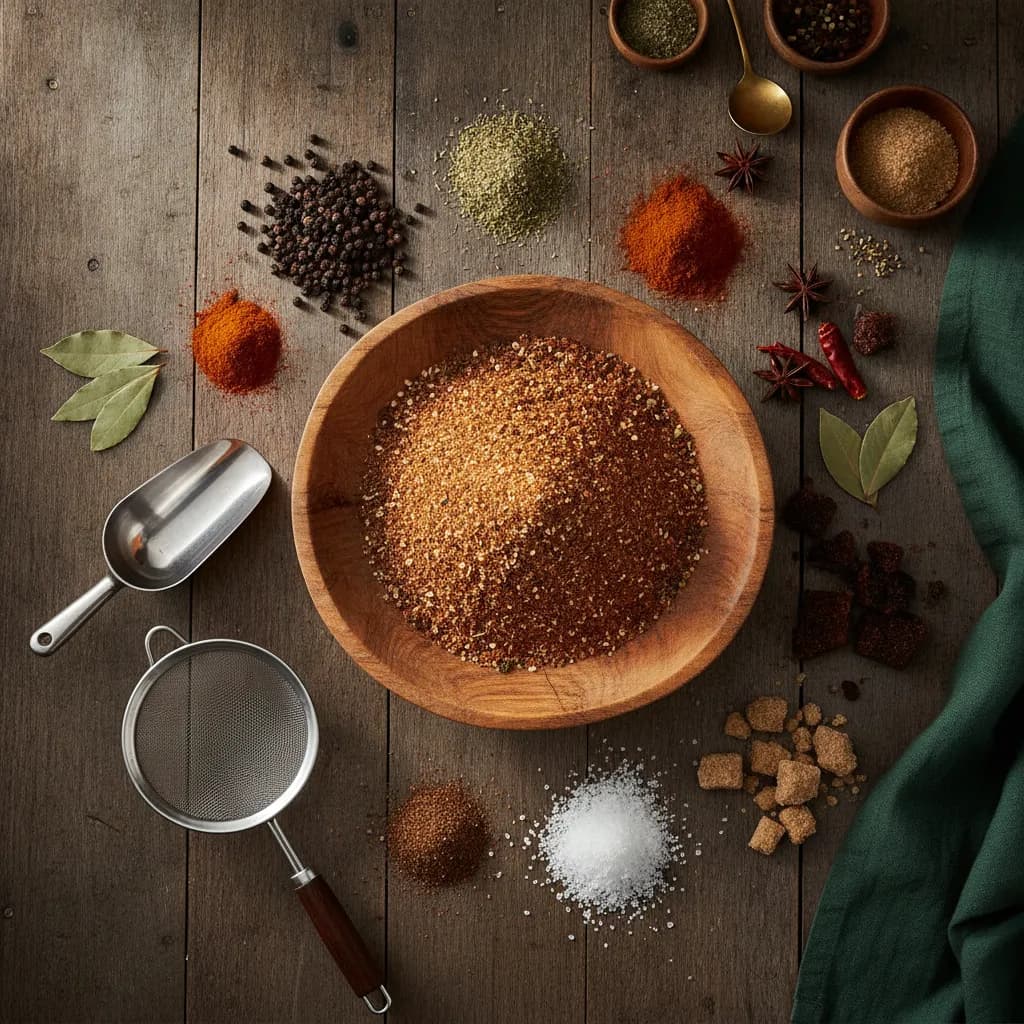
You built a dry rub people fight over: garlic, smoked paprika, brown sugar, coarse pepper, all balanced and recognizable. You hand-mixed a few pounds in a bowl and every taster agreed, this is the one. Then you scaled to a fifty-pound blend and filled a case, and something went sideways. The bottle at the top of the case tastes sharp and peppery, the one at the bottom sweet and salty. Six weeks later, a few have set into a brick you break loose with a fork.
This is one of the most common scale-up surprises I work through with founders moving from sauces into a dry line, or launching a seasoning brand cold. Nothing is wrong with the recipe. A dry blend is a physics problem wearing a culinary costume, and powders do not behave like the sauces most of this site is written about.
A finished sauce is one homogeneous liquid that mostly stays blended once it is filled. A dry seasoning is a suspension of dozens of solid particles that never stop trying to sort themselves by size, weight, and shape. Keeping a blend uniform from the mixer to the mouth is its own discipline, and it starts with two related variables.
Particle Size and Bulk Density: Why Blends Separate
The biggest lever in a dry blend is not the recipe ratio. It is particle size, and how well your ingredients' particle sizes match each other. Ground spices are specified by mesh size, the openings per linear inch in a sieve, so a higher number means a finer grind. Coarse cracked pepper might be 12 to 14 mesh, table-grind pepper 18 to 28, and a dusting-grade paprika 60 mesh or finer. Granulated garlic and fine garlic powder are not interchangeable.
Its partner is bulk density, the weight of a given volume of loose powder: fine salt is dense and heavy, while dehydrated herbs and vegetable flakes are light and fluffy. When you combine ingredients that differ in size and density, they separate the moment the blend is handled. Every conveyor, drop, and case that rides a truck lets fine, heavy particles sift down through the gaps between coarse, light ones. That is segregation, the layered spice jar with the powder at the bottom, and it means a blend that was uniform leaving the mixer arrives non-uniform at the filler, then keeps sorting on the shelf so the customer's first and last shake taste different.
The fix is to design the blend so particle sizes and densities live in a tight band. A coarse-crack pepper against a fine garlic powder will always separate; move the pepper to a medium grind near the granulated garlic and it holds together. This has to happen before you lock the recipe, since a mesh change alters flavor release, look, and flow at once. Because mesh only describes the largest dimension that passes the screen, a serious spec calls out a particle size distribution or percent-passing target, not a single number. It also helps to minimize free-fall transfers between mixer and fill head, since every drop sorts the blend.
Blend Uniformity and How You Actually Verify It
Most commercial dry blending happens in a ribbon blender, a horizontal trough with a twisted agitator that folds powder over on itself. It is efficient and gentle, which matters with delicate flakes, but it is not magic. Over-blend and you generate fines and start segregating inside the mixer; under-blend and a heavy ingredient never fully disperses. The right blend time is specific to your formula and vessel.
The founder question is always the same: how do I know it is uniform? You do not eyeball it, you sample and measure. Pull small samples from multiple locations with a sampling thief, then test whether a marker ingredient shows up at the same concentration everywhere. Brands often track an easy marker like salt, through a quick conductivity check, and calculate the relative standard deviation across samples. A tight spread means uniform; a wide spread means keep blending or design out a segregation problem. Write the method into the spec, since "blend until uniform" is a vibe while a sample count and a target spread is a specification. For turning a kitchen recipe into something a plant can run, see what makes a recipe production-ready.
Moisture, Caking, and the Ingredients That Fight You
Dry blends have a natural enemy: water. Even at low levels, moisture turns a free-flowing seasoning into a clump, a cake, or a brick in the jar. The culprits are the hygroscopic ingredients that pull moisture from the air: salt, sugar, some dehydrated vegetable powders, and acids like citric acid. When they grab humidity they get sticky, and sticky particles bridge and lock the blend into a mass.
The first line of defense is real, boring, and free: keep water out. Specify low-moisture ingredients, hold the finished blend to a low water activity, use moisture-barrier packaging, and control humidity in the blending and filling room. A low water activity makes the blend both more shelf-stable and far less prone to caking (for the wet-side companion, see water activity vs pH, and confirm safety parameters with a process authority for your product). Format helps too: coarser, more uniform particles cake less than fine dust, so a slightly coarser grind of a hygroscopic ingredient resists caking before any additive is needed.
Anti-Caking the Real-Food Way First
When founders hit caking, the reflex is an anti-caking additive, and the industry default is silicon dioxide (synthetic amorphous silica), sometimes calcium silicate or tricalcium phosphate. These work, and I want to be honest about that: silica has enormous surface area, so a tiny amount coats particles, soaks up surface moisture, and keeps everything sliding. But it is not where I start. We solve caking with real food and good engineering first, and treat an isolated additive as a compromise only when that toolkit runs out. Before silica I work through the moisture and particle-size controls above, which solve a large share of caking problems on their own.
When a blend still needs a flow aid, a small percentage of rice flour or tapioca starch acts as a natural free-flow agent and moisture buffer, and both read as real ingredients a shopper understands. They are gentler per gram than silica, so you use a touch more and confirm they do not muddy the flavor, but the trade-off is usually worth it for a real-ingredient brand (this connects to what your label tells shoppers, see what clean label means for CPG brands). Silicon dioxide stays on the shelf as a last resort, disclosed honestly, not the first answer.
Sugar in a Rub: The Melting and Caramelization Problem
Sugar earns its place in a barbecue rub. It balances heat and salt, builds bark, and caramelizes on the grill into the crust that makes a rub feel finished. But it is also the ingredient most likely to misbehave in a dry blend. It is hygroscopic and a primary caking driver, and brown sugar is worse than white because the residual molasses stays soft, which is why an all-brown-sugar rub clumps hardest. A dried or free-flowing brown sugar, blending in a less hygroscopic sugar, or the moisture controls above all help.
Sugar also melts and scorches at a lower temperature than the rest of the rub. On the grill that is a feature, but a sugar-heavy rub burns over high direct heat, so your usage guidance should steer people to the right application. Honest sourcing pays off: a real cane or coconut sugar browns predictably, where a cheap sugar substitute engineered for a lower glycemic number may not brown or build bark. I am not against reformulating sweetness when there is a real reason, but I lead with real sugars because they do the culinary work a rub needs. If a lower-sugar version is the goal, we design it deliberately and test how it browns rather than swapping in a high-intensity sweetener and hoping the bark still forms.
Sourcing: Spice Quality, Lot-to-Lot Variation, and Real Over Artificial
A seasoning brand is a sourcing brand whether the founder realizes it or not. The finished flavor is almost entirely the quality of the raw spices and dehydrated ingredients, and those are agricultural products that vary by origin, crop year, and grind: paprika color drifts with the harvest, black pepper volatile oil varies by source, alliums differ in pungency lot to lot. Buy on price alone from whoever is cheapest this month and your blend tastes different month to month before you notice.
This is where a real spice house earns its margin. A good supplier holds a specification for you: a color value on paprika, a mesh and volatile oil spec on pepper, and a Certificate of Analysis on every lot so you can verify what you received. That consistency is what makes a brand taste the same in January and July instead of drifting, and it is the honest way to manage cost, because you cut variability rather than quality (for protecting flavor while protecting margin, see reduce COGS without changing flavor).
The bigger decision is real versus artificial, and here Molly's brand is not neutral. I build blends on real spices, real dehydrated alliums, and real dehydrated vegetables. For savory depth I reach for real umami: tomato powder, mushroom, a touch of miso, roasted garlic and onion. For color I use real colorants that are also flavors, like smoked and sweet paprika, turmeric, or annatto, rather than a synthetic dye that only paints. The processed tools exist, natural and artificial flavors, artificial colors, and yeast extracts engineered to boost savoriness cheaply, and I present them honestly as tools with real trade-offs in transparency and consumer trust, not the default and never the exciting answer. A shopper who reads the back of the bottle should see food they know (the substance behind that promise is in ingredient transparency as a brand promise). Real first, additives only as a disclosed compromise, is the rule.
Flowability on the Line and Writing the Spec
Everything above collides at the filling line, where the seasoning has to flow from a hopper into a bottle at production speed and dose to an accurate fill weight. Too fine and it dusts and fills unevenly; caking bridges over the auger; mismatched particles segregate so fills drift as the hopper empties. Good flowability is the payoff for the particle-size matching, moisture control, and format choices you made upstream, and all of it has to live in a written specification, because the co-packer runs the number, not your intention. A real dry-blend spec names each ingredient by grade and mesh with a percent-passing tolerance, and sets a finished water activity ceiling, a bulk density target, a blend-uniformity limit, a fill-weight range with a reject threshold, and a color reference. Hand them a recipe card and a good feeling and you get back a different product every run.
Related Reading
For the surrounding scale-up picture, see working with co-packers, what makes a recipe production-ready, and reduce COGS without changing flavor.
Frequently Asked Questions
Why does my seasoning separate in the bottle even though I mixed it well?
Almost always segregation from mismatched particle size and density. Fine, heavy particles sift down through the gaps between coarse, light ones every time the blend is handled, so the top and bottom of the bottle taste different. The durable fix is upstream: bring your ingredient particle sizes into a tighter band, for example a medium-grind pepper closer to your granulated garlic, and minimize the transfers between mixer and filler.
Do I have to use silicon dioxide to keep my rub from caking?
No. Most caking is solved first with real-food and engineering moves: matching and slightly coarsening particle sizes, holding the blend to a low water activity, better moisture-barrier packaging, and controlling humidity. When you still need a flow aid, a small amount of rice flour or tapioca starch can work and keep your label clean. Silicon dioxide is effective and legal, but I treat it as a last resort to disclose honestly, not the default.
How do I keep the flavor consistent from batch to batch?
Control your raw materials. Spices are agricultural and drift by crop and origin, so work with a real spice house that will hold a specification and provide a Certificate of Analysis on each lot. Consistency at the ingredient level is what makes the blend taste the same in January and July, and it beats buying the cheapest lot available.
Can I lower the sugar in my rub without wrecking it?
Sometimes, but design it deliberately rather than swapping in a high-intensity sweetener and hoping. Sugar in a rub balances heat and salt and builds the caramelized bark, so if you cut it, test how the new version browns on the grill and lean on real ingredients rather than a substitute that will not caramelize. Verify any shelf-stability implications with a process authority, since sugar also affects moisture behavior.
Where a Dry Blend Becomes Real Work
A seasoning that stays uniform, resists caking, flows on the line, and tastes the same every batch is not a lucky recipe. It is a chain of decisions about particle size, density, moisture, sourcing, and honest ingredient choices, all made before the first production run. Getting them right the first time is far cheaper than discovering the layered bottle after ten thousand ship. If you are taking a rub from the bowl to the shelf and want it engineered to hold up, that is exactly the kind of work I do with founders. Book a Free Discovery Call and we will map the blend, the spec, and the sourcing before you commit to a run.
Need Help With Your Formulation?
Whether you're scaling your first recipe or reformulating an existing product, let's talk about how to get it right.
Book a Free Discovery Call