The best co-packer move is the one your customers never notice. The jar looks the same, the sauce pours the same, and the flavor someone has bought for three years is still there on the first spoonful. That is harder than it sounds, because a move puts your product on new kettles, new fillers, and new ingredient lots, in front of a new crew, all at once.
Brands move for good reasons. They outgrew the plant's capacity, they need a facility closer to their customers, or the plant's direction and theirs have parted. None of that is a verdict on the plant you are leaving. It is a business decision, and it deserves a careful handoff on both ends.
My part is narrow on purpose. I do not choose the new plant, negotiate the agreement, or run either relationship; finding and qualifying a plant is covered in how to find and vet a co-packer. What I do on a move is make the formula portable, so a different plant can make the same product, and help match what comes off the new line to your gold standard.
Start With What Your Current Plant Actually Makes
Before you send anything anywhere, check whether your paper spec still matches the product in the jar. The two can drift apart without anyone deciding they should. A good crew learns your product. They add a little water when a lot of paste comes in thick, hold the kettle longer when a batch looks loose, or add the herbs a little later so they stay bright. Those are sensible calls by people who know their line. But if they never made it into your spec, your spec describes a product you no longer sell.
So start with a careful audit:
- Batch records for recent runs, including the adjustments made along the way.
- Measured results for pH, Brix (the sugar and dissolved solids reading), viscosity, and salt across those batches.
- Retained samples from recent lots, yours and the plant's.
- The ingredient suppliers the plant actually buys from, which may not be the ones your spec names.
Then decide what you are transferring. Usually it is the product your customers buy today, not the version on paper from two years ago. That product becomes your gold standard: a physical reference you hold, judge at the two-week mark, and store under controlled conditions. If you do not have one, set it before the move, not during it. I go through how in setting a gold standard and keeping retained samples.
What to Send the New Plant, and When
A move has two phases of conversation with the new plant, and they call for different documents.
While you are still evaluating: a product brief and a jar, not the recipe
Early on, the new plant needs enough to tell you whether your product fits their line and to quote it: a product description, the format and package, run size and forecast, target specs, the process type (kettle cooked, hot filled), allergens, and certifications. Send jars from the shelf so they can taste it. Your ingredient statement is already on the label. The percentages, ingredient grades, order of addition, and process are not, and those stay with you for now.
Close to signing, with an NDA in place: the full formula
My rule is simple. The full recipe does not leave your hands until you are close to signing and an NDA is in place, and that includes the trial run. Even in a trial, the people in the room learn the process you paid to develop. This is not a judgment about the plant. Good plants expect it, and they protect their other clients the same way. The ownership side of it (what the NDA should cover, who owns improvements, why the master spec is the thing you really own) is laid out in who owns your recipe when you work with a co-packer. The agreement itself belongs with your attorney.
The Transfer Package
Once the NDA is signed and a trial is booked, the new plant gets the transfer package: everything a skilled crew who has never seen your product needs to make it right, ideally the first time.
- The master formula, by weight, with a version number. The version the current plant actually runs, including the adjustments you chose to keep.
- Ingredient specs. Identity, grade, and each ingredient's job in the formula (acid, body, heat, color), with approved suppliers and alternates. A brand name alone leaves the new plant guessing.
- Process notes. The order of addition, the checkpoints, and what each step is for. More on this below.
- The finished product spec. Targets and ranges for pH, Brix, viscosity, salt, color, and fill, and how each one is measured.
- The gold standard. Physical reference samples, with when they were set and how they have been stored.
- The packaging spec. Container, closure, fill weight, and headspace.
- The regulatory and safety file. Your current process authority letter for reference, your allergen statement, and label copy, for the new plant's food safety team to review.
- Batch history. Known adjustments, past problems and their fixes, and seasonal ingredient quirks. Hard-won knowledge belongs on paper, not in someone's memory.
Write Process Notes the New Kettle Can Follow
Process notes copied from the old plant describe that plant's equipment. A different kettle heats faster or slower, evaporates differently, and works the product harder or more gently, so the same settings can give you a different sauce. I write process notes around what each step has to accomplish, with a measurable checkpoint, and leave the equipment settings to the new plant's team:
- Instead of only a cook time, say what the cook is for: reduce to a target Brix, develop color to match the gold standard, or reach a viscosity range at a stated temperature.
- Instead of "add the garlic at step six", say why it goes in late: so the aroma is not cooked off during the heat-up. On a slower kettle, "late" may land somewhere else.
- Flag where the texture is sensitive. If the body comes from a starch or a gum, remember that it was fitted to the old plant's equipment as much as to the recipe. A harder-working pump or a longer hold can break down a texture that was stable at the old plant. The same goes for particulates that need to stay whole.
None of this loosens the safety side. If your product has a scheduled process, its temperatures, times, and pH limits come from the process authority, not from the process notes, and the new plant's food safety team runs within whatever the process authority sets for their line.
Co-packers optimize for their line, and your spec protects your product. Notes written this way let the new crew run their equipment well while holding the parts of the product that make it yours.
Settle the Process Authority Question Before You Sign
If a process authority reviewed your product's process, that review covered a specific formula, process, and package. New equipment means the process now happens somewhere else, so in my experience a move usually means the process authority looks at the product again. Your existing letter is useful background, but whether it carries over is for your process authority and the new plant's food safety team to decide.
Who arranges the review varies. Sometimes the new plant takes it to the process authority they already work with and asks you for the formula and data. Sometimes they ask you to arrange it yourself. Find out which before you sign, put the answer in writing, and budget for both the cost and the weeks it takes. It also helps to ask the process authority what data they want from the trial, such as pH readings across the batch, so the trial produces it the first time. The basics are in process authority letters for acidified foods.
Expect a pH conversation too. A new plant will want to see that your product has headroom for pH that keeps moving after filling. If your product has been living close to its limit, it is better to hear that before the trial than at it.
Run the Side-by-Side Trial Against Three Samples
Define success before the kettle heats: the numbers from the finished product spec, plus a sensory check against the gold standard for flavor, aroma, color, and texture. Agree on that list with the new plant in advance.
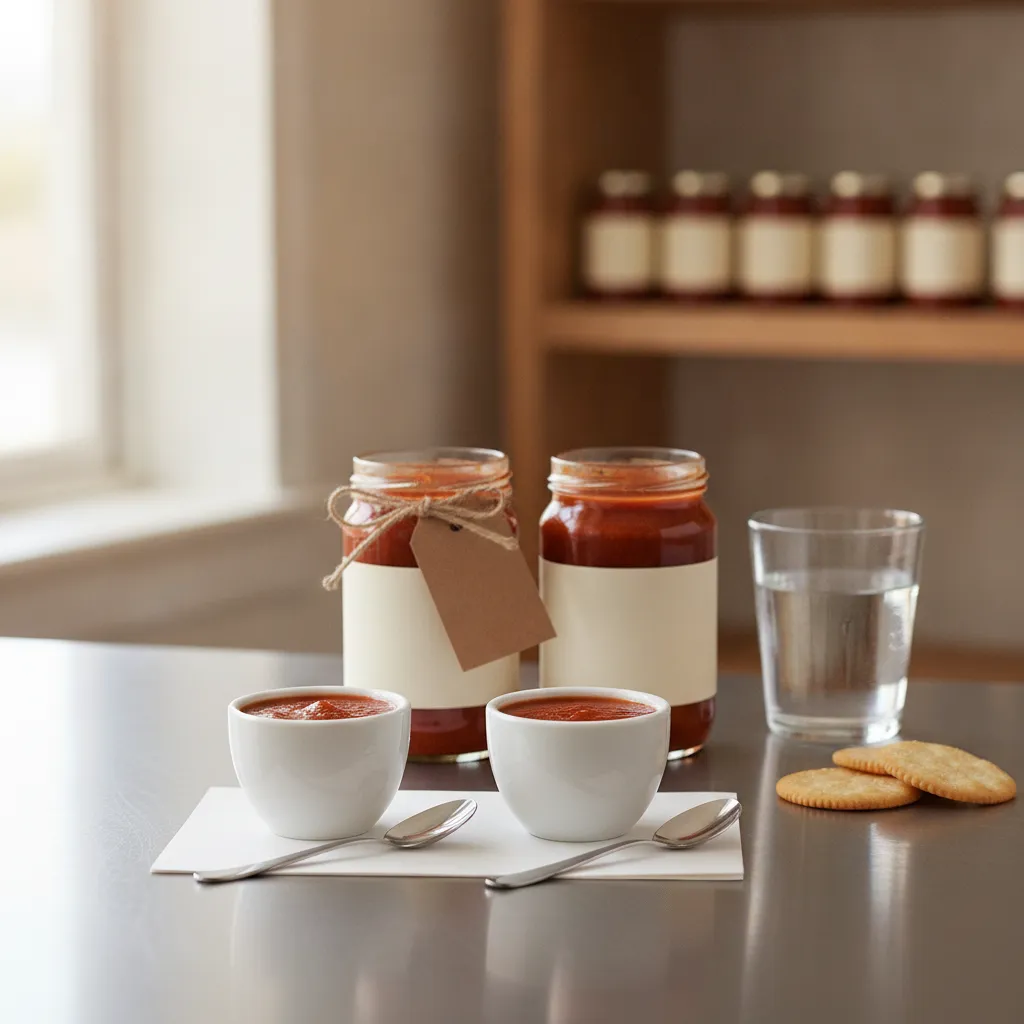
Then compare three samples, not two: the gold standard, the current plant's most recent lot, and the new plant's trial. The current plant's lot shows you what normal variation looks like, so you do not chase a difference that is already inside your everyday range.
Check all three as the trial settles. Day one can mislead you in either direction, so make the call at week two.
Agree on how every number is measured, too. If the old plant reads viscosity on one instrument at one temperature, and the new plant uses another instrument or reads it hotter, the numbers will disagree even when the sauce does not.
If the trial misses, look at the process first and change one thing at a time. A miss on texture or color can come from heat, shear, or hold rather than from the formula, and then the fix lives in the process notes. Touch the formula only when the process cannot close the gap, and record that change as a new version.
Keep the Old Plant Running Until the New One Is Proven
Do not stop production at the old plant until the new one has made a released batch that matches. Trials miss, re-trials take weeks to schedule, and a process review can run long. With no inventory to cover the gap, the pressure is to ship something not quite right because the shelves are empty.
So plan a bridge of finished product from the current plant, with room for at least one trial that does not match. How many weeks is a business call for you and the plants, based on sales, code dates, and schedules. From the formula side, two things matter. The bridge stock has its own shelf life, so it cannot be built too far ahead. And for a while, product from both plants will be on shelves at once, which is exactly why the match has to be real. Make sure your lot codes show which plant made each lot.
Once regular production starts at the new plant, ask for a sample from every batch and taste it against the gold standard yourself. Quality control is mostly the plant's job, and their team runs it. Your own check is how you know the product your customers get is still yours.
What Not to Change During a Move
A move already changes the equipment, the crew, and probably some ingredient lots. Every other change you add makes it harder to tell what caused a difference. Hold these still until the new plant is running steadily:
- The formula. No while-we-are-at-it improvements. Reformulate before the move, at the plant that knows your product, or after the new plant is stable.
- The package. A new jar or closure changes heat transfer, headspace, and how the product fills.
- The hero ingredients. Same suppliers and grades where you can. If you supply them yourself, set that up before the trial.
- The label and its claims. Add no new claims during a move, and confirm the ones you already make (organic, gluten-free, allergen statements) still hold at the new plant with its food safety team, your certifier, and whoever handles your labeling.
- The gold standard. The reference before the move is the reference after it.
The new plant may propose a substitution: an ingredient they already stock, or a starch that runs better on their line. Take it seriously, because they know their equipment. Then log it and evaluate it after the move, with its effect on the label, allergens, and the process review checked first, the way I describe in formula change control. If the process authority or the new plant requires a change before they will run the product, make it the only change and version it like any other.
Leave the Outgoing Plant Well
The plant you are leaving made your product, maybe for years, and likely solved problems for you along the way. Leaving well is good business and plain courtesy, and you may want to work with them again someday.
- Read your agreement with your attorney before you announce anything. Notice periods, minimums, any exclusivity terms, your ingredients and packaging at the plant, and which records you are entitled to are contract questions, not formula questions.
- Ask early and politely for batch records, adjustment notes, and your retained samples.
- Keep scheduling with them through the overlap. Your bridge inventory depends on their calendar and their goodwill.
- Tell them the real reason. If the move is about capacity or geography, say so.
For the wider set of terms a co-packing relationship usually covers, including how it ends, see working with co-packers.
The Part of a Move That Depends on Your Product
The framework above holds for most sauces, dressings, salsas, and soups. The calibration is product by product: which ingredient will notice a different kettle, which step will behave differently with more shear or a longer hold, which week-two differences are worth chasing and which already sit inside your normal range. That judgment comes from working through a specific formula on both plants' equipment, and it is the work I do inside a client project. Done that way, a move has its best chance of ending where it should. The new plant runs your product, your customers keep buying it, and nobody notices that anything changed.
Need Help With Your Formulation?
Whether you're scaling your first recipe or reformulating an existing product, let's talk about how to get it right.
Book a Free Discovery Call