Nobody Notices the Money Leaving
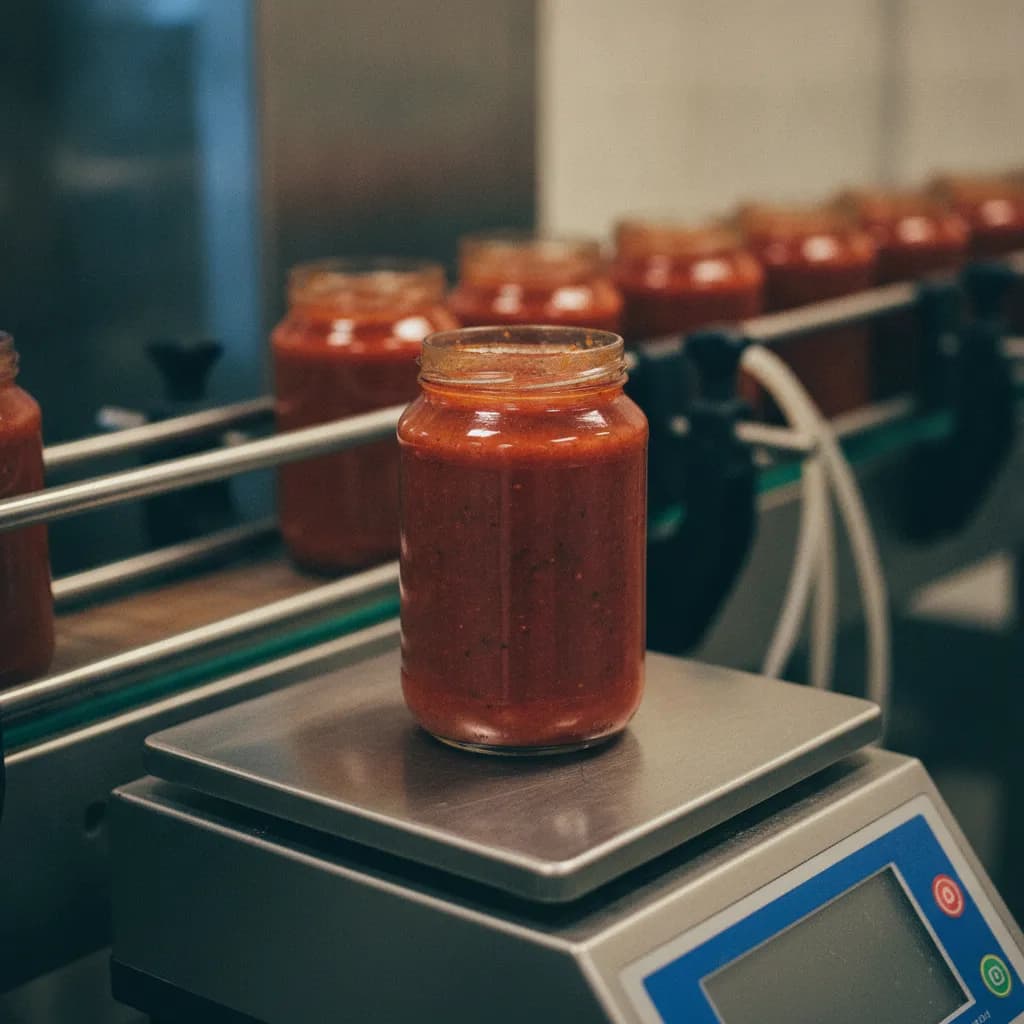
Founders obsess over ingredient cost. They will spend three weeks finding a chili supplier two cents cheaper per pound. Then they will run a fill line that puts 12.4 ounces into every 12 ounce jar for two years and never look at it.
Do the arithmetic. A 3 percent overfill is 3 percent of your ingredient cost, on every jar, forever. It does not show up as a line item anywhere. It hides inside your yield and inside your cost per unit, both of which you already assumed were imperfect. In the industry this is called giveaway, and it is the most common quiet margin leak I find in a small brand's production.
The reason it persists is that the alternative sounds scary. Underfilling is a compliance problem. So everyone aims high and stops thinking. But "aim high" is not the only way to stay legal, and it is the most expensive one.
What the Rules Actually Require
Net quantity of contents is a labeling requirement with two layers. The federal labeling side, for FDA-regulated foods, flows from the Fair Packaging and Labeling Act and the net quantity declaration requirements at 21 CFR 101.105: where the statement appears, how it is expressed, what units it uses.
The enforcement side is where NIST Handbook 133, Checking the Net Contents of Packaged Goods, comes in. That handbook is the reference state and local weights and measures officials use when they inspect packages. It is developed by NIST and adopted through the National Conference on Weights and Measures. Its procedures are what someone actually runs when they pull your jars off a shelf and weigh them.
Handbook 133 sets two distinct requirements, and understanding that they are separate is most of the battle.
The average requirement. The average net contents of the packages in a lot must at least equal the labeled quantity. This one is about the center of your distribution. An average below label is a failure regardless of how consistent you are.
The individual package requirement, expressed as Maximum Allowable Variation. The MAV limits how far any single package may fall short. Packages underfilled by more than the MAV for that package size are treated as unreasonable minus errors. The MAV values live in tables in the handbook, with the tables for packages labeled by weight organized by labeled quantity, so you find your declared weight in the left column and read across. A lot can fail on unreasonable errors even when the average is fine.
Two operational details worth knowing:
- Tare matters, and there are two kinds. Net contents means product, not glass, not closure, not label. For products packed in a liquid medium the distinction between dry tare and wet tare becomes a real technical question, and it is one to settle with your co-packer before it becomes an argument with an inspector.
- Your scale has to be good enough. Handbook 133 expects a scale division no larger than one sixth of the MAV for the package size being checked. A shop scale that reads to the nearest 0.1 ounce is not a fill control instrument for a small jar.
There is also a sampling structure: the handbook defines sampling plans by lot size, including plans for testing packages away from the point of pack, with a sample size and an allowed number of packages exceeding MAV. The takeaway is that an inspection is a statistical test on a sample, not a check of one jar, which is exactly why the shape of your fill distribution is what you should manage.
The Real Lever Is Variation, Not the Target
Here is the mental model that changes how founders think about this.
Your fill process produces a distribution of weights, with a mean and a spread. To satisfy the average requirement your mean has to sit at or above label. To avoid unreasonable minus errors your low tail has to stay within MAV of label. So your target fill ends up being label weight plus a cushion sized by how wide your distribution is.
That means the cushion is a tax on your variation. A line that fills within a tight band needs a small cushion. A line that scatters needs a big one. Two brands with identical recipes and identical labels can run meaningfully different ingredient costs per jar purely because one line is steadier than the other.
So the way to cut giveaway is not to lower your target and hope. It is to narrow the distribution first, verify it, then bring the target down to match. Lowering the target without tightening the process just moves your low tail below the line, which is the one outcome worth avoiding.
Where Fill Drift Comes From in a Sauce
This is the part a generic operations article cannot give you, because the causes are specific to viscous, particulate, hot-filled product.
You are filling by volume and selling by weight. Most fillers a small brand will meet are volumetric: a piston or a timed valve delivers a volume. Your label declares a weight. The bridge between them is density, and density is not a constant. It moves with temperature, with dissolved solids, and with entrained air. Nothing on the line tells you when that bridge shifts, which is why a batch that reads perfect on Monday can run light on Thursday.
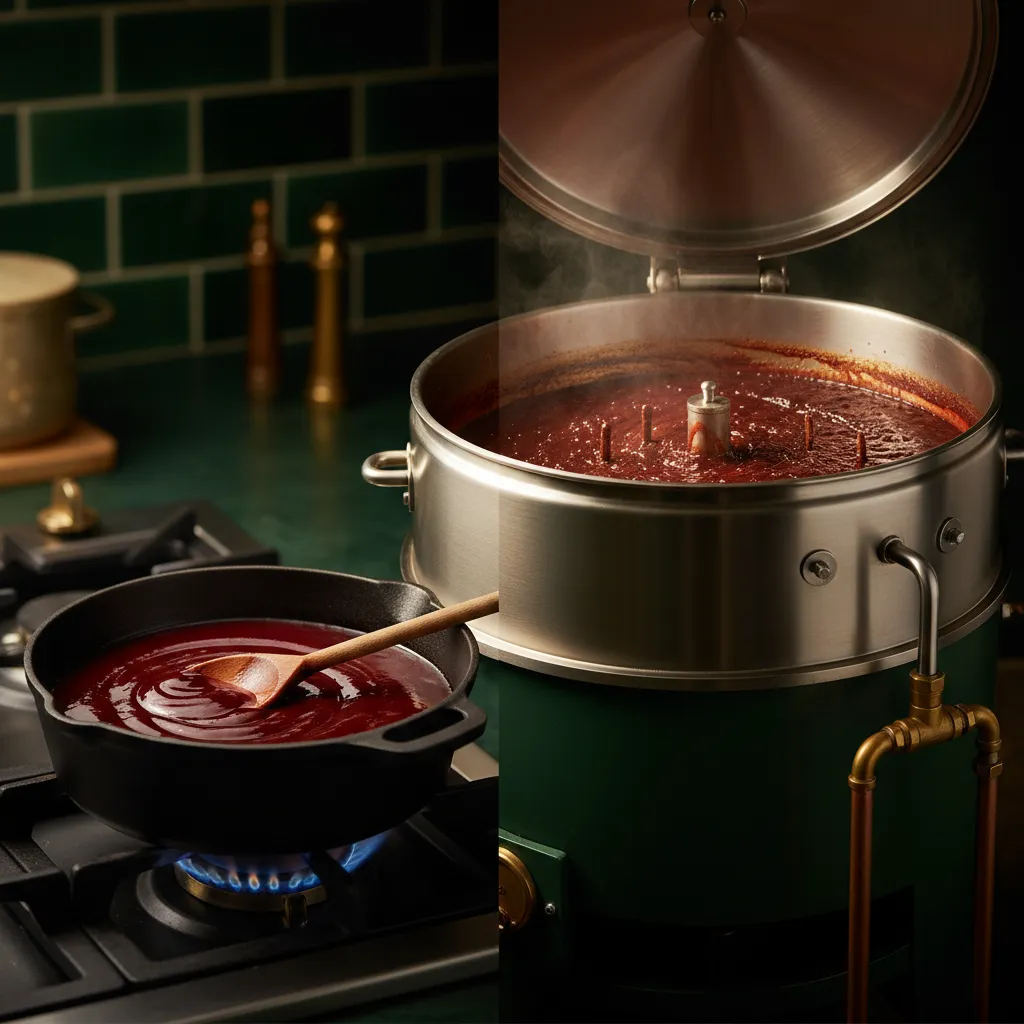
Temperature drift during a hot fill. Product density and viscosity both change as the fill tank cools. If the first jars off the run go out at one temperature and the last jars at another, you have a systematic drift across the run, not random noise. This is a direct cousin of the viscosity behavior described in why your kettle batch does not match your stovetop.
Entrained air. Aggressive agitation, a vortex in the fill tank, or a pump that cavitates will whip air into the product. Air occupies volume and weighs nothing. A volumetric filler happily delivers it, and the jar reads light.
Soluble solids drift. Brix changes density. If your batch finishes at a different Brix than the one the fill was set to, the same delivered volume is a different delivered weight. This is one of several reasons to hold a real Brix target rather than cook to appearance, as covered in Brix targets for BBQ and condiment manufacturing.
Particulates. Chunky salsa, a chili crisp with fried alliums, a relish: any product where solids and liquid can separate in the hopper will produce jars with different solid-to-liquid ratios and therefore different weights. Agitation in the supply tank is a fill control issue, not just a quality one.
Mechanical causes. Piston seal wear, inconsistent product level in the supply tank, line speed changes, a filler warming up over the first dozen units. Startup jars are systematically different from steady-state jars, which is why startup product is its own category in the yield accounting in where the kettle batch actually goes.
A Practical Program for a Small Brand
You do not need a checkweigher on day one. You need data and a rule.
Weigh a sample on a schedule, not at random. Pull units at a fixed interval through the run, for example every fifteen minutes and at every stoppage, and record the net weight. Interval sampling is what exposes drift; grabbing whatever is nearby hides it.
Record the numbers, not a pass or fail. A log of checkmarks is useless. A log of actual weights lets you see the mean walking downward across a run, which is the single most useful pattern in the whole exercise.
Look at the spread, then the mean. If your spread is wide, fix the cause before you touch the target. If it is tight, you may have room to bring the target down, carefully, with verification.
Write the target into the specification. Target fill, acceptable range, check frequency, and what the operator does when a reading falls outside. If it is not in the spec, it is not a control, it is a habit. This belongs alongside the other technical targets in a production-ready recipe.
Ask your co-packer what they currently target and why. Many facilities set a generous default cushion because it is safe for them and the ingredient cost is yours, not theirs. That is not bad faith, it is a rational response to who carries which risk. It is also a conversation worth having, and it belongs in the same discussion as the yield assumption in reading and negotiating a co-packer quote.
When Not to Chase It
I will be straight about the limits. If you are running a few hundred units a quarter, the giveaway is real but small, and the engineering attention is better spent elsewhere. Chasing fill precision on a pilot run is optimizing a rounding error.
It becomes worth serious attention when volume rises, when your product is ingredient-heavy enough that a few percent matters, or when you are being asked to sharpen your price for a distributor. At that point, fill control is one of the few levers that improves margin without touching the recipe, which puts it in the same category as the process-side savings in cutting COGS without touching flavor. Most of the others ask you to give something up. This one just asks you to stop giving product away.
Sources: NIST Handbook 133, Checking the Net Contents of Packaged Goods · NIST Handbook 133 (2023), full text PDF · FDA, Guidance for Industry: Food Labeling Guide · eCFR, 21 CFR 101.105, Declaration of net quantity of contents · NIST, Office of Weights and Measures
Need Help With Your Formulation?
Whether you're scaling your first recipe or reformulating an existing product, let's talk about how to get it right.
Book a Free Discovery Call