Classical French cooking hands every young cook a handful of mother sauces and one simple idea: master the base, and the variations follow. A velouté finished with cream becomes one sauce. Finished with white wine, it becomes another. Restaurant kitchens still run this way. One well-made base sits in the steam well, and several finished sauces come off it during service.
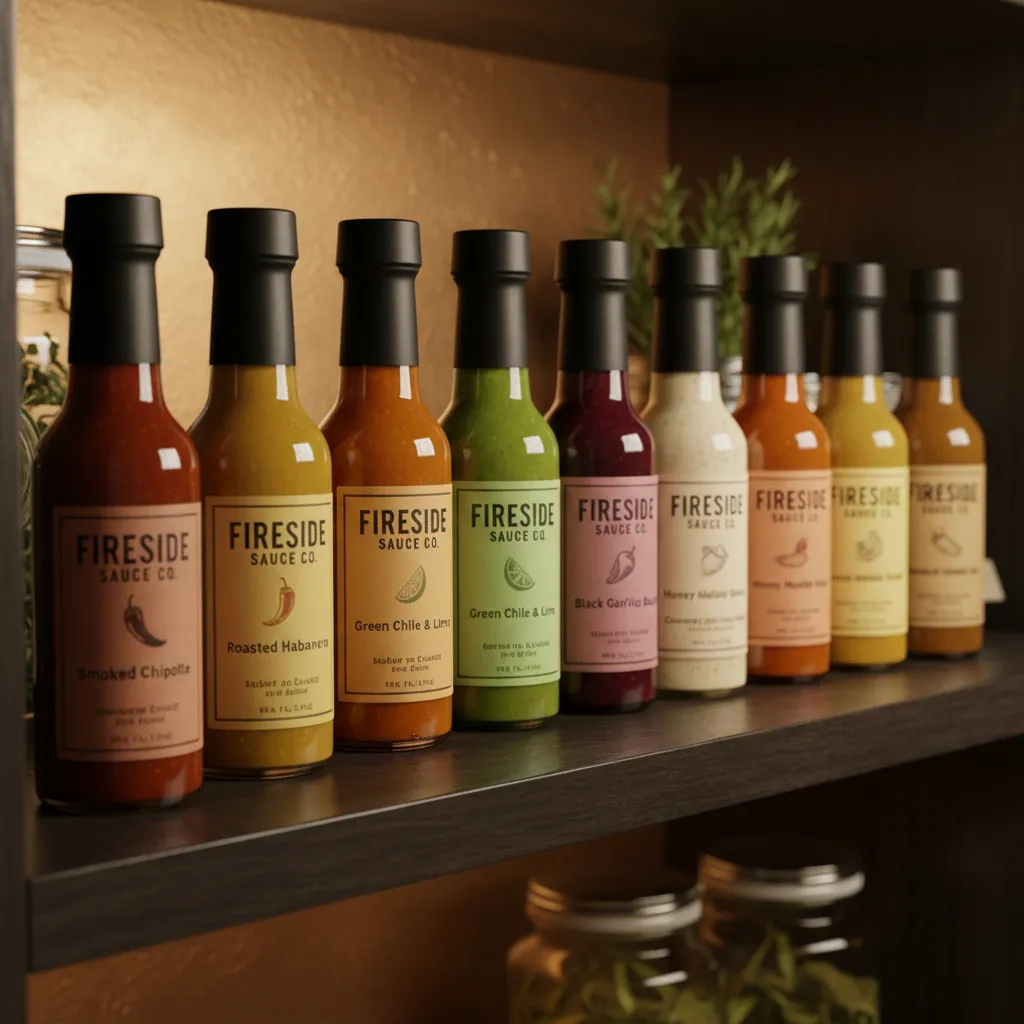
A shelf-stable line can be built the same way, and it is often the smartest way to add flavors to a product that already sells. There is one big difference from the restaurant, though. On the line, the daughter sauce is eaten tonight. In a jar, every daughter sauce has to survive a cook, a fill, a two-week settle, and a long shelf life on its own, as its own product, with its own numbers. The base can be shared. The targets cannot.
The business side of adding SKUs (when to expand, how many, in what order) is covered in my piece on going from one SKU to a full line. This article is the kitchen side: how a base-plus-flavors system is actually formulated so that every new flavor is safe, repeatable, and still unmistakably yours. A new format, like turning your sauce into a dressing, is a different job; here the format stays the same and the flavor changes.
What a Base Formula Is, and Two Ways to Build One
A base is a formula in its own right. It is weighed, written in percentages, made the same way every time, and it has its own targets. It is not "the original sauce, minus a few things, more or less." If the base is loose, every flavor built on it inherits that looseness, multiplied by the number of SKUs.
There are two ways to set one up.
Your winning sauce is the base
Each new flavor is an addition to the finished original. This is the fastest route, and the original stays untouched. The catch is that the original was balanced to be complete. Everything you fold into it pushes its numbers somewhere: fruit adds sugar, peppers add water, creamy ingredients change the texture, and most additions move the acidity. The further a flavor travels from the original, the more corrections it needs inside its own formula.
A base built on purpose
Here the base is designed to be finished. It holds back on some of what the flavor layers will bring, so each flavor has room. If most of your planned flavors add fruit, for example, the base might carry less sweetness than your original does. Your original then becomes one of the flavors: the base plus its own finishing addition. This takes more work up front, and the base is usually not sold on its own.
Neither is right for every line. In my experience, the first model works well for one or two flavors that sit close to the original. Once you are planning several flavors that pull in different directions, sweet and fruity in one jar, smoky and savory in the next, a purpose-built base usually saves you from rebalancing every flavor from scratch.
Name the Family Signature Before You Add Anything
Before you develop a single new flavor, write down three short lists.
- What every flavor shares. The two or three things that make a jar recognizably yours: maybe a particular vinegar, a roasted garlic backbone, a spoonable texture, a clean finish. These live in the base and do not change from flavor to flavor.
- The hero of each new flavor. The one ingredient a customer would name after the first taste, and the reason this flavor deserves shelf space next to your original. I ask the same question of a new flavor that I ask of a new product: why does the world need another one? If you cannot name the hero, the flavor is not ready.
- Your non-negotiables. What no flavor in the line will ever contain, and what every ingredient has to meet. The stores you sell to may ban certain ingredients or expect certifications, and your own brand values can narrow the supplier list further. A new flavor's hero ingredient has to clear the same bar as everything already in the jar.
The signature list matters because the hero will fight it for attention. A good flavor extension lets the hero lead while the signature is still the thing the mouth recognizes as home.
What Each Kind of Addition Does to the Jar
Every addition brings flavor. It also brings water, solids, sugar, acid or a lack of it, and sometimes a new allergen. Here is what to watch for by type.
Fruit
Fruit purees and juices bring sugar, so Brix (the measure of dissolved solids, mostly sugar, read on a refractometer) goes up. Many fruits are acidic, but most are less acidic than a vinegar-built sauce, so folding them in tends to pull the pH up. Fruit solids also buffer, which means they resist changes in pH, so it can take more acid than you expect to bring the flavor back where it belongs. Pectin and fiber thicken, and a fruit flavor that pours like the base on fill day may set up thicker in the jar. Fruit also changes with the crop, sweeter and less acidic in some seasons than others, which I cover in managing ingredient seasonality.
Peppers and other vegetables
Fresh or roasted peppers, onions, garlic, and most other vegetables are low-acid ingredients, so they pull the pH up and bring water that thins the sauce and dilutes the base's acid. Pieces add a wrinkle. A chunk of pepper starts at its own pH and takes time to reach the acidity of the liquid around it, so a reading taken on fill day can creep upward as the pieces catch up. That equilibration is the subject of why pH drifts after production. If the new flavor also adds heat, treat heat as its own dial, the way I describe in keeping mild, medium, and hot consistent.
Dairy-free creamy ingredients
In a dip or dressing line, a creamy flavor often comes from cashews or other nuts, seeds, oats, coconut, or plant proteins. These are low in acid, many are rich in protein or fat, and they tend to buffer strongly, so they can take a lot of acid to move. Protein meeting acid and heat can turn grainy. Fat changes how an emulsion behaves. Some of these ingredients keep thickening on the shelf as they hydrate, and some thin out under the shear of the plant's pumps and mixers.
They can also bring an allergen into a line that never had one. Tree nuts, sesame, and soy are all on FDA's list of major food allergens. Adding one changes your labels, the plant's run order and cleaning, and possibly which plants can make the product at all. That conversation goes to your co-packer's food safety team and your regulatory or labeling advisor before you formulate, not after.
Herbs, spices, and savory boosters
Small by weight, big in effect. Fresh herbs fade and darken over shelf life, and dried herbs and spices vary from lot to lot. Oleoresins (concentrated spice extracts) can hold flavor, heat, and color more steadily than ground spices, which helps a flavor taste the same at the end of its code date as it did at week two. Savory boosters like miso or soy sauce bring their own salt, so the base's salt plus the booster's salt can overshoot. They can bring allergens too: soy, and wheat in many soy sauces.
Why Every Flavor Gets Its Own pH, Brix, and Viscosity Targets
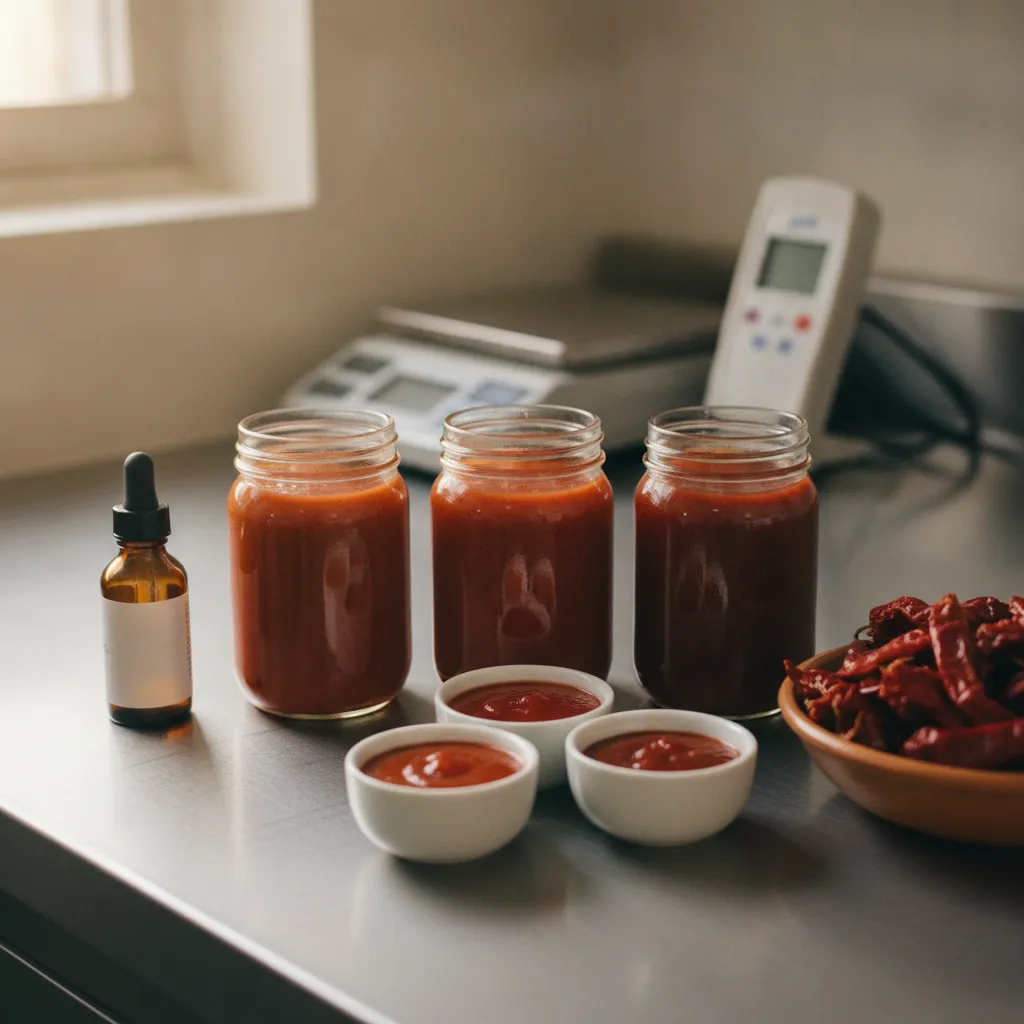
This is the rule I hold every line to: the base's numbers belong to the base. Each flavor gets its own targets, set on that flavor, measured on that flavor, and judged on that flavor at week two. A flavor built on a safe, stable base is not automatically safe or stable itself.
pH. The regulatory line for acidified foods is a finished equilibrium pH of 4.6 or below. In practice, though, the ceiling I see process authorities and plants ask for is lower, somewhere from 4.0 to 4.3, to allow for migration after the jar is sealed. Here is an example with made-up numbers, just to show the logic. Say your original settles at pH 3.9 at week two. You fold in roasted red pepper for a new flavor, and the new flavor settles at 4.25. On paper it is still under 4.6, but it now sits at the top of the window most reviewers want, with almost no room for drift. That flavor needs its own acid correction and its own pH target, confirmed with your process authority. Borrowing the base's number would hide the problem. A meaningful amount of a low-acid ingredient can also change how the rules classify the product, which is one more question for your process authority.
Brix. A fruit flavor will usually read higher than the base, and that is fine. The target belongs to the flavor. What is not fine is borrowing the base's Brix range and then either rejecting good batches or cooking a flavor down to hit a number that was never meant for it.
Viscosity. Measure every flavor with the same method, so the numbers can be compared across the line, but give each flavor its own target. A thickener is tuned to a particular acidity and a particular amount of mixing and pumping, so a flavor that lands at a different pH, or goes through an extra mixing step, may not get the same texture from the same thickener at the same level. Particulates also change the reading, so a chunky flavor and a smooth one will not measure alike.
The same goes for salt, color, and the sensory profile. Each flavor gets its own day-one, week-one, and week-two checks, its own gold standard, and its own retained samples, set up the way I describe in gold standards and retained samples. And each flavor usually goes in front of the process authority as its own formula. Sometimes the co-packer arranges that review and sometimes the brand does, so find out which early, put it in writing, and budget for it per flavor.
Where You Split the Batch
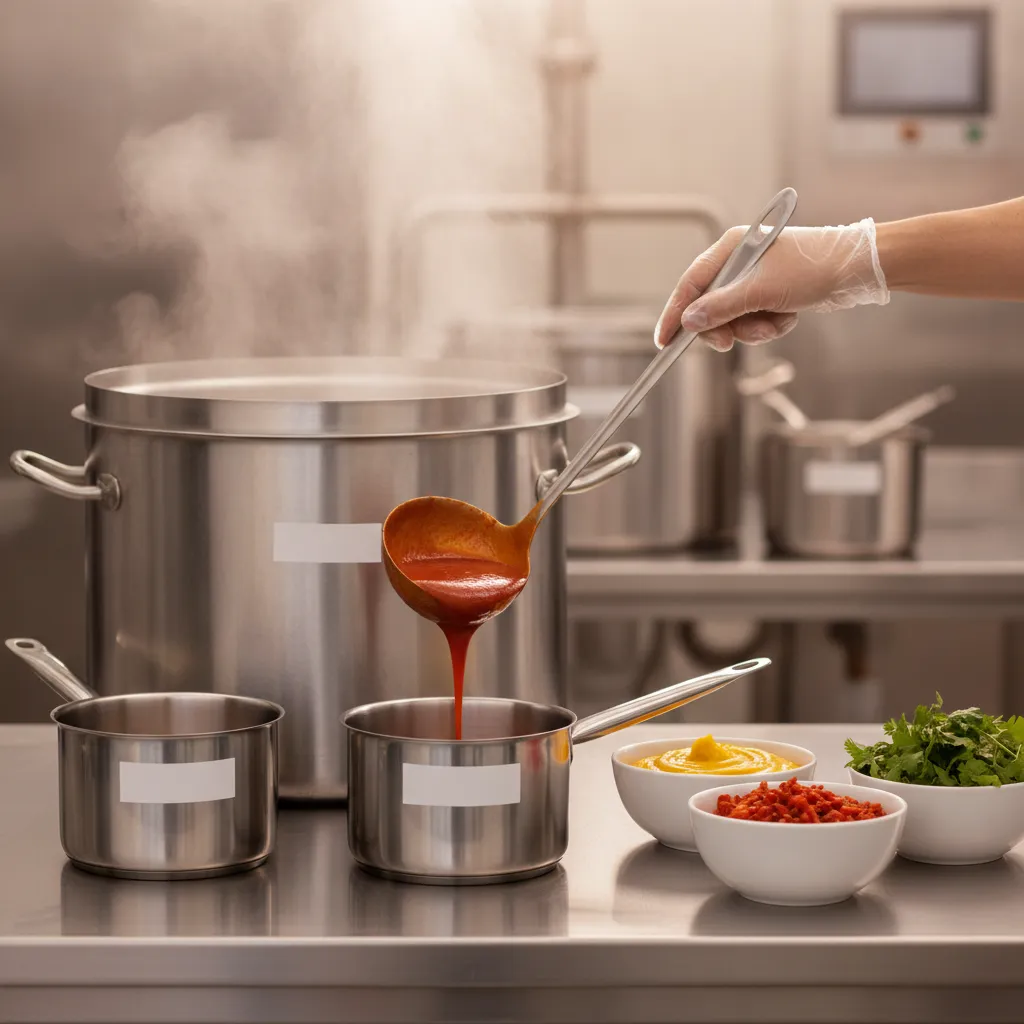
The operational payoff of a base is that the plant can make one large base and finish several flavors from it. That only works if the split is written down as carefully as the base itself.
- The split point. The base is divided by weight, not volume, into flavor batches. Each flavor's ingredients go in at a defined point, in a defined order, at a defined temperature. Raw fruit and vegetables may need to cook through after they go in. Delicate aromatics may need to go in late to survive.
- The process review covers the real route. The scheduled process your process authority writes has to match how the product is actually made, split step included, not just the base cook.
- Hold time. If the base waits while flavors are finished one after another, the last split has sat hot longer than the first, and texture, color, and flavor can shift. Set a maximum hold, or plan smaller bases.
- Run order. The plant's food safety team sets the run order and the cleaning between flavors. A common pattern is mildest and allergen-free flavors first, with the strongest and any allergen-containing flavor last, so ask early how the plant will schedule yours.
- What may move. State which ingredients may be adjusted in each flavor, within what range, and that the base itself never gets adjusted to rescue a single flavor. Any adjustment that touches acid or pH needs your process authority's sign-off first.
Shared ingredients are where a base-plus-flavors line saves real effort. The base ingredients consolidate naturally, because every flavor uses them. The flavor-only ingredients are where the trouble lives. Suppliers often sell by the pallet when one flavor needs a few pounds per batch, so work the minimum out with the vendor and the co-packer, confirm someone has room to store it, and check that the ingredient's own shelf life outlasts the time it takes to use it up. Wherever you can, build a new flavor from ingredients you already buy for another SKU. The ingredient-side cleanup across a whole deck is covered in simplifying ingredients across a product line.
Tasting the Line as One Family
At week two, line up the original and every flavor, with water and something plain between them, and ask:
- Is the signature the first thing you recognize in every jar?
- Does each hero come through clearly, or is it a rumor?
- Does any flavor make the original taste dull by comparison? If so, the original may be the one that needs attention.
- Do the textures and colors read like siblings on a shelf, or like products from different companies?
After launch, the same logic runs every batch. The plant handles quality control, and you ask for a sample from every batch of every flavor, tasted against that flavor's own gold standard. A base system also gives you a useful diagnostic. If one flavor drifts while the others hold, look first at that flavor's own ingredients and its finishing step. If every flavor drifts the same way at once, look at the base.
What Stays at the Bench
A base-plus-flavors system is one of the cleanest ways I know to grow a line without multiplying problems, and the framework above is the honest shape of it. What it leaves out is the calibration: how much headroom your base needs, which correction keeps a fruit flavor safely acidic without making it taste like vinegar, which thickener holds when a flavor lands at a different pH, and where the split belongs on your plant's equipment. Those answers depend on your product and your co-packer's line. I work them out at the bench with your sauce in hand, and the result is a spec for each flavor that your co-packer can run as written.
Sources: The definition of acidified foods (section 114.3), including the finished equilibrium pH of 4.6 or below and the acid foods it excludes, is in 21 CFR Part 114 on eCFR. FDA's list of major food allergens is on its Food Allergies page.
Need Help With Your Formulation?
Whether you're scaling your first recipe or reformulating an existing product, let's talk about how to get it right.
Book a Free Discovery Call