"Can You Just Put It in a Gallon?"
A restaurant group loves your hot sauce. They want it in gallons. Your co-packer says they can fill gallon jugs. It looks like a scheduling question.
It is not. A foodservice pack is a different product built on the same formula, and treating it as a repack is how brands end up with a jug of sauce that will not pour, breaks on a steam table, darkens in the can, or, much more seriously, runs on a thermal process that was never validated for that container.
The Formats, Briefly
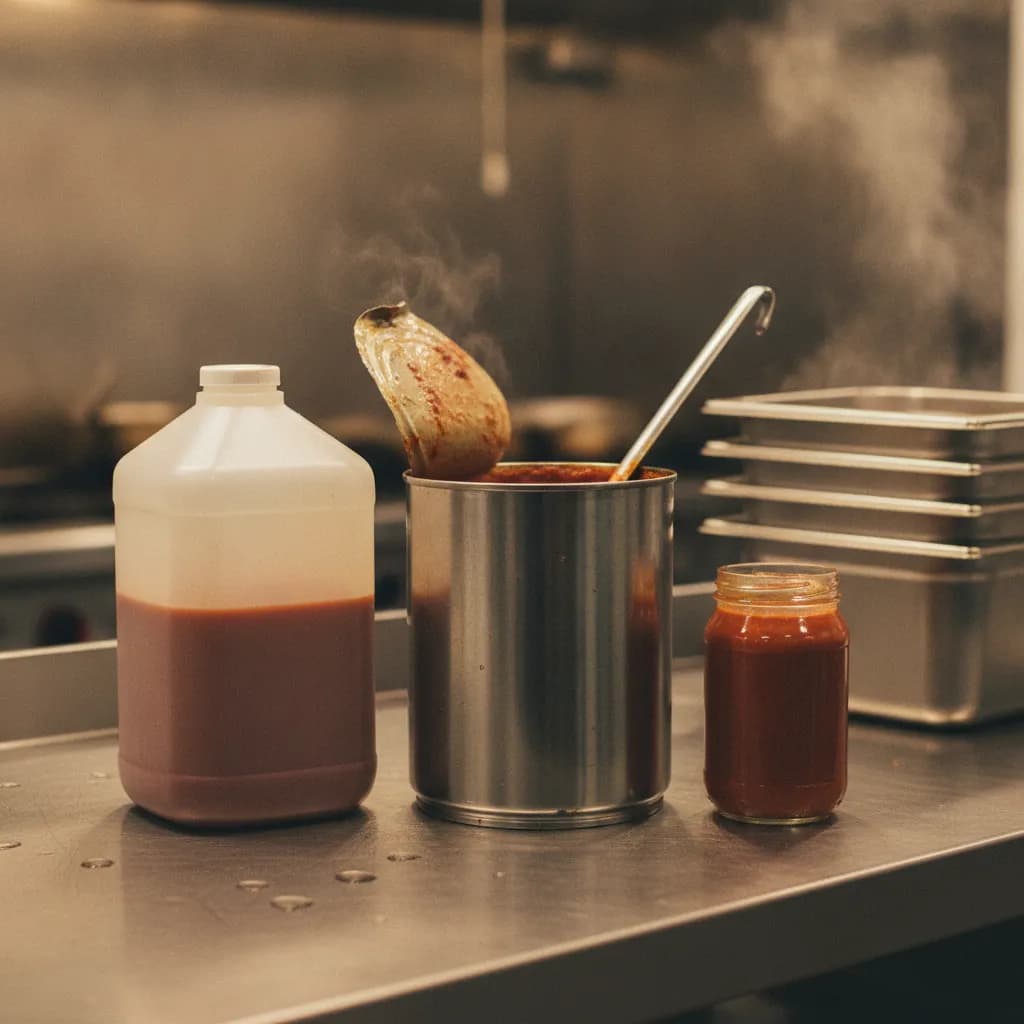
The gallon jug. Usually HDPE or PET, conventionally packed four to a case. This is the workhorse for pourable sauces, dressings, and bases.
The #10 can. The standard institutional can, roughly 6 3/16 inches in diameter and about 7 inches tall, holding somewhere in the neighborhood of three quarts, and conventionally packed six to a case. This is the format for thicker product, particulate product, and anything that benefits from a metal container and a long ambient shelf life.
Pails and bag-in-box. Larger volumes, usually for high-use bases and operators with dispensing equipment.
Portion control packets. A different manufacturing problem with its own equipment and co-packer ecosystem, not a conversion of your retail item.
What Changes in the Process, and Why It Is Not Optional
Start with the one that matters most.
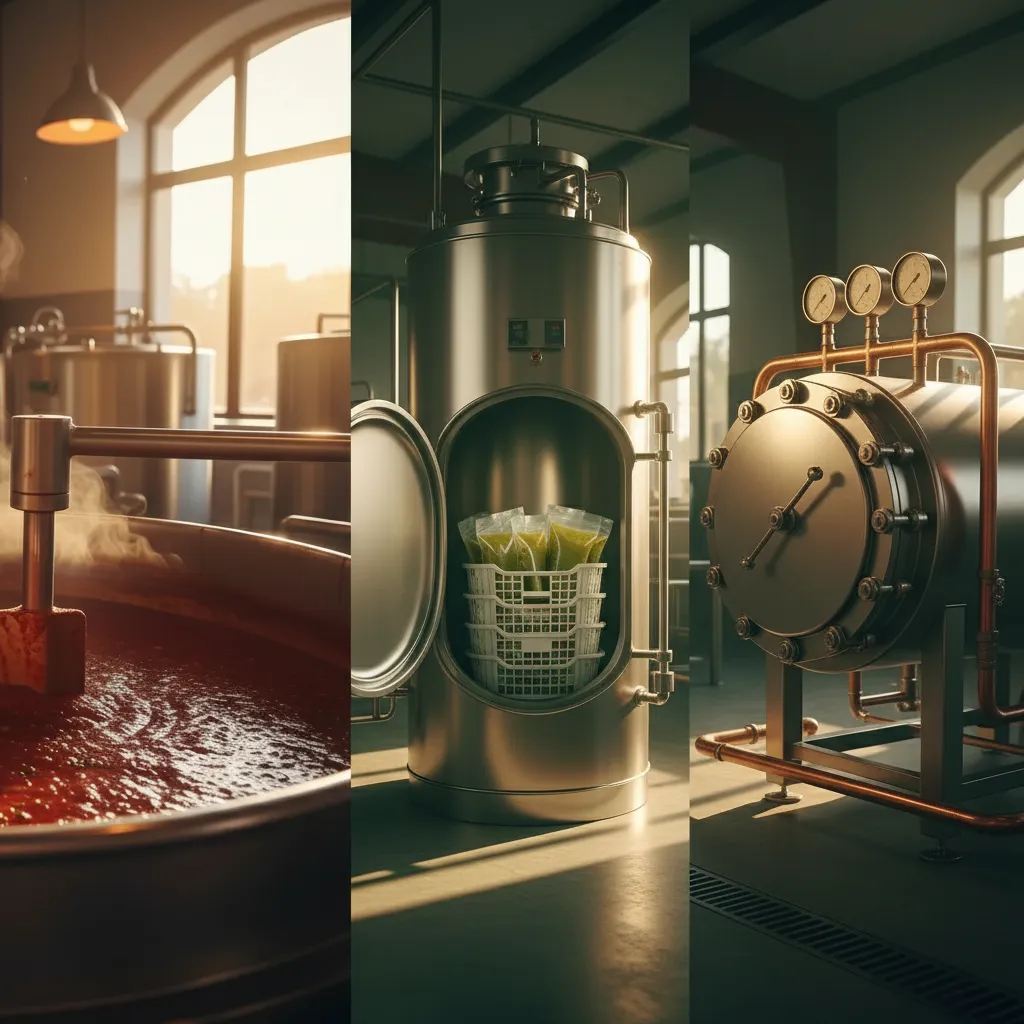
A new container size is a new thermal process. For acidified foods the scheduled process is specific to the product, the container type and size, and the equipment. That is the entire premise of the framework described in the process authority primer for acidified foods. The scheduled process you filed for a 12 ounce glass jar does not carry over to a gallon jug or a #10 can, and running a new container on an old process is not a paperwork shortcut, it is producing on an unvalidated process.
The physics behind that rule also explains the quality problems.
Big containers cool slowly. A 12 ounce jar loses heat quickly. A gallon holds heat for a long time, and a full case of hot gallons on a pallet holds it longer still. That extended time at temperature matters for safety, which is why the process has to be evaluated, and it matters for quality, because you are effectively giving your product hours of additional cooking.
The quality consequences are predictable and I see all of them:
- Color darkens. Tomato and pepper products in particular continue to brown during slow cooling.
- Volatile aromatics dissipate. The top notes in a spice-forward or smoke-forward product are the first casualties, the same mechanism described in BBQ sauce at scale.
- Texture shifts. Starches continue to hydrate and then break down; pectin softens further; particulates go soft.
None of that is a reason not to do it. It is a reason to expect the gallon version to taste and look different unless you adjust for it, and to build that adjustment into development rather than discovering it on the first run.
Container tolerance matters too. The jug has to tolerate the fill temperature without distorting, and a jug that deforms is a seal integrity problem as well as a cosmetic one. Cans bring their own considerations, including how an acidic product interacts with the can's internal coating over a long shelf life. Both are conversations with the packaging supplier, not assumptions.
What Changes in the Formula
The retail consumer opens a jar and eats what is inside. The foodservice operator does something to your product first. Formulate for what they do.
It has to come out of the container. A thick retail sauce that you scoop with a knife is a nightmare in a gallon jug. If the operator has to shake, bang, or scrape a gallon, they will stop ordering. Pourability out of the specific container is a spec, and it is not the same number as the Bostwick reading you use at retail. See sauce viscosity at scale for how to specify viscosity so a co-packer can hit it.
It has to survive a hot hold. This is the most common failure and the one retail formulation never tests for. A sauce sitting in a steam table well for four hours does things it never does on a shelf: starches break down and it thins, water separates and pools at the edges (syneresis), emulsions break, color deepens. Test it the way the operator will use it: put it in a hotel pan, hold it, and look at it every hour.
It may need to be a base, not a finished condiment. Retail condiments are seasoned to be complete. Chefs season to taste and often use your sauce as a component. Many successful conversions dial back salt, heat, and sweetness slightly so the product is a platform rather than a finished statement. The way to make that call is to watch an operator actually use it.
Particulates have to fit the dispensing method. If the operator uses a pump or a squeeze bottle, your solids have to pass through it. A chunky retail salsa may need a finer grind, which changes the eating experience. Decide that deliberately.
Freeze-thaw, if the pack will be frozen. Some foodservice distribution is frozen, and a formula that separates on thaw needs a different stabilizer strategy. The emulsion considerations in clean label dressings apply with more force.
Concentrates deserve real caution. Operators sometimes ask for a concentrate they dilute in house. Understand what that means: your carefully controlled pH and water activity become whatever the kitchen makes them, outside your control and outside your scheduled process. I would not build a concentrate without direct process authority involvement, and in many cases I would decline.
What Changes on the Label
Labeling obligations for a foodservice pack genuinely differ from a retail package, and this is an area where I want to be careful rather than confident on your behalf.
The nutrition labeling regulations contain exemptions relevant to foodservice: food served in restaurants and similar establishments is generally exempt from the Nutrition Facts panel requirement, and there are exemptions in the labeling regulations for shipments intended for further processing, labeling, or repacking under specified conditions. Those exemptions are conditional and narrow, and they turn on facts about who receives the product, what they do with it, and what claims you make. Making a nutrient content claim can pull you back into full requirements.
What that means practically: do not assume your gallon does not need a compliant label. Do assume the requirements differ from your retail jar, and get the specific answer from regulatory counsel for the specific pack and channel. Separately, the information a foodservice buyer wants on the case (yield, portions per container, storage and hold instructions, allergen statement, lot code, shelf life) is a commercial requirement even where it is not a legal one.
Allergen control does not relax. If anything, a foodservice pack ends up in more downstream preparations, which is why the discipline in allergen control in co-packing matters here.
What Changes in the Economics
This is where founders get the biggest surprise, in both directions.
Your price per ounce drops a lot. A gallon does not sell for eleven times a 12 ounce jar. Foodservice buyers purchase on cost per portion, they will calculate it, and they will compare it to the incumbent. Come in with the portion math done: yield per container, cost per ounce, cost per serving as the operator plates it.
Your cost per ounce also drops. Packaging is dramatically cheaper per ounce in a gallon than in a retail jar with a decorated label and a custom closure, and filling is faster per unit of volume. So the gross margin percentage is often closer to retail than founders expect, even though the price per ounce is far lower.
Volume and predictability improve. A restaurant group that puts your sauce on a menu orders on a rhythm. That can be the thing that finally gets your run sizes up to where your cost per unit works, which is the mechanism in the co-packer MOQ guide.
Brand equity mostly does not accrue. Unless the menu names you, the diner has no idea whose sauce that is. Some brands run both deliberately, with the retail item driving the brand and the foodservice item driving plant utilization.
The route to market is different. Broadline foodservice distribution is its own channel with its own players, separate from the natural-channel distributors in broker versus distributor versus DSD.
When It Is Worth Doing, and When It Is Not
Worth doing when you have a real operator asking for it, when your run sizes are painfully small and this fills the kettle, or when the same batch can be split between retail and foodservice packs and carry the fixed run costs across more units.
Not worth doing when it is speculative. Developing a foodservice pack on the theory that restaurants might want it means paying for a new scheduled process, new packaging minimums, new label work and a new development cycle, to make inventory nobody asked for. That is an expensive way to test a hypothesis you could test with a phone call to three chefs.
The conversion is genuinely worth it for the right brand. Just go in knowing you are developing a product, not printing a bigger label.
Sources: eCFR, 21 CFR Part 114, Acidified Foods · eCFR, 21 CFR 101.9, Nutrition labeling of food · eCFR, 21 CFR 101.100, Food; exemptions from labeling · FDA, Food Labeling Guide · FDA, Acidified and Low-Acid Canned Foods: Guidance Documents and Regulatory Information
Need Help With Your Formulation?
Whether you're scaling your first recipe or reformulating an existing product, let's talk about how to get it right.
Book a Free Discovery Call