Your line is selling. A buyer wants two new flavors for spring, the plant mentioned that last month's run of your best seller came out thinner than usual, and half your formulas are still written the way they were when you made everything yourself. All of that is product development work, and right now somebody is doing it after hours. Probably you, or your operations lead.
You don't need a full research and development department to get this work done well. You do need to decide who does it. There are five realistic routes: keep doing it yourself, use your co-packer's R&D team, work with a university food science program, hire someone full time, or bring in an outside chef-formulator. Each one is the right answer for some brands. Below is what each is good at, where it strains, and who ends up owning the formula, because that last question tends to surface at the worst moment: when you move plants, add a second one, or sell the company.
One note before we start. I'm an outside chef-formulator, so one of these five routes is my own. I've described all five the way I would to a friend.
First, Name the Work
"R&D" sounds like one job. For a brand that's already on shelves, it's usually three jobs, plus a fourth that never ends:
- New SKUs. New flavors, heat levels, formats, and companion products, each with its own formula and its own targets.
- Cleaning up the recipe deck. Turning formulas that live in volume measures, old spreadsheets, or the plant's batch sheets into current, versioned specs you control.
- Fixing factory quality problems that trace back to the formula. Separation, color or flavor drift, a product that tastes different from one run to the next. The plant runs quality control and its own process. The question is whether your formula and spec give them something worth holding.
- Keeping it all current. Every ingredient swap, supplier change, and plant adjustment has to find its way back into the master formula.
Keep your own version of that list in mind as you read.
Route 1: You (or Your Ops Lead) Keep Doing It
It's where you started, and for plenty of work it stays the right choice. Nobody knows your flavor the way you do. You can make a small adjustment, taste it, and decide in an afternoon. The person who cares most about the product is the one making the calls.
Where it strains is the technical side and the clock. Some of the work takes specific training, like knowing why a finished pH can move in the weeks after the run, or choosing a starch that survives the plant's heat, hold time, and shear (how hard the pumps and mixers work the product) and still holds its texture on the shelf. And when every new SKU waits on the same person who also runs sales and the plant relationship, the line grows at the speed of your free evenings.
Who owns the formula: usually you do, as long as the paperwork agrees. If an employee develops it, companies usually cover that in the employment agreement, and if a founder created it before the company existed, it's worth confirming the company now holds it. Both are questions for your attorney. The practical catch is documentation. A formula that lives in one person's head or notebook is owned on paper and fragile in practice, because it leaves when they do. If that has already happened, there's a way to rebuild a formula when the documentation is thin.
Route 2: Your Co-Packer's R&D Team
Some co-packers have product developers on staff, and their strength is real: nobody knows that line better. They know how fast the kettle heats, how hard the pump shears, how the filler behaves, and what has held up on their equipment before. Development and production under one roof can be a fast route from idea to first run, especially for a small step off a product they already make well, such as a new heat level or a seasonal variation.
The trade-offs come from the same place. Their team serves the plant and its other brands, so your project takes its place in their schedule. The formula tends to be built around their line, which works well while you're there and can take real work to move later. And some plants develop from house bases, their own base formulas adjusted toward each client's flavor. None of that is a knock on co-packers. Making products run well in their own building is exactly what a plant's developers are there to do, and good ones are very good at it. What leaves with you is the written spec, so the question to settle up front is whether you'll come away holding one.
If you're talking with a new plant's development team rather than your current one, hold back the full recipe until you're close to signing, with a non-disclosure agreement (NDA) in place. Early conversations can run on a product brief that leaves the recipe out.
Who owns the formula: it depends on the agreement, and on what the product is built from. Improvements developed by the plant's staff may not become yours unless your agreement says so, and if the product is a house base with your seasoning on top, the foundation was never yours to take with you. Ask directly, get the answer in writing, and have a food-industry attorney draft the terms. I've gone deeper on house bases, plant improvements, and NDAs in who owns the formula when a co-packer is involved.
Route 3: A University Food Science Program
Many universities with food science departments work with outside companies, often through extension programs or food innovation centers. Depending on the school, that can mean product development help, shelf-life and sensory testing, analytical lab work, time on pilot-scale equipment, or a process authority review.
The strengths are rigor and equipment. You typically get people who know food safety and stability deeply, instruments most brands don't own, and testing done carefully and independently. For a brand with a technical question (why a dressing separates at month four, or whether a shelf-life claim holds up), it can be an excellent fit.
What to plan around: academic calendars and project queues set the pace, and if students staff your project, the team can change when a semester ends. A pilot plant is not your co-packer's line, so a formula developed there still needs translating to the plant's equipment. And stay close to the flavor decisions yourself, with your gold standard (the approved reference sample of your product) in hand.
Who owns the formula: universities have their own intellectual property policies, and the terms for a paid service project can differ from those for a class or research project, including what can be published. Ask before you share anything, read what the agreement says about ownership, confidentiality, and publication, and have your attorney review it.
Route 4: Hiring a Food Scientist or R&D Chef Full Time
A full-time hire gives you someone who lives inside your products. They learn your deck, your plant, and your customers. They can stand at the line for trials, catch a drift early, own the change log, and carry what was learned on one SKU into the next. For a brand with a steady stream of projects, more than one plant, or a deck big enough that something always needs attention, that's hard to beat.
The trade-offs are cost structure and fit. A salary and benefits run every month, whether you're launching four SKUs this quarter or none, and development work at a growing brand often comes in waves. Training also shapes strengths. A food science background usually goes deepest on safety, stability, and process; a culinary background usually goes deepest on flavor and ingredients. Plenty of people are strong in both, but finding one who covers everything your category needs takes time. And one person holding all the knowledge is its own risk, unless writing it down is part of the job.
Who owns the formula: as with any employee, confirm with your attorney that the employment agreement says plainly that formulas and specs developed on the job belong to the company. Then make complete, current specs part of the role, not a someday task.
Route 5: An Outside Chef-Formulator
This is the model I work in, so read this section knowing that.
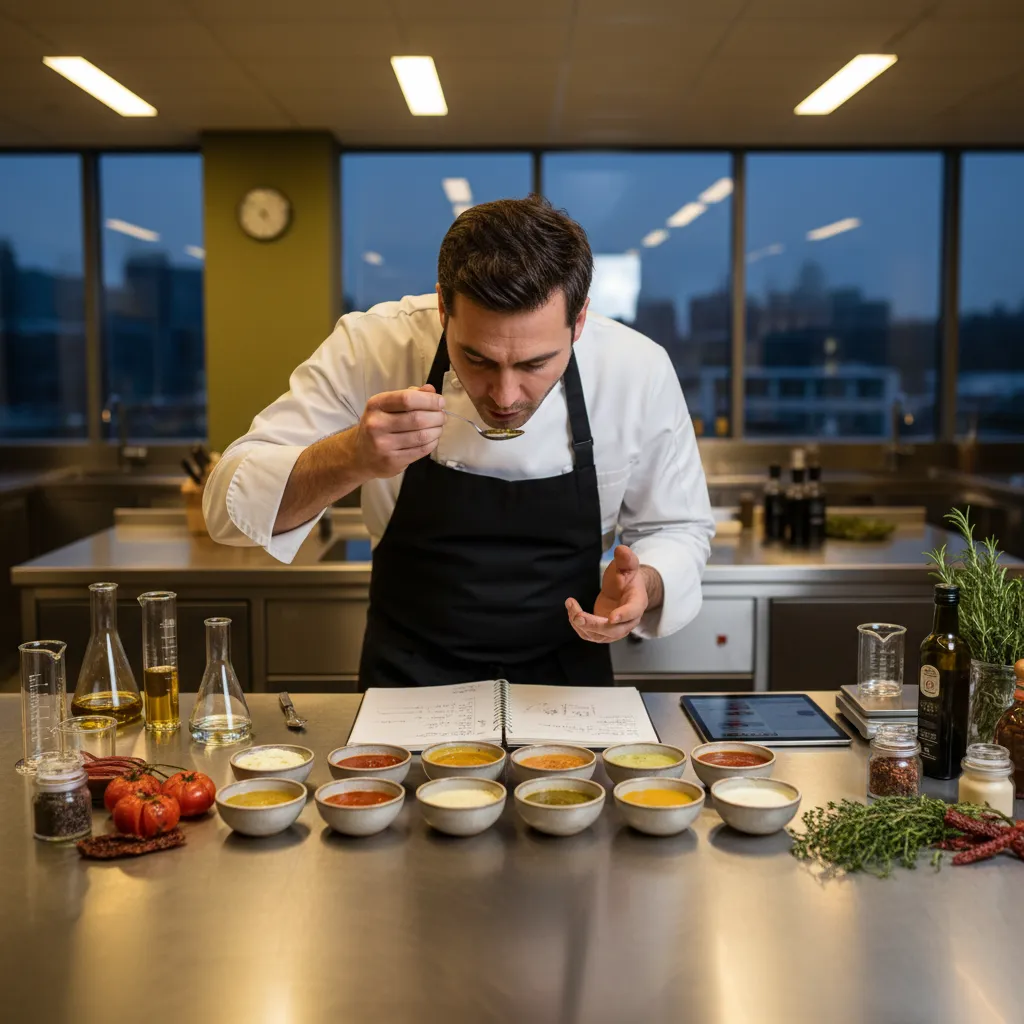
An outside chef-formulator is development you switch on when you need it (a launch, a line extension, a deck cleanup, a quality problem that traces back to the formula) and switch off between projects. My version of it is a chef who speaks factory. I build the flavor first, the way a chef does, and I build it with manufacturing in mind from the start: the plant's equipment, ingredients that are commercially available at volume, and shelf stability. What you get at the end is a formula by weight, targets with ranges, process notes, and a spec sheet written so a co-packer can run it without improvising.
The honest limits: an outside developer isn't in your building or at your plant every day, so they learn your line through your spec, trial results, retained samples, and conversations with you and the plant. You still need someone inside who owns the deck day to day. Outside developers also vary in where their work stops. I don't operate plants or run quality control, choose or manage your co-packer, negotiate pricing or supplier terms, run cost calculations, or file regulatory paperwork or nutrition panels. Ask any developer exactly where their work ends before you start, and book early around launches, because their calendar is a real constraint.
Who owns the formula: the development agreement sets it. What you're looking for is language that makes the formula, specs, and documentation yours on payment, while the developer keeps their general know-how. That's how I want it too, because a formula a brand can't fully control isn't an asset it can build on. Have your attorney review the agreement either way. For what a development engagement looks like from the inside, see when to hire a recipe developer.
These Routes Combine Well
None of this is either-or. Here's what a combined setup can look like for a brand with six or eight SKUs and one plant:
- Your operations lead owns the deck: the master specs, the version numbers, and the change log.
- An outside formulator builds the new SKUs and rebuilds the formulas that still live in cups and notebooks.
- The co-packer's team handles line trials and proposes adjustments for their equipment, and every adjustment you accept gets written back into your master spec.
- A university or independent lab runs shelf-life testing.
- A process authority reviews each product's process, arranged by you or by the plant, whichever you've agreed in writing.
The one rule I'd hold any combination to: whoever does the development, the finished formula and spec come back to you, and one person inside your company is the keeper. That person decides which version is current and approves every change, the way I describe in who is allowed to change your formula, and how. Without a keeper, five capable contributors can still leave you with five versions of the truth.
How to Tell Which You Need
Work through these honestly, ideally with your ops lead in the room:
- How much development is coming in the next year, and how steady is it? A full calendar all year points toward a hire. Bursts around launches and cleanups point toward outside help.
- What kind of work is most of it? New flavors and formats lean on flavor skill and fluency with production. Technical questions about stability or safety lean on lab depth. Small adjustments on one plant's equipment may go fastest with the plant's own team.
- Does the formula need to travel? If a second plant, a move, or a sale of the company is possible, you need a portable spec you hold, not a formula that only works in one building. Moving a product is its own project, covered in moving your product to a new co-packer.
- How much of the flavor judgment do you want to keep? If you want the final call on every flavor, choose a route where you're at the tasting table, not just reading a report.
- Who inside will own the deck? If there's no answer yet, settle that first. Every route works better with a keeper.
- What does your current plant offer, and on what terms? Ask what their development help includes, how projects get scheduled, and how ownership is written, before you decide whether you need anyone else.
Two Things Every Route Still Needs
Is a process authority the same as a food scientist I'd hire for development?
No, even though many process authorities are food scientists. A process authority is the qualified expert who evaluates your formula, process, and container and sets out, in writing, how the product has to be made to be safe. Many sauces, salsas, and dressings are acidified foods that need that review. Developing your flavor isn't part of it. Whichever route you choose for development, the review still happens when it applies, and who arranges it varies by plant and by agreement: sometimes the co-packer, sometimes the brand. Settle which one early, in writing, along with who pays. My primer on process authority letters covers the basics.
What should I have in hand when any development project ends?
Whoever did the work, ask for the same things: a formula by weight and percentage, with one current version; targets with ranges for that SKU, covering pH, Brix (roughly, how much sugar and other dissolved solids the product carries), viscosity, and whatever else matters for the product; ingredient specs written by function, form, and grade, with approved alternates; process notes written for the plant's equipment; a gold standard sample, approved only once the flavor has settled, which in my experience is around the two-week mark; and written confirmation of who owns all of it.
Start With the Work, Not the Job Title
The real question usually isn't whether to hire a food scientist. It's what the next twelve months of development look like, who is best placed to do each piece, and how you make sure every finished formula lands in a spec you hold. Answer those three, and the right mix for your brand tends to show itself.
Need Help With Your Formulation?
Whether you're scaling your first recipe or reformulating an existing product, let's talk about how to get it right.
Book a Free Discovery Call